

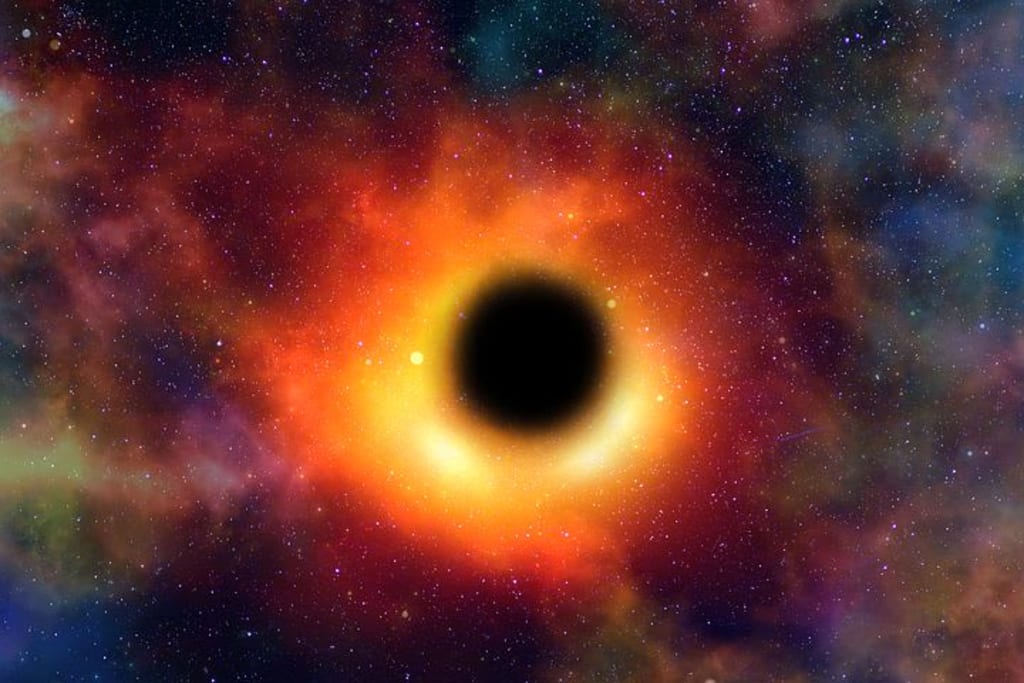
Holes: The Ultimate Cosmic Mystery
Black holes are some of the most fascinating and mysterious objects in the universe. They are areas of space where gravity is so strong that nothing, not even light, can escape from their pull. Despite their name, black holes are not actual "holes" but rather regions where matter is extremely dense and has a strong gravitational pull.
The concept of black holes first emerged in the late 18th century when British astronomer John Michell theorized that there could be objects in space so massive and dense that their gravity would not allow anything to escape, not even light. However, it was not until the early 20th century that scientists, including Albert Einstein, developed the mathematical framework to fully understand black holes.
There are three main types of black holes: stellar black holes, intermediate black holes, and supermassive black holes. Stellar black holes are formed from the remnants of massive stars that have exhausted their fuel and collapsed under the force of gravity. They are typically a few miles in diameter and can have masses several times that of the sun. Intermediate black holes are thought to be the missing link between stellar black holes and supermassive black holes, but very little is known about them. Supermassive black holes are the largest type of black holes and can have masses billions of times that of the sun. They are thought to exist at the centers of most galaxies, including our own Milky Way.
Black holes are invisible by nature, but their presence can be detected by observing the effects of their gravity on other objects in space. For example, when a black hole and a star are in close proximity, the star will be pulled towards the black hole, causing it to speed up and change direction. This is known as gravitational lensing and can be used to infer the presence of a black hole. Another way black holes can be detected is by observing the emission of X-rays and other high-energy particles as matter falls into the black hole and is heated up to extreme temperatures.
One of the most mysterious and fascinating aspects of black holes is the existence of event horizons. An event horizon is the boundary around a black hole beyond which nothing, not even light, can escape the pull of its gravity. Once something crosses the event horizon, it is considered to be inside the black hole and cannot escape.
The center of a black hole is known as the singularity, where the laws of physics as we know them break down. The singularity is thought to be an infinitely small, infinitely dense point where the laws of gravity become so strong that they cannot be described by our current understanding of physics.
Despite the enormous amount of research that has been done on black holes, there is still much that scientists do not understand about them. One of the biggest mysteries is what happens to matter that falls into a black hole. It is believed that matter that falls into a black hole is compressed into an infinitely small point, known as the singularity, but it is not known what happens to the matter after this point. Some scientists believe that the matter is destroyed and no longer exists, while others believe that it is somehow transported to another part of the universe.
Another mystery of black holes is how they were formed in the first place. It is thought that the seeds of black holes were formed in the early universe, shortly after the Big Bang. However, it is not clear how these seeds grew into the massive black holes we see today.
Despite the many mysteries surrounding black holes, they continue to be one of the most exciting and important areas of research in astronomy and astrophysics. Scientists hope that by studying black holes, they can gain a deeper understanding of the universe and the laws of physics that govern it.
About the Creator
Keep reading
More stories from Mahesh mahto and writers in Education and other communities.
Amazon jungle
The Amazon jungle, also known as the Amazon rainforest, is a vast and diverse ecosystem that covers over six million square kilometers in South America. It is considered the largest rainforest in the world, and home to countless species of flora and fauna, many of which are found nowhere else on earth. The Amazon jungle is not only a source of awe and wonder for visitors, but also a vital component of our planet’s delicate balance, providing essential ecosystem services such as the regulation of our planet's climate and the production of 20% of the world’s oxygen.
By Mahesh mahto3 years ago in Education
Purposeful Scaling for a Recognizable Brand in a Growing Market
Business growth can bring excitement and opportunity. Companies often expand to reach new customers, increase revenue, and build a stronger market presence. However, expansion without direction can weaken brand identity. Businesses that grow with a clear strategy are more likely to develop a recognizable brand that customers remember and trust.
By Asad Malika day ago in Education
Smart Strategies for Scaling a Coffee Bar Business
A thriving neighborhood coffee bar often begins with a simple mission: serve great coffee and create a welcoming place for people to gather. However, growth quickly introduces new challenges. Higher customer demand, operational complexity, and the need for consistent quality can stretch even the most passionate owners. Therefore, building a clear strategy early helps transform a small shop into a sustainable brand.
By Alexander Schifterabout 22 hours ago in Education


Comments
There are no comments for this story
Be the first to respond and start the conversation.