
The Mirror of Growth
Tracing the Path from Potential to Purpose
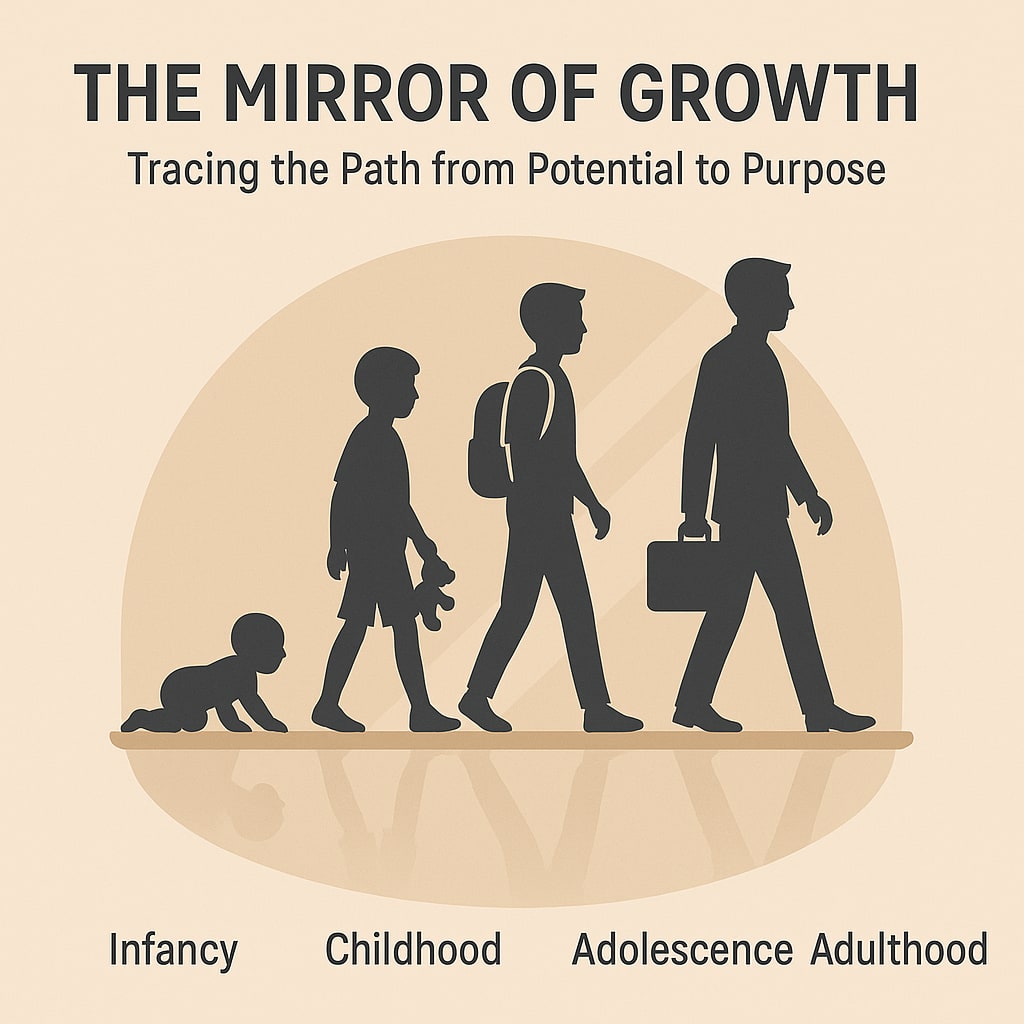
Human development is more than a biological process; it’s a deeply personal, emotional, and intellectual journey. From the moment we take our first breath to the day we reflect back on the lives we've led, we are constantly evolving. This evolution is not just seen in our height or age but in our thoughts, emotions, dreams, relationships, and understanding of the world. "The Mirror of Growth" reflects this transformation — showing how we move from raw potential to living with purpose.
1. The Seed of Potential (Infancy and Childhood)
Every person begins as a blank canvas, yet full of hidden colors waiting to be revealed. Childhood is the foundation of human development — a time of learning, absorbing, and reacting to the world. At this stage, curiosity blooms naturally. A child asks "why?" not out of rebellion but out of a need to understand their place in the world. During these formative years, love, attention, and security shape the roots of emotional stability. The mirror at this stage reflects innocence, possibility, and the beginnings of self-awareness.
2. Identity and Exploration (Adolescence)
Adolescence is perhaps the most turbulent and transformative stage of growth. It is here that individuals begin to seriously explore who they are — emotionally, socially, and intellectually. Questions like “Who am I?”, “Where do I belong?”, and “What do I stand for?” become central. Teenagers begin to test boundaries, form beliefs, and navigate complex emotions. This is the age of experimenting — with ideas, appearances, friendships, and values. The mirror now reflects a swirling storm of potential, confusion, and courage. Though often marked by insecurity, adolescence is the first real confrontation with identity.
3. The Pursuit of Purpose (Adulthood)
As we transition into adulthood, life begins to take form around our responsibilities, careers, families, and aspirations. Here, the journey of self-discovery becomes a mission for direction and meaning. Many individuals begin to define success — not just in terms of money or status, but through personal values, relationships, and contributions to society.
Adulthood is where the potential of childhood meets the reality of the world. It’s the time for growth through action: building, creating, loving, failing, and trying again. The mirror reflects experience, resilience, and a growing sense of who one is becoming. Some find their purpose early, while others discover it later in life — but the journey continues regardless of age.
4. Reflection and Legacy (Later Life)
In later years, human development becomes more internal than external. Physical strength may fade, but wisdom deepens. This is the time of reflection — looking back on life’s choices, relationships, successes, and regrets. The mirror at this stage holds a depth of knowledge that cannot be taught, only lived.
Many people begin to focus on legacy: What have I contributed? What will I leave behind? There is a desire for peace, for closure, and for connection — with others and with oneself. Some return to passions they left behind, while others find new meaning in simplicity and presence. This phase reminds us that growth never truly ends — it simply takes new forms.
What the Mirror Teaches Us
The concept of "The Mirror of Growth" isn’t about perfection. It’s not about becoming the smartest, richest, or most successful person. It’s about becoming real — embracing the full spectrum of human experiences: joy, pain, love, failure, healing, discovery, and connection.
Growth is not always visible. Sometimes it's quiet — happening in late-night thoughts, hard decisions, tears behind closed doors, or small acts of courage. It’s found in forgiveness, in vulnerability, in learning to start over.
Every stage of human development holds its own beauty and challenge. Whether you’re a child learning to trust, a teenager finding your voice, an adult building your path, or an elder finding peace — you are standing in front of the mirror. And in that mirror is not just who you are, but who you’ve been… and who you’re becoming.
About the Creator
Mindset in Bloom
Amira sat on the balcony, her notebook open in her lap, though the pen hadn’t moved in ten minutes. Below her, the city buzzed with life—cars honking, people shouting, horns blaring. But up here, time felt frozen. She stared at the blank page, the weight of unwritten dreams pressing down on her chest.
By Asad jan10 months ago in Motivation
How Early Hustle Jobs Build Real Mental Toughness for Life
Early hustle jobs—like babysitting, mowing lawns, stocking shelves, or working the drive-thru—might seem small on paper, but they often shape big psychological strengths. These first experiences with responsibility, pressure, and real-world expectations can build mental toughness in ways school alone usually can’t.
By David Lipan5 days ago in Education
The CEO of Everything
They say "jack of all trades, master of none," but they forgot to mention the part where the jack of all trades is also the camera woman, the makeup artist, and the person currently yelling at a tangled Wii microphone cable in a her own bathroom while recording herself singing and trying to make it look realistic and professional. (As professional as you can make it with nothing but a cell phone camera and a mic that doesn't work)
By Sara Wilson7 days ago in Humans



Comments
There are no comments for this story
Be the first to respond and start the conversation.