

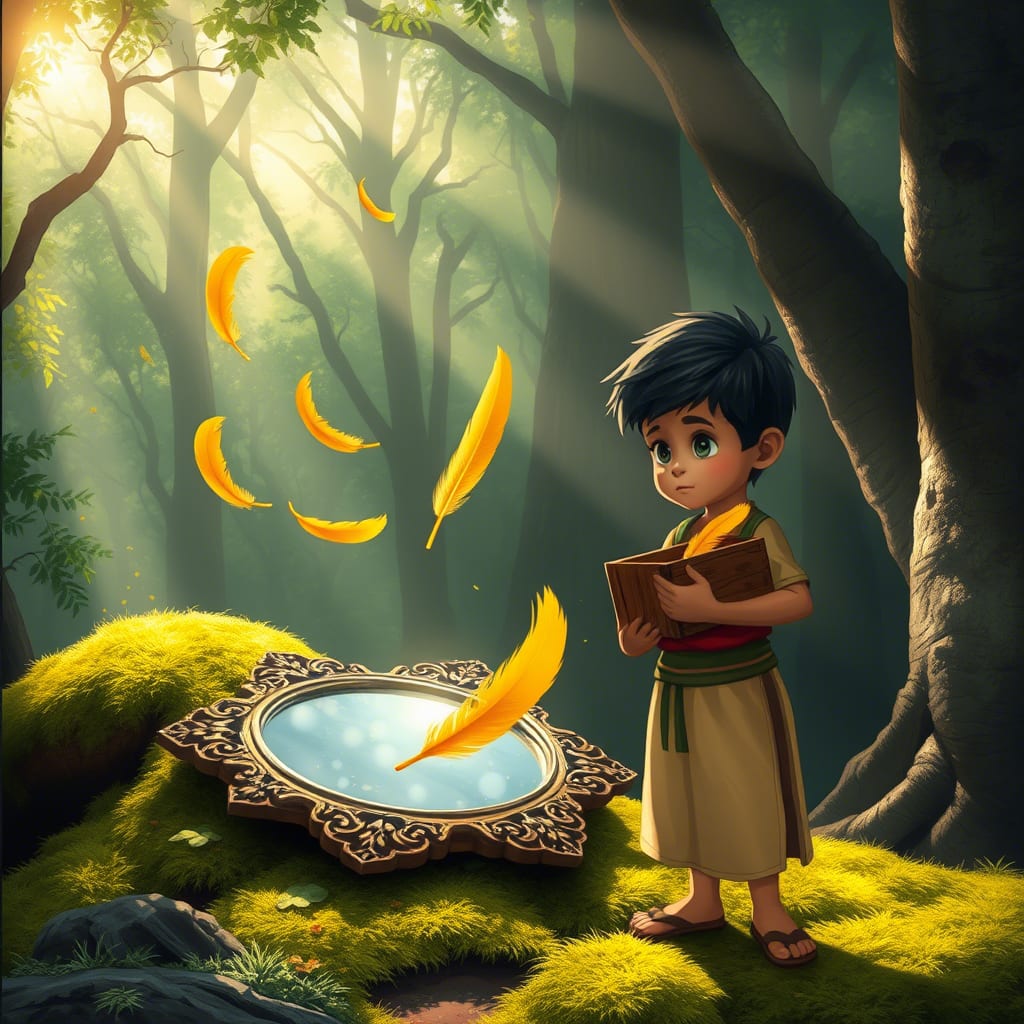
The Mirror in the Woods
Long ago, in the village of Elmswood, there lived a boy named Kiran. He was clever and strong, but he was also proud—too proud. He often bragged about his talents, his strength, and his cleverness, making others feel small. Though he never meant to hurt anyone, his words left wounds.
One day, after winning a race against all the other boys in the village, Kiran stood on a tree stump and shouted, “No one in this village is as fast or smart as I am! Why should I even stay among people who can’t match me?”
An old woman sitting nearby raised her eyes. She was a quiet villager, rarely noticed. “If you truly wish to find your match, go deep into the forest,” she said calmly. “There you may meet someone just like you.”
Kiran laughed. “Is that a challenge, grandmother?”
“It is advice,” she replied.
Fuelled by pride and curiosity, Kiran packed some food and set off the next morning. He walked into the forest, past the birdsong and babbling brooks, until the trees grew taller and the light grew dimmer. Eventually, he reached a clearing, and in the center stood an ancient stone framed mirror.
The mirror shimmered without reflecting the forest behind it. Instead, it showed only him—Kiran, standing alone.
He stepped closer.
Suddenly, his reflection blinked.
Kiran jumped back. The reflection didn’t.
“What kind of trick is this?” he muttered, eyes wide.
Then, the reflection smiled and spoke. “So, you’re the mighty Kiran. The boy who thinks he's better than everyone.”
Kiran frowned. “I’m just speaking the truth.”
“Are you?” the reflection said. “Let’s see.”
Without warning, the reflection stepped out of the mirror. Now, standing before Kiran was another version of himself—but colder, sharper, and with a glint of arrogance in his eyes that Kiran had never noticed before.
“Let’s have a race,” the double said. “If you win, you may leave. If I win, you stay.”
Confident, Kiran agreed. “You’re just a reflection. You’ll never beat me.”
They raced through the trees like shadows chasing light. Kiran ran faster than he ever had before, but no matter how hard he pushed, his double was always one step ahead. Every shortcut Kiran took, the other took too. Every clever move was matched with one just as smart.
Exhausted, Kiran finally collapsed near the clearing.
The reflection stood above him, not smug, not cruel—but firm. “Do you see now?” it asked. “I am you. I only do what you do. Every action you take, I mirror it. Not just your talents—but your pride. Your blindness. Your need to prove yourself.”
Kiran stared up, breathing hard.
“What am I supposed to do?” he whispered.
The reflection knelt. “Understand this: strength means nothing if it puts others down. Intelligence loses value if it brings no kindness. What you think makes you better, actually makes you lonely.”
Kiran sat in silence. For the first time, he saw not just his talents—but how they made others feel. He remembered the face of his friend Raju, who never spoke after Kiran beat him in front of everyone. He remembered the girl who once asked for help with her writing, only to be laughed at when she stumbled. His chest ached.
“I never wanted to hurt anyone,” he said.
“But you did,” the reflection replied. “Now—what will you do with that truth?”
Kiran looked up. The mirror shimmered again. The reflection walked backward into it, fading with a final glance—not of judgment, but of understanding.
Kiran stood alone in the forest.
This time, when he looked into the mirror, it showed the trees, the sky, and his true reflection—humble and quiet.
He returned to Elmswood the next morning, not with a boast, but with silence. People greeted him, expecting another tale of glory. Instead, he smiled and joined them in their daily tasks—helping the blacksmith, drawing water for the elders, tutoring the children in reading and math.
He never bragged again. He let his actions speak for him, and this time, they spoke of kindness, teamwork, and quiet strength.
Years later, when he became the village leader, no one questioned it. Not because he was the strongest or the smartest—but because he had learned how to lead with humility.
Moral of the Story:
True greatness comes not from proving you are better, but from lifting others up. Pride divides—humility connects.
About the Creator
Keep reading
More stories from VISHWANATHA and writers in Education and other communities.
The Golden Touch
The Golden Touch Once upon a time, in a land of mountains and rivers, there lived a wealthy merchant named Arman. He had everything a man could dream of—large houses, beautiful clothes, chests full of gold, and ships that brought in treasures from distant lands.
By VISHWANATHA9 months ago in Education
Building Stronger Schools Through Student Mental Health Support
Schools across the United States face a growing responsibility to support students with anxiety and depression. Academic pressure, social media influence, family stress, and uncertainty about the future affect students at younger ages than ever before. Therefore, schools must recognize that mental health directly shapes learning outcomes, behavior, and long-term well-being. When students feel emotionally supported, they engage more fully in class and build stronger relationships. As a result, mental health care should stand alongside academic instruction as a core school priority.
By Martin Karp3 days ago in Education


Comments
There are no comments for this story
Be the first to respond and start the conversation.