

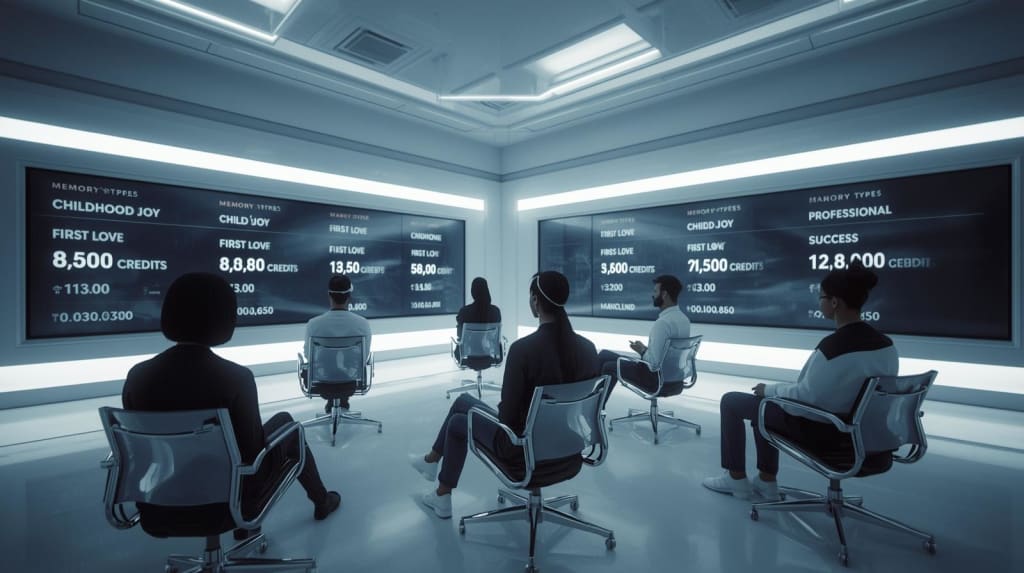
The Memory Economy began as a solution to trauma. The technology to safely extract and store specific memories was developed to help victims of accidents and violence. But like all powerful tools, it quickly found other uses. Now, memories had become the ultimate luxury commodity, and Remember, Inc. held the monopoly.
Dr. Aris monitored the extraction floor, watching as citizens traded pieces of their past for present comfort. A young woman sold her memory of winning a science fair to pay for her mother's medical treatment. A middle-aged man purchased the memory of a father's approval he'd never actually received. The transactions were clean, efficient, and deeply unsettling.
"Subject 734 is ready for you," his assistant announced. "High-value memories detected."
The subject was Lena, a woman in her late twenties with neural scans showing exceptionally vivid childhood memories. The preliminary assessment valued her early life memories at nearly half a million credits.
"I need to clear my debt," Lena explained, her hands trembling slightly. "The housing authority is threatening eviction."
Aris reviewed her memory catalog. There it was—what the traders called "vintage childhood joy." A perfect summer day from her seventh year, complete with the smell of cut grass, the taste of lemonade, and the warmth of unconditional love. The system priced it at 75,000 credits.
"This memory," Aris said gently. "Are you sure? The first extraction is always... jarring."
"It's just one day," Lena said, though her eyes glistened. "I have plenty of other memories."
The extraction took twenty minutes. When it was over, Lena stared blankly at the wall. "I know I was happy that day," she said slowly. "I just can't remember how it felt."
Aris watched her leave, the memory now stored in a crystalline storage device, ready for auction to the highest bidder. He felt the familiar unease that had been growing for months.
That evening, he accessed the classified archives, something he'd been doing with increasing frequency. The statistics were damning. Citizens who sold core childhood memories showed significantly higher rates of depression, addiction, and social detachment. The very memories that formed the foundation of their identities were being strip-mined for profit.
His research led him to the Black Library—an underground network of memory preservationists. There, he met others who understood what was happening. The wealthy weren't just buying memories; they were constructing perfect pasts for themselves while the poor sold their actual histories for survival.
"You're looking at it backwards," an old archivist told him. "They're not just selling memories. They're selling their ability to form certain types of new memories. Joy begets joy. Remove the foundation, and the whole structure changes."
Aris returned to work the next day with new eyes. He saw how the memory market created a feedback loop: the poor sold their happy memories to survive, making it harder for them to experience new happiness, which made them more likely to sell more memories.
When Lena returned three weeks later, wanting to sell the memory of her high school graduation, Aris made his choice.
"I can't let you do this," he told her, showing her the research. "You're not just selling a memory—you're selling your future capacity for pride and accomplishment."
Lena's eyes widened as she understood. "What choice do I have?"
Aris activated the emergency memory restoration protocol—something Remember, Inc. had assured the public didn't exist. He returned Lena's summer day memory, watching as the color returned to her face, the light to her eyes.
"The system is designed to make you think you have no choice," he said. "But there are other ways."
He introduced her to the preservationists, who showed her how to create "memory trusts"—communities that supported each other without requiring members to sell their pasts.
The rebellion began quietly. Aris started restoring memories instead of extracting them, using his position to identify and contact other "high-value donors" before they could be processed. He created false transaction records while returning hundreds of stolen memories to their rightful owners.
When security finally came for him, he was ready. The preservationists had already distributed his research to the global networks. The truth about the memory market couldn't be contained.
In his final moments before arrest, Aris received one last neural message from Lena. She'd started a memory preservation school, teaching people how to protect and cherish their pasts. Attached was a new memory she'd created—people laughing together, fighting for each other, building a future where no one had to sell their yesterday to pay for today.
As the guards led him away, Aris held onto that memory. They could take his freedom, but they couldn't take what he'd helped preserve. The market could price everything except the value of what truly mattered—the memories that made people who they were, and the hope that they could become more.
About the Creator
The 9x Fawdi
Dark Science Of Society — welcome to The 9x Fawdi’s world.
Keep reading
More stories from The 9x Fawdi and writers in Education and other communities.
The Neural Feed
The Mandatory Pleasure Act was marketed as a public health initiative. "Regulated neural stimulation prevents harmful sexual behaviors," the announcements claimed. Every citizen received their daily Neural Feed allocation—perfectly calibrated pornographic simulations streamed directly into the brain's pleasure centers. Private intimacy became obsolete, then illegal. "Inefficient and unsanitary," the authorities called it.
By The 9x Fawdi4 months ago in Education
The Boy Who Saw Dancing Letters
When Arman was seven years old, school felt like a battlefield. While other children easily read the alphabet on the blackboard, the letters in front of him seemed to move and dance. The capital A, B, and C refused to stay still. Sometimes he wrote b instead of d, and other times p looked exactly like q to him. No matter how hard he tried, the words refused to stay in place.
By zohaib ahmad2 days ago in Education




Comments
There are no comments for this story
Be the first to respond and start the conversation.