

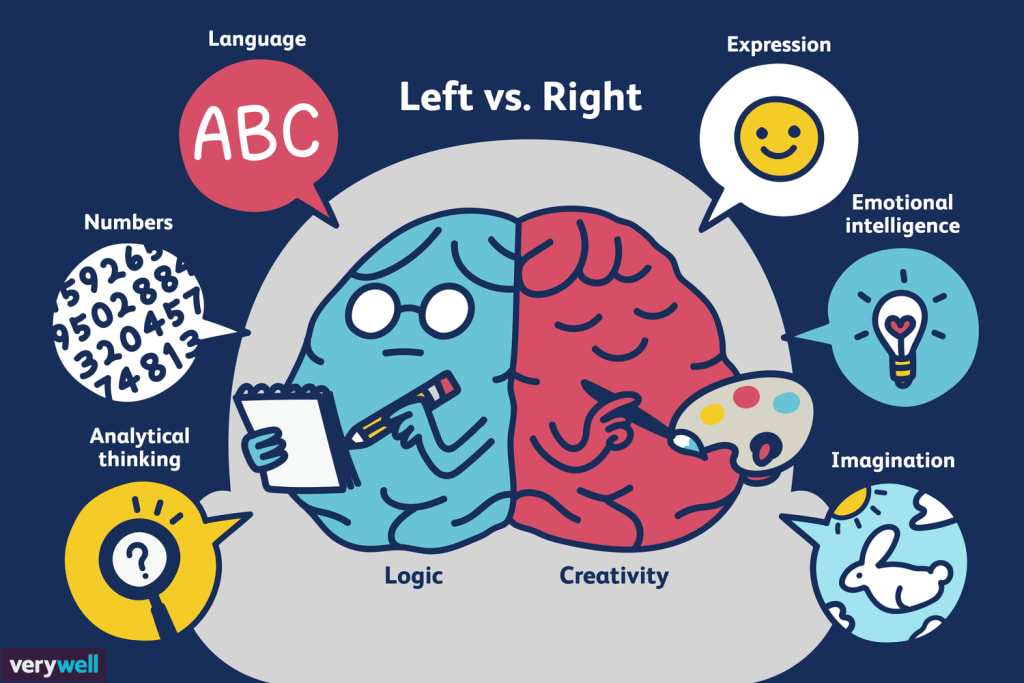
Look at the bumpy geography of the human brain, which is clearly divided into a left and a right side. One of the most common notions about the brain is that the left side governs reasoning and the right, according to this arrangement. And yet, there is no scientific proof for this notion. What is wrong with this false notion, and how did it come to be? The brain does indeed have a right and a left side. The cortex, which is the outer layer, is where this is most obvious. Although internal structures like the striatum, hypothalamus, thalamus, and brain stem seem to be comprised of a single piece of tissue, they are actually divided into left and right halves. Movement and vision are just two examples of the several bodily activities that the left and right sides of the brain regulate. The left arm and leg are moved by the right side of the brain, and the opposite is true for the left. Even more complicated is the visual system. There is a left and right visual field in each eye. Both visual fields from the left are delivered to the right side of the brain, and the same is true for the right. In order to create a full picture of the world, the brain thus needs both sides. Scientists are unsure of the precise cause of that crossing over. According to one idea, it started soon after animals evolved more sophisticated nerve systems because it provided them the advantage of quicker responses for survival. It is advisable for an animal to flee to the right if it notices a predator approaching from the left. Therefore, we may claim that this left-right arrangement is important for two systems, namely vision and movement control. However, issues arise when we apply this concept too broadly to logic and creativity. When two neurologists, Broca and Wernicke, studied patients who had communication difficulties as a result of injuries in the middle of the 19th century, this myth was first propagated. The researchers hypothesized that language is controlled by the left side of the brain since they saw damage to the patients' left temporal lobes. That attracted people's attention. The concept of a conflict between a rational left hemisphere and an emotive right hemisphere was later established by author Robert Louis Stevenson's characters Dr. Jekyll and Mr. Hyde. But when medical professionals and researchers looked at individuals who were missing a hemisphere or had their two hemispheres split, this theory fell apart. These patients displayed a wide variety of rational and imaginative activities. Later studies revealed that certain tasks require the use of one side of the brain more than the other. Left is where language is localized more, while right is where attention is focused. The amount of work that each side of the brain does therefore varies by system rather than by individual. There is no evidence to support the assumption that people have dominant brain sides or a left-right split between logic and creativity. Although some individuals may possess exceptional logic or creativity, this has nothing to do with the sides of their brains. Even the notion that logic and creativity are incompatible with one another seems unconvincing. Inspiring creativity is necessary to solve complicated arithmetic problems, yet many bright works of art feature intricate logical structures.The entire brain working as a single unit is the hallmark of almost every act of creativity and logic.
About the Creator
Niks
I deliver Informative content.
Navigating Business Consulting Challenges to Build Stronger Companies
The modern business world moves fast and puts pressure on businesses from all sides. Leaders often know something is wrong but cannot see the whole picture. This is where strategic consulting pain points become precise and vital. Consultants help companies slow down, gain clarity, and solve problems that block growth. Their role is not to take control but to guide teams toward better decisions and steady progress.
By Nicole Metz6 days ago in Education
Why Every Volunteer Should Play a Team Sport to Serve Better and Last Longer
Volunteering takes heart, time, and steady effort. Many volunteers give their energy freely, but they can also feel tired or overwhelmed over time. One strong way to stay balanced and effective is to play a team sport. When people ask why every volunteer should play a team sport, the answer is simple. Team sports build skills, habits, and strength that directly support meaningful volunteer work.
By Paul Wiedmaier7 days ago in Education


Comments
There are no comments for this story
Be the first to respond and start the conversation.