
🌿 "The Last Mango Tree" — A Moral Story (820 Words)
moral story

🌿 "The Last Mango Tree" — A Moral Story (820 Words)
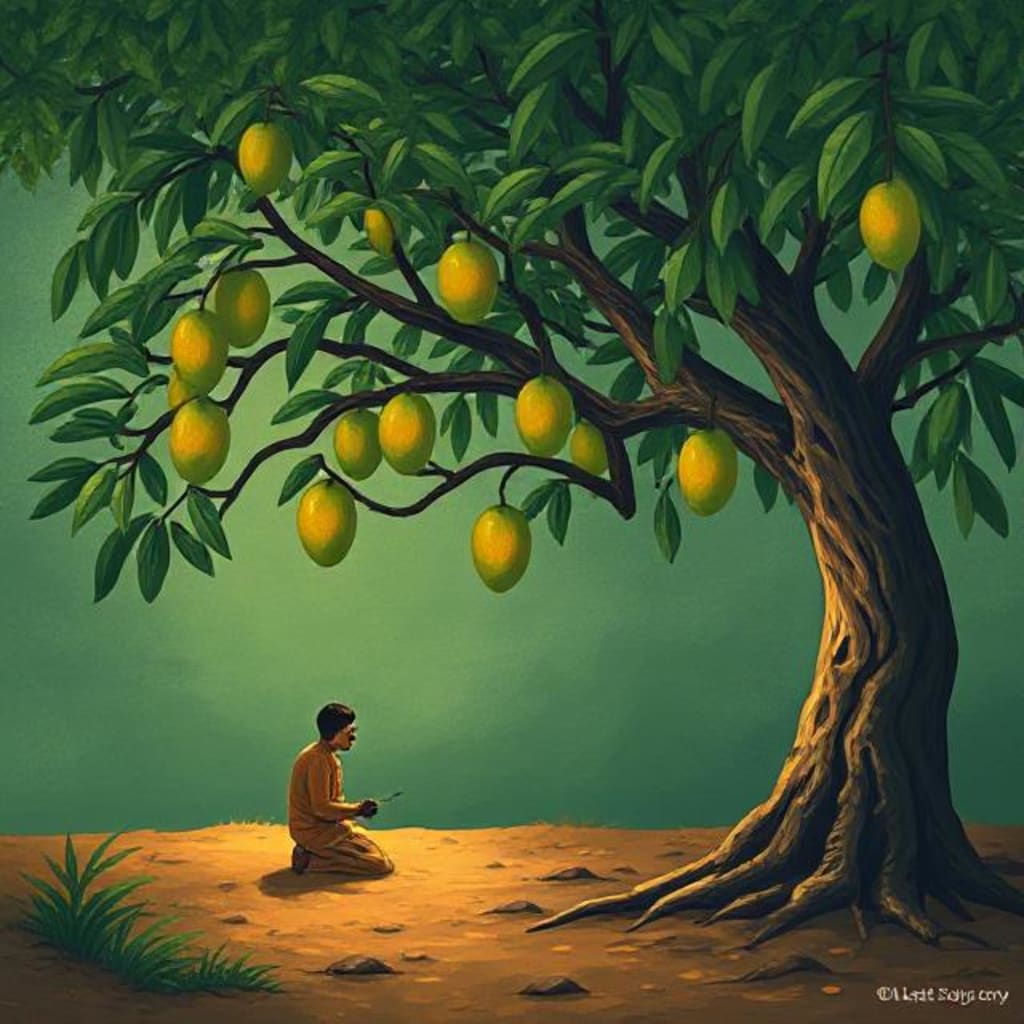
In the quiet village of Haridham, nestled between green hills and golden fields, there lived an old man named Ramu. Ramu was a humble farmer, known not just for his harvest, but for the great mango tree that stood in the center of his land. It was not an ordinary tree—it was the last of its kind, a rare mango species known for its unmatched sweetness and healing properties.
Villagers often spoke of the tree as if it were magical. Some said it could heal a fever with one bite. Others believed the tree listened to human emotions and bore sweeter fruit when it felt love around it. Whether true or not, no one could deny that the tree was special. Ramu cared for it like a child—talking to it, watering it by hand, and guarding it during storms.
Ramu had one son, Arjun, who had left the village years ago to work in the city. He found village life too slow, too simple. “Who cares about one old tree, Baba?” he would say whenever he visited. “Come with me to the city! There are better things out there.”
But Ramu always replied gently, “This tree gave me shade when I was a child. It fed your mother when she was sick. It gives without asking. Not everything of value can be sold, Arjun.”
Years passed. Ramu grew older, and the village began to change. Builders arrived, talking of roads and factories. The government marked lands for development. Ramu's field, including the sacred mango tree, was now at risk.
One day, Arjun returned, wearing a suit and holding papers. “Baba, I have news. A company wants to buy this land. They’ll pay a fortune. You can finally rest, travel, even come live with me!”
Ramu took the paper and stared at it in silence. Then he looked at the tree. “And what will happen to this?”
“They’ll cut it, Baba. But they’ll plant more somewhere else,” Arjun replied carelessly.
Ramu shook his head. “You cannot plant a hundred trees to replace one heart.”
Arjun grew impatient. “It’s just a tree!”
“It’s not just a tree,” Ramu said firmly. “It is my friend, my history, my legacy. You left to build buildings. I stayed and built life.”
They argued late into the night. Eventually, Ramu said, “If you think this land is just dirt and wood, then you have truly forgotten where you came from. You may leave now.”
The next morning, Arjun left, angry and confused.
That year, a terrible drought hit Haridham. Crops failed. Rivers dried. People suffered. But in Ramu’s land, the mango tree remained green. Its roots, deep and ancient, tapped into hidden underground springs. It bore more fruit than ever before.
Ramu didn’t keep the fruit. He gave it to the villagers—for free. “The tree gives,” he said. “So shall we.”
News spread. People from other villages came, not just for the fruit, but to witness the miracle. Doctors studied the mangoes. Scientists took soil samples. Reporters arrived with cameras. The government declared the tree a national treasure. The land was preserved, and Ramu’s field became a protected sanctuary.
Years later, Ramu passed away under the shade of the tree, with a smile on his face and peace in his heart.
Arjun returned, older and wiser. He stood before the tree, now surrounded by flowers, birds, and children laughing in its shade. He wept quietly, not for the money lost, but for the love he had failed to see.
From that day, he took care of the tree. Not as a businessman, but as a son reclaiming his roots. He planted more trees. He told his children stories of their grandfather and the miracle mango tree.
And the tree? It continued to give, just as it always had.
🌟 Moral of the Story:
Not everything of value can be sold. Some things—like love, nature, and legacy—must be protected, not profited from. True wealth lies not in what we own, but in what we nurture.
About the Creator
Keep reading
More stories from VISHWANATHA and writers in Education and other communities.
The Greedy Farmer
The Greedy Farmer Long ago, in a small village surrounded by golden fields and blue skies, lived a farmer named Hariram. He owned a piece of land that had been passed down for generations. The soil was fertile, and the crops yielded enough to feed his family and sell a little at the market. Hariram was not rich, but he had enough.
By VISHWANATHA8 months ago in Education
Where Wisdom Meets Action: The Deep Connection Between Culture, Education, and Service
In any thriving society, specific values act as the foundation for growth, unity, and identity. Among these, culture, higher education, and service stand out as essential pillars. While they may operate in different spheres, they are deeply connected by a shared purpose — to empower individuals and strengthen communities through knowledge, empathy, and tradition.
By Carmen Reid4 days ago in Education
The Architecture of Community Strength: Uniting Faith, Family, and Financial Responsibility
Communities that endure social, economic, and cultural challenges are rarely held together by policy alone. Their strength lies in shared values, stable relationships, and the responsible use of resources. Faith, family, and finance represent three foundational forces that shape how communities function and grow. When these forces are aligned, they form a reliable framework for building stronger, healthier, and more resilient communities.
By Jason Barakat2 days ago in Education
The CEO of Everything
They say "jack of all trades, master of none," but they forgot to mention the part where the jack of all trades is also the camera woman, the makeup artist, and the person currently yelling at a tangled Wii microphone cable in a her own bathroom while recording herself singing and trying to make it look realistic and professional. (As professional as you can make it with nothing but a cell phone camera and a mic that doesn't work)
By Sara Wilson7 days ago in Humans


Comments
There are no comments for this story
Be the first to respond and start the conversation.