
The James Webb Space Telescope Discoveries
How It’s Reshaping Our Understanding of the Cosmos
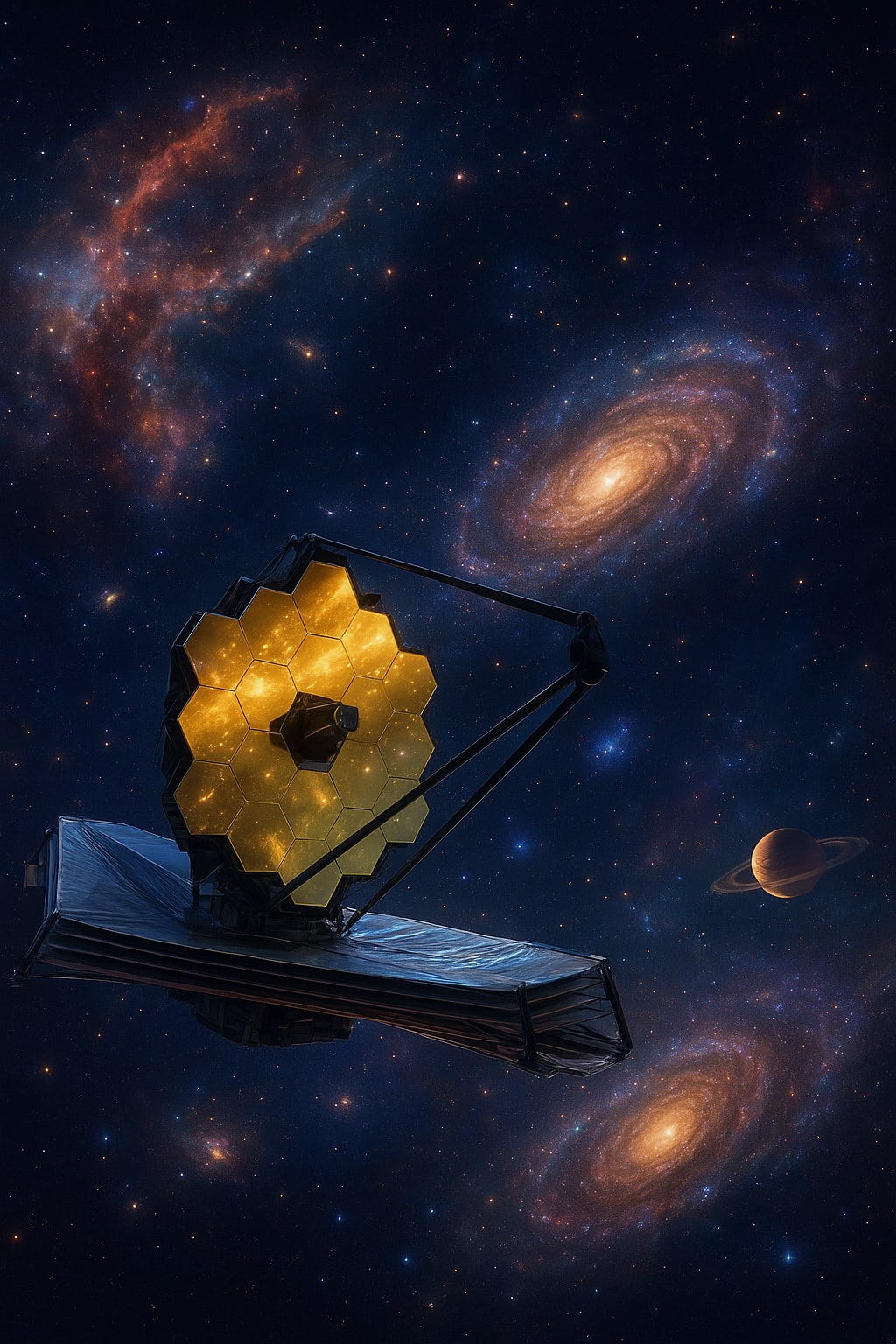
The James Webb Space Telescope Discoveries – How It’s Reshaping Our Understanding of the Cosmos
When the James Webb Space Telescope (JWST) launched on December 25, 2021, the world held its breath. Positioned a million miles from Earth, this engineering marvel was designed to peer deeper into space and further back in time than any telescope before it. Within just a short time, JWST has lived up to its promise, revolutionizing astronomy and reshaping how we understand the cosmos.
A Window Into the Early Universe
One of JWST’s most exciting achievements is its ability to look back in time to the earliest galaxies that formed after the Big Bang. Using its powerful infrared instruments, the telescope can see light that has been traveling for over 13 billion years.
Early images stunned astronomers by revealing galaxies that appeared more massive and developed than expected so soon after the universe’s birth. These findings challenge current theories of galaxy formation, forcing scientists to reconsider how quickly stars and galaxies could have formed in the young universe.
Discovering Exoplanets Like Never Before
JWST has also opened a new chapter in the study of exoplanets—planets orbiting stars beyond our solar system. By analyzing starlight passing through exoplanet atmospheres, JWST can detect the presence of molecules such as water vapor, methane, and carbon dioxide.
In one groundbreaking observation, the telescope detected water and carbon-based molecules in the atmosphere of WASP-39b, a giant planet 700 light-years away. These results demonstrate JWST’s ability to search for the chemical building blocks of life. In the future, this capability could help identify potentially habitable worlds—or even signs of biological activity.
Unlocking the Secrets of Star Birth
Stars are born inside clouds of gas and dust, regions that are often opaque to visible light. Unlike the Hubble Space Telescope, JWST’s infrared vision can pierce through these clouds, revealing the hidden processes of star and planet formation.
One of its first iconic images, the Carina Nebula, showed breathtaking details of “stellar nurseries”—towering clouds where young stars are igniting. These observations are giving astronomers clues about how stars form, how they influence their surroundings, and how planetary systems like our own may emerge.
Studying Our Own Solar System
JWST is not only looking at distant galaxies; it is also turning its gaze closer to home. The telescope has studied Jupiter, showing its rings, giant storms, and even tiny moons in unprecedented detail. It has also observed Saturn, Neptune, and Uranus, revealing atmospheric structures never seen before.
These observations help scientists understand not only our solar system but also how giant planets form and evolve in other systems.
Challenging Our Understanding
Perhaps the most remarkable impact of JWST so far is how it is challenging established scientific models. The discovery of unexpectedly massive early galaxies, unusual chemical compositions in exoplanet atmospheres, and surprising details about star formation all point to one fact: the universe may not work exactly the way we thought it did.
This doesn’t mean our understanding is wrong, but rather incomplete. JWST is providing the missing pieces of the puzzle, forcing scientists to refine their theories about how the cosmos works.
A Telescope for the Future
What makes JWST especially exciting is that its discoveries are just beginning. With a mission expected to last at least a decade, the telescope will continue to gather data that will inspire generations of scientists.
The telescope has already proven that it is not just a successor to Hubble—it is a revolutionary leap forward. By capturing faint signals from the earliest moments of cosmic history and revealing the chemical makeup of distant worlds, JWST is helping humanity understand where we came from, how we fit into the universe, and whether we are alone.
In many ways, the James Webb Space Telescope is doing more than science. It is giving us a new perspective on the cosmos and our place within it—a reminder that the universe is vast, mysterious, and still full of secrets waiting to be discovered.
About the Creator
Keep reading
More stories from Muhammad Shahram and writers in Education and other communities.
The Future of Space Travel
The Future of Space Travel – Can Humans Colonize Mars or Even Travel Beyond Our Solar System? For centuries, humanity has gazed at the night sky with wonder, asking whether we could one day leave Earth and make a home among the stars. With rapid advances in technology and growing interest from both governments and private companies, that dream feels closer than ever. The question is not only whether we can travel beyond our home planet, but whether we can truly colonize other worlds like Mars—or even venture beyond our solar system.
By Muhammad Shahram5 months ago in Education
Where Real Growth Is Happening in Hospitality Today
On a recent trip, I checked into a small boutique hotel that remembered my name before I reached the front desk. The lobby felt less like a transaction point and more like a living room. The café next door doubled as a coworking space, and the staff moved with a kind of calm confidence that suggested they were part of something thoughtful, not rushed. It struck me that growth in hospitality no longer announces itself solely through grand openings. It shows up in subtler, smarter ways.
By Asad Malik4 days ago in Education
Why Chatbots Are Reshaping Digital Communication in the United Kingdom?
Digital communication is now the most common way that businesses and organizations communicate with customers․ In the UK, companies are increasingly using chatbots to provide automated responses to customer enquiries in real time, on websites, messaging apps and mobile apps․
By deepanshu Thakur4 days ago in Education



Comments
There are no comments for this story
Be the first to respond and start the conversation.