

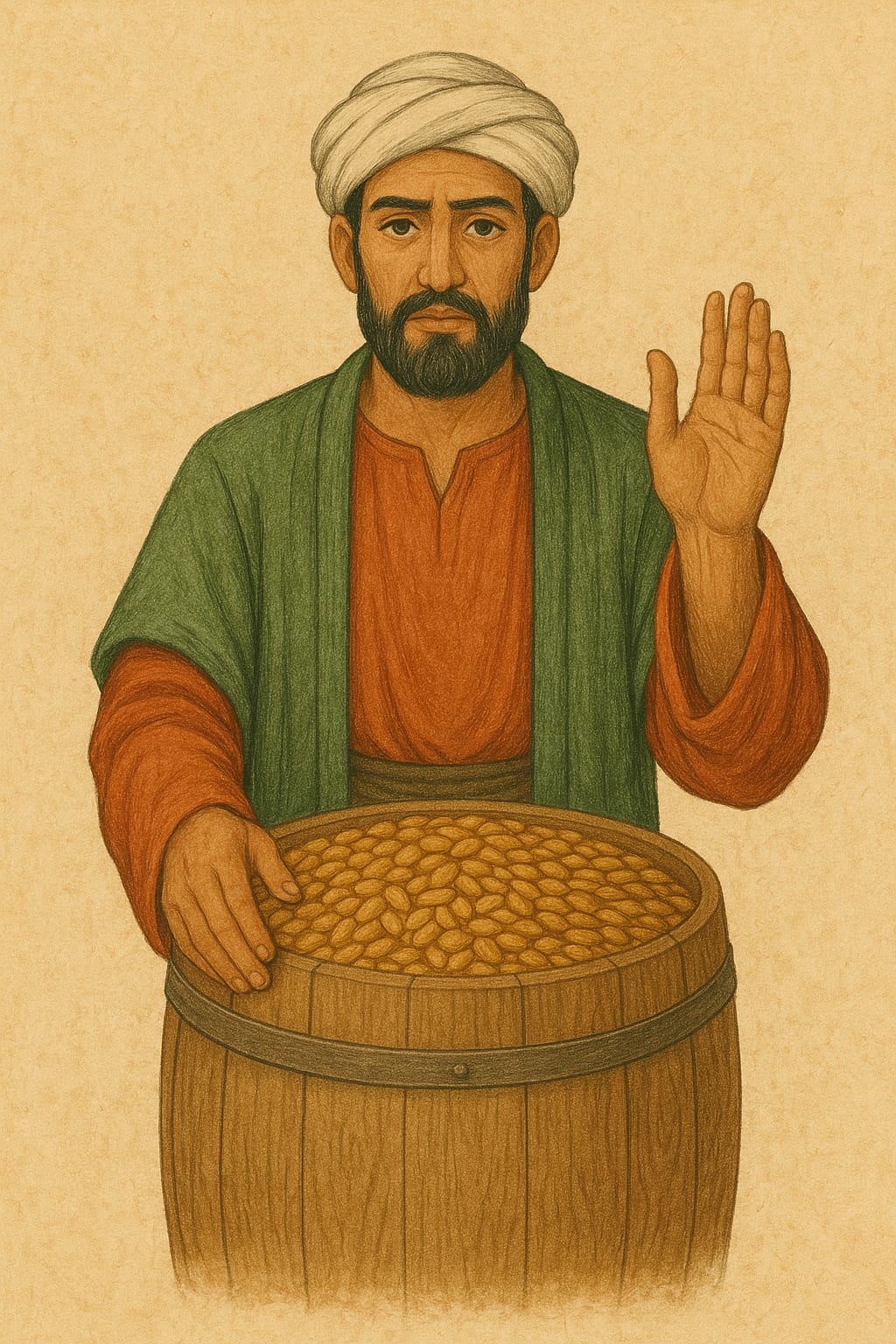
In the bustling city of Makkah, centuries ago, long before Islam spread across the Arabian Peninsula, there lived a young man named Malik. He was known for his honesty and sincerity. Malik inherited a small shop in the market from his late father and sold simple goods—dates, cloth, and spices.
Malik was not wealthy, but his heart was rich with faith. He believed deeply in Allah and followed the teachings of the Prophet Muhammad (peace be upon him), who was alive during Malik's youth. The Prophet himself was known as Al-Amin, the trustworthy, and Malik tried to follow his example in every aspect of his life.
One day, during the peak of summer, a traveler entered Malik’s shop. The man was tired, his clothes dusty from the desert wind. He asked for some water and dates. Malik offered him water and brought out a basket of dates. The traveler picked up a date and examined it closely.
“These dates look old,” the man said. “Do you have fresher ones?”
Malik smiled and replied, “These are from last week’s stock. I do have fresher ones, but they cost a bit more. Would you like to see them?”
The traveler nodded, and Malik brought out another basket. The dates were plump and shiny. The man bought some and sat down to rest.
As the traveler ate, he noticed that other merchants in the market were shouting loudly, boasting about their goods, and pressuring customers to buy more. But Malik remained calm, never raising his voice or exaggerating the quality of his products.
Curious, the traveler asked, “Why don’t you try to attract customers like the others do? You could sell more.”
Malik replied, “The Prophet Muhammad (peace be upon him) taught us that honesty brings blessings. He said: ‘The truthful and trustworthy merchant will be with the Prophets, the truthful, and the martyrs on the Day of Judgment.’ I would rather earn less and please Allah than gain more through lies.”
The traveler was impressed. He stayed a while longer, watching Malik treat every customer with fairness. He didn’t shortchange anyone, always measured accurately, and if he found a defect in a product, he would mention it before selling.
Days turned into weeks. Word of Malik’s honesty began to spread. Travelers from far away would ask for his shop. Locals preferred buying from him even if others offered lower prices. His business grew not through deception, but through trust.
One day, a wealthy merchant named Harith came to visit. He had heard of Malik and wanted to offer him a business deal.
“I can give you twice the money you earn now if you come work for me,” Harith said. “You have a reputation for honesty. Together, we could dominate the market.”
But Malik declined. “I am grateful for your offer,” he said, “but I’m content with what Allah provides. My goal is not to dominate the market, but to earn halal (lawful) income and live a life pleasing to Allah.”
Harith was taken aback. In a world where greed ruled many hearts, Malik’s words echoed a higher truth. The merchant left, humbled by the young man’s faith.
Years passed, and Malik’s small shop remained a symbol of integrity. Children would point to his shop and say, “That’s the honest merchant!” Malik became a mentor to younger traders, teaching them the importance of sincerity, patience, and gratitude.
One day, a group of traders approached him. “We want to form a guild,” they said. “A group of merchants who agree to follow the principles you live by—honesty, fairness, and faith.”
Malik smiled. “Then let us make an intention together. We trade not only to earn money, but to worship Allah through fair dealings. If we remain sincere, Allah will bless our efforts.”
Thus, a new chapter began in Makkah’s market. Inspired by the teachings of Islam and the example of Prophet Muhammad (peace be upon him), more and more merchants began to embrace honesty. The market became a place of trust and harmony, where people were not just customers, but brothers and sisters in faith.
And Malik? He never became the richest man in Makkah, but his legacy was far greater. His story was told to children for generations—not as a tale of wealth, but as a beacon of righteousness.
Moral of the Story:
This story teaches us the Islamic value of honesty in trade. Islam encourages fairness, trust, and sincerity in all dealings. A believer’s success is measured not just by money, but by how closely he follows the path of righteousness. As the Prophet (PBUH) said:
“Whoever cheats is not one of us.” (Sahih Muslim)
About the Creator
Alfia Mahajabin
Islamic History
Keep reading
More stories from Alfia Mahajabin and writers in Education and other communities.
The Gift of the Date plam
In a quiet village nestled between golden sands and a shimmering oasis, lived a young boy named Zayd. He was kind-hearted, respectful to his elders, and always eager to learn about Allah and the teachings of the Prophet Muhammad (peace be upon him).
By Alfia Mahajabin10 months ago in Education
Why Clear and Simple Communication Builds Real Trust
The meeting had gone on for almost an hour, yet no one seemed sure what had actually been decided. Slides were polished. The language sounded impressive. Still, as people packed up their laptops, there was a quiet tension in the room. Later that afternoon, someone sent a short follow-up email. It used plain words. It listed three simple points. Suddenly, everyone understood. The mood shifted. What changed was not the strategy. It was the clarity.
By Stacey Yima day ago in Education




Comments
There are no comments for this story
Be the first to respond and start the conversation.