
The Hidden Face of Democracy
A word that smiles, but never fully speaks

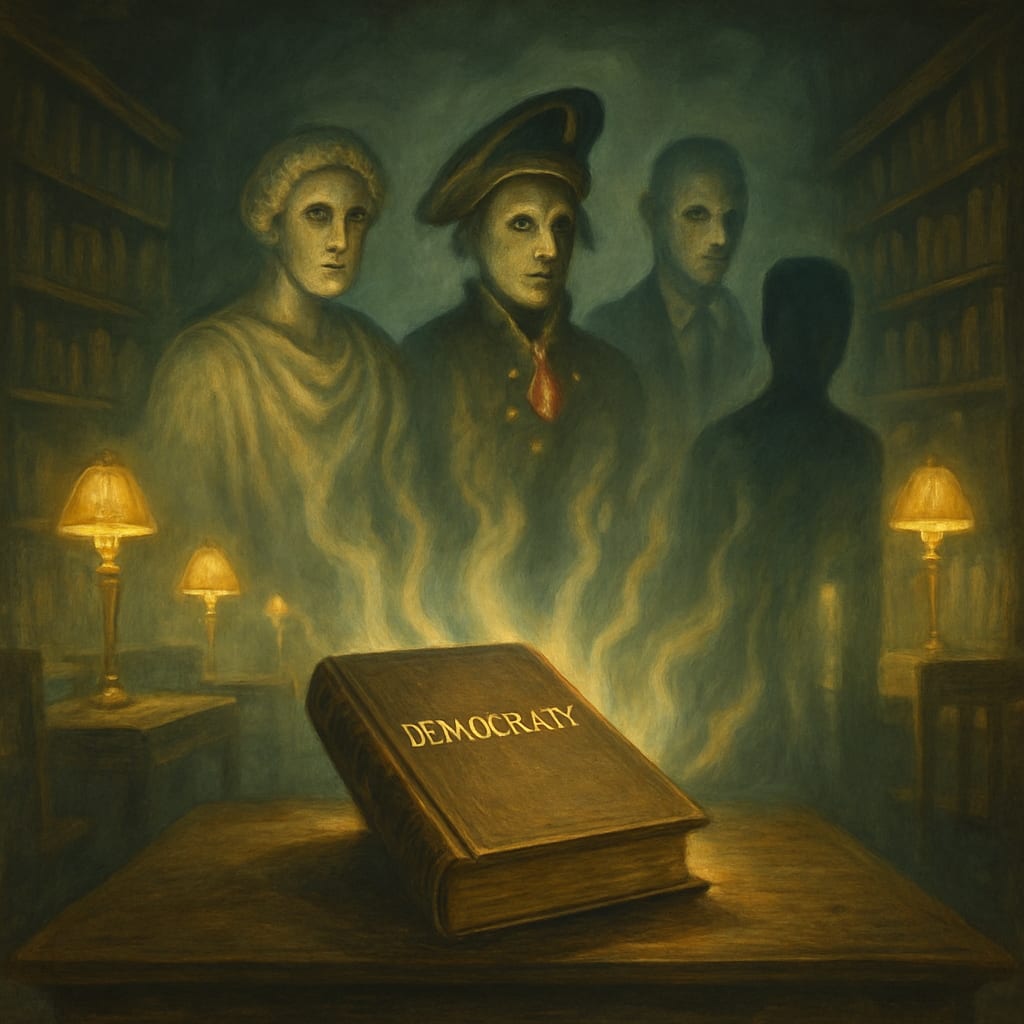
One evening, in a forgotten library, I found a word sitting quietly on the shelf: Democracy.
It looked ordinary, like any other word made of flesh and paper. But when I leaned closer, it smiled—as if it had secrets to tell. A smile too calm, too knowing, like a stranger who remembers your face though you have never met.
And that was when I realized—this word was not just a system. It was a story. A wandering spirit wearing different masks through centuries, whispering promises, and hiding truths.
1. The Birth of a Word
The word democracy was born in Athens in the 5th century BCE, stitched from two simple fragments: demos (the people) and kratos (power). To the poets and statesmen of Athens, it must have sounded revolutionary, a dream of citizens shaping their own destiny.
Yet even in its birth, democracy carried shadows. Women, slaves, and foreigners—most of the city’s inhabitants—were denied entry to its sacred assembly. It was, in truth, a selective dream: the power of the people, but not all people.
Like a child born under two suns, democracy began its journey marked both by brilliance and blindness.
2. The Ghost That Traveled
The word did not stay in Athens. It became a ghost that wandered across empires. In Rome, the Senate borrowed its spirit but chained it with hierarchy. Centuries later, in the echo of revolutions in France and America, democracy returned wearing a new robe—one stitched with declarations and parchment.
And yet, even as it marched across continents, it always left something behind. In Paris, it left blood in the streets. In Philadelphia, it left behind the voices of the enslaved who were promised liberty but handed chains.
Everywhere it traveled, democracy took a different mask, but the eyes behind the mask always looked the same—calm, knowing, untouchable.
3. The Hidden Mechanisms
There are things about democracy that people rarely speak of. In Athens, they had a peculiar ritual: ostracism. If a man grew too powerful, citizens could scratch his name on a piece of pottery. Enough scratches, and he was exiled for ten years. Democracy, it seemed, survived not by trust, but by fear of imbalance.
Plato despised democracy. He saw it as a marketplace of noise, where ignorance shouted louder than wisdom. To him, democracy was a road not to freedom, but to chaos—and from chaos, tyranny was born.
Even today, the secret remains. Democracy is often less about people’s voices and more about invisible hands pulling strings: lobbyists in polished offices, money folded into ballots, power traded in back rooms where no citizen’s vote can reach.
4. The Word That Eats Promises
Sometimes, when I think of democracy, I do not see a parliament or a ballot box. I see a creature that feeds on promises. It whispers during elections, feasts on speeches, and grows fat on the applause of the hopeful.
But once the lights dim and the crowds go home, the creature curls up in silence. It does not starve—it only digests. It waits, patient, until the next feast of words.
In Murakami’s world, cats disappear into thin air, wells open into other dimensions, and time folds quietly. In ours, democracy behaves the same: a word that shifts shapes, slipping through fingers the moment you think you’ve grasped it.
5. Masks Through Centuries
Democracy is not one face, but many.
In Athens, it was the stern mask of the citizen-assembly.
In France, it was a guillotine blade falling in the name of liberty.
In America, it was a parchment declaring freedom while men remained enslaved.
In our time, it is a glowing screen, tallying digital votes while algorithms quietly decide what we believe.
The mask changes, but the spirit does not. It drifts between centuries, like a dream that retells itself in different languages. Sometimes it comforts, sometimes it terrifies. But always, it endures.
6. The Unfinished Question
And so, the word sits quietly again. On library shelves, in constitutions, in speeches on television. We hold it up like a holy book, but few dare to ask what it really is.
Maybe democracy was never about giving us power. Maybe it was about teaching us to search for it—endlessly, like a dream we wake up from but can never quite recall.
When I left that library, the word was still smiling at me. Not kindly. Not cruelly. Just smiling, as if to say: You think you know me. But I know you far better.
About the Creator
Natik Ahsan
Welcome to a world of wonder, curiosity, and nature's quiet magic.
Here, I explore stories that open minds, spark thought, and invite gentle conversation.
Thank you for being here—your presence means everything.
Keep reading
More stories from Natik Ahsan and writers in Education and other communities.
Overcoming Procrastination: A Step-by-Step Guide to Finally Moving Forward
I remember the night all too well. It was 1:47 AM. A cold cup of coffee sat on my desk. The glow of the laptop screen bathed my room in a ghostly blue light. My deadline was at 9:00 AM. The project was important. The topic? Familiar. The task? Doable. But somehow, I hadn’t written a single word.
By Natik Ahsan8 months ago in Education
Decoding the Rise and Fall of Global Commodity Markets
Commodity markets have always moved in waves, rising and falling in response to forces that stretch far beyond daily trading activity. These movements can appear chaotic on the surface, yet beneath the volatility lies a structure shaped by economics, human behavior, and long-term investment patterns. From energy and metals to agricultural products, commodities follow cycles that repeat over time, although never in the same way. Understanding these cycles offers clarity in markets often seen as unpredictable.
By Anthony Blumberg7 days ago in Education
Top 10 Essential Skills for Success in 2026
By 2026, the job market is no longer driven only by degrees or titles. Technology, especially Artificial Intelligence (AI), automation, and remote work, has changed how companies operate and how people work. Many routine tasks are now handled by machines, while humans are expected to do work that requires thinking, judgment, creativity, and emotional understanding. This shift means that skills — not just education — determine success. The following 10 skills are considered essential for 2026 because they combine technology awareness with human intelligence. Let’s understand them one by one, step by step.
By Talha khan6 days ago in Education



Comments
There are no comments for this story
Be the first to respond and start the conversation.