
“The Girl Who Healed Dreams”
A Story of Determination, Sacrifice, and the Making of a Young Doctor

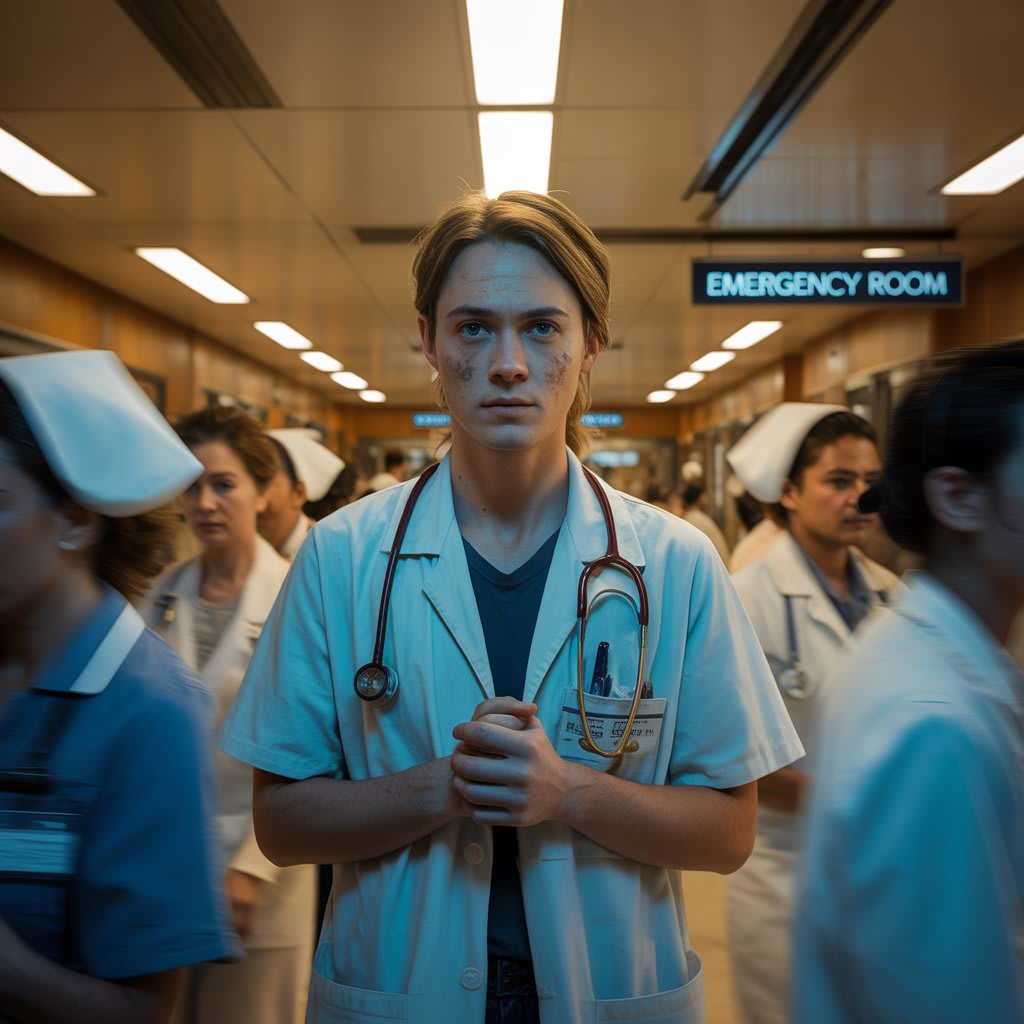
In the heart of a dusty village called Kalipur, surrounded by wheat fields and long-forgotten roads, lived a girl named Meera Verma. She was born on a stormy night in a small clay house with a tin roof that rattled in the wind. Her father, a farmer, earned just enough to feed his family. Her mother stayed at home, raising Meera and her two younger brothers.
Meera was unlike other girls in the village. While others played with dolls or helped in the kitchen after school, Meera spent her time reading her father’s old newspapers and medical pamphlets he brought from town. Her curiosity wasn’t just about learning — it was about understanding. At age ten, when her neighbor lost a child due to a simple infection that wasn’t treated in time, Meera didn’t just cry — she asked, “Why did no one help in time?”
That question stayed with her for years.
The First Spark
The village had one health worker who visited once a week. Meera often followed her around like a shadow, asking questions about coughs, fevers, wounds, and strange sounds in the chest. The woman, impressed by Meera’s interest, gave her an old stethoscope and said, “If you want to be a doctor, you have to be stronger than everyone who tells you you can’t.”
That sentence became her compass.
When Meera turned 13, her school began pressuring girls to “focus on home skills” and prepare for early marriage. But Meera had already made a silent promise to herself: she would wear a white coat, carry a stethoscope, and return to Kalipur not as a girl, but as Doctor Meera Verma.
The Mountain of Obstacles
Her dream wasn’t welcome in a place where girls weren’t expected to study beyond 10th grade. Her relatives mocked her ambitions. “A doctor? From this family? From this village?” they laughed. “Better to teach her how to cook well. That will help her more.”
Her father was torn between society’s expectations and his daughter’s passion. But Meera’s determination wore down his doubts. She studied by candlelight, walked five kilometers each day to school, and tutored younger kids in exchange for books and exam guides.
At age 17, she sat for the NEET exam — India’s entrance exam for medical school. Her first attempt? She failed.
People whispered, “We told you. It’s a man’s world.”
But Meera didn’t stop. She cried that night, quietly under her blanket, but the next morning she was back to work — studying harder, smarter, and with more fire than ever.
The Breakthrough
On her second attempt, Meera cleared NEET with a decent score. She got admission to a government medical college in the city — hundreds of kilometers away from her village. Her mother cried when she left, both proud and afraid. Her father sold part of their land to buy her a secondhand scooter and a small laptop.
Medical school was a world unlike anything Meera had seen. Students spoke fluent English, wore branded clothes, and talked about internships abroad. Meera felt like a stranger at first. But what she lacked in polish, she made up for in grit.
She studied night after night, asked questions even when others laughed, and practiced endlessly in the lab. By her third year, she was among the top students in her batch.
But life threw her another test.
The Fall and the Rise
During her final year, Meera’s father suffered a stroke. She rushed home and stayed by his side for weeks. The family couldn't afford private treatment, and the village still didn’t have a proper doctor.
She watched helplessly as the man who once carried her on his shoulders struggled to speak.
This became her second turning point.
She returned to college with even more urgency — not just to pass, but to serve. She graduated with distinction, completed her internship, and despite several lucrative offers from city hospitals, she made a decision few understood:
She packed her bag and returned to Kalipur.
The Doctor Arrives
When she stepped off the bus wearing her white coat and carrying a stethoscope around her neck, children ran after her shouting, “Doctor Didi!”
She set up a small clinic using a loan and local help. It was a simple building — two rooms, a waiting bench, and a fan that worked only when the power came on. But what she offered was priceless: care, dignity, and hope.
She treated fevers, delivered babies, stitched wounds, educated mothers, and most importantly, listened. Every patient left her clinic not just with medicine, but with trust.
Her fame spread. Patients came from nearby villages. NGOs took notice. Donations poured in. She hired a nurse, then another doctor. Her clinic grew into a rural health center.
The Full Circle
One evening, Meera sat on the same porch where she had once studied by lantern light. Her father, now recovered, watched her with quiet pride. Her mother brought tea and biscuits. Across the road, girls played with plastic stethoscopes pretending to be doctors.
Meera smiled.
She remembered every name, every wound, every time someone said “no” to her dreams. And then she remembered the health worker who had once handed her a real stethoscope and said she’d need strength.
She had found it — in books, in setbacks, in silence, and in herself.
🌟 Epilogue
Years later, a journalist from a national newspaper interviewed Meera.
“Why didn’t you stay in the city where you had more money, comfort, and recognition?” he asked.
She replied, “In the city, I might have saved lives. But here, I’m also saving dreams — dreams like the one I once had, sitting in a dusty room with nothing but hope.”
The article was titled:
“The Girl Who Healed a Village — One Patient at a Time.”
About the Creator
AFTAB KHAN
SUBSCRIBE ME AND READ STORY
Storyteller at heart, writing to inspire, inform, and spark conversation. Exploring ideas one word at a time.
Writing truths, weaving dreams — one story at a time.
From imagination to reality
Keep reading
More stories from AFTAB KHAN and writers in Education and other communities.
What’s the best position to sleep in?
In the 1970s, psychoanalyst Samuel Dunkell proposed a curious, albeit almost completely unsubstantiated, theory that the position you sleep in reflects your personality. For example, preferring to snooze in the so-called royal position indicated self-confidence, while sleeping semi-fetal meant you’re sensible and well adjusted. While Dunkell’s ideas lack any definitive proof, how we sleep can impact our health. So, what’s the best position to sleep in? Sleep positions go by countless creative names—
By Munesh Yadavabout 24 hours ago in Education
How a Bowl of Noodles Became a Global Phenomenon That Crossed Borders
A bowl of noodles is one of the most familiar meals in the world. It appears in many cultures, served in different ways, yet always recognizable. The path of how a bowl of noodles became a global phenomenon is tied to human movement, simple cooking methods, and the need for comfort food. This story explains how a basic dish grew into a worldwide favorite.
By Table to Stix Ramen5 days ago in Education


Comments
There are no comments for this story
Be the first to respond and start the conversation.