
The Genius Who Built a Computer in Ancient Greece
2,000 years before modern technology, one mysterious machine proved the ancients were far ahead of their time
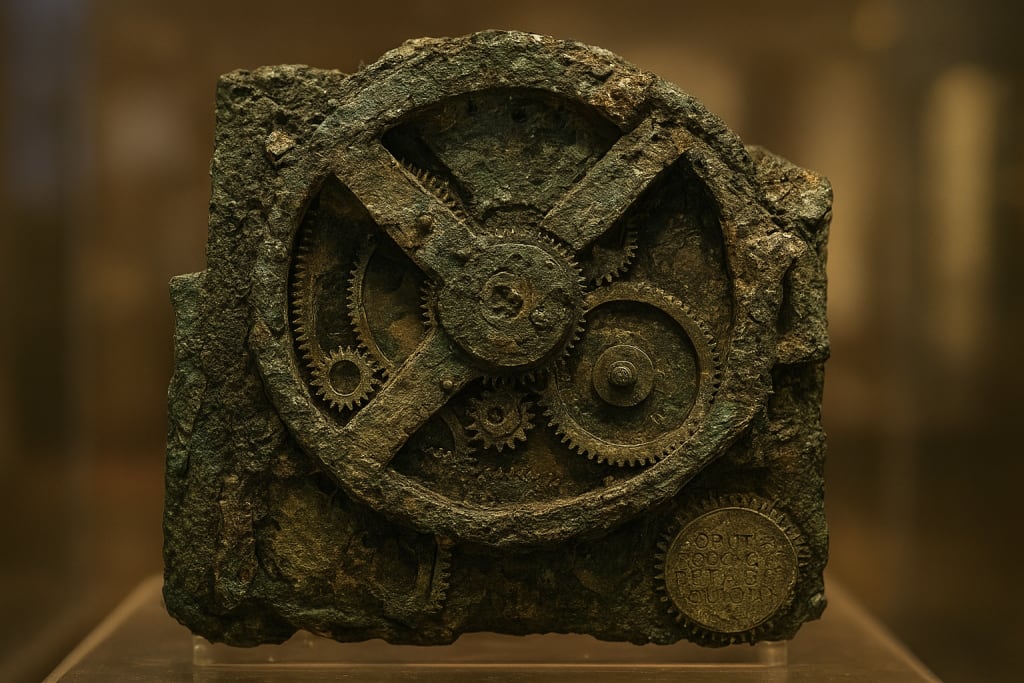
For centuries, historians believed that the ancient world knew nothing of complex machines. They imagined Greece as a land of philosophers and marble statues—not gears, dials, and engineering genius.
Then, in 1901, a group of sponge divers off the coast of the tiny Greek island of Antikythera made a discovery that changed everything.
Beneath the turquoise water, among the broken remains of a Roman shipwreck, they found something that shouldn’t have existed—
a corroded lump of bronze, filled with tiny interlocking gears.
At first, archaeologists thought it was just a piece of rusted junk. But when they began cleaning it, they saw something no one expected: intricate gear teeth, inscriptions, and precise craftsmanship that rivaled a modern clock.
They had no idea what they were looking at.
For decades, scholars argued over the strange object. Some thought it was an astrolabe. Others said it was a navigational tool. But as technology advanced, so did the truth.
In 1959, British physicist Derek de Solla Price made a bold claim after years of study:
this was no simple device.
It was, in his words, “like finding a jet engine in the ruins of a medieval monastery.”
Price realized that the object—now called the Antikythera Mechanism—was a machine designed to calculate the positions of the sun, moon, and planets, decades in advance. In other words, it was the world’s first known computer.
A device built over 2,000 years ago… capable of predicting eclipses, tracking the calendar, and modeling celestial motion.
The mechanism had more than 30 bronze gears, each carefully cut with astonishing precision. Some were smaller than a coin, yet perfectly aligned. When turned by a hand crank, the gears moved together like clockwork, displaying the movements of the heavens on small circular dials.
But here’s the mystery that still stuns experts today:
the level of mathematical and mechanical knowledge needed to create it shouldn’t have existed until 1,500 years later.
No other known civilization at the time—Greek, Roman, or otherwise—had such advanced gear systems. For comparison, Europe wouldn’t see anything this complex again until the 14th century.
So who built it?
Most historians now believe it was created by scientists from the school of Archimedes, one of the greatest inventors of antiquity. Archimedes was known for designing war machines, hydraulic systems, and complex astronomical models.
But others argue it came from Rhodes, an island famous for its engineers and astronomers. One name often emerges—Hipparchus of Nicaea, the astronomer who first mapped the stars and developed early trigonometry.
Whoever made it wasn’t just an inventor.
They were a genius centuries ahead of their time.
Even more fascinating? The Antikythera Mechanism wasn’t a one-of-a-kind miracle.
It was likely a copy.
Ancient Greek texts discovered later referenced “spheres” and “calculating devices” that matched its description. That means this level of technology may have been part of a hidden golden age of science—one that vanished when Rome rose and the ancient world fell into darkness.
For nearly two thousand years, that knowledge was lost.
Modern X-ray scans have revealed new secrets within the device: faint Greek letters, complex mathematical tables, and even a “user manual” explaining how to operate it.
It’s as if a voice from the past is whispering,
“We were smarter than you think.”
And maybe that’s the most haunting part.
The Antikythera Mechanism isn’t just a machine—it’s a question.
How much ancient knowledge have we lost?
How many inventions were destroyed by time, war, or ignorance?
Each corroded gear is a reminder that history isn’t a straight line of progress. Sometimes, humanity takes giant leaps forward—and then forgets it ever happened.
Today, the Antikythera Mechanism sits in the National Archaeological Museum in Athens, protected behind glass. It’s small, unassuming, and silent. But inside those ancient gears lives a story that refuses to die.
A story that proves genius isn’t bound by centuries.
💡 If this story fascinated you, tap ❤️, drop a comment, and follow me — because the next discovery might rewrite everything we think we know about history.
About the Creator
OWOYELE JEREMIAH
I am passionate about writing stories and information that will enhance vast enlightenment and literal entertainment. Please subscribe to my page. GOD BLESS YOU AND I LOVE YOU ALL
Keep reading
More stories from OWOYELE JEREMIAH and writers in Education and other communities.
The Man Who Predicted Electricity 2,000 Years Before Edison
They called him Thales of Miletus — philosopher, astronomer, engineer, dreamer. To history, he’s a quiet name whispered among the Seven Sages of ancient Greece. But behind that quiet name hides a spark — one that glowed two thousand years before the first light bulb ever flickered to life.
By OWOYELE JEREMIAH3 months ago in Education
How to Clean Up Messy Financial Records Before Tax Season in New Westminster?
Tax season creates stress for many people. This stress grows when financial records are disorganized. Missing receipts, unclear expenses, and late entries make tax filing harder. In New Westminster, messy records can also raise red flags with the CRA.
By Phoenix Knight 7 days ago in Education


Comments
There are no comments for this story
Be the first to respond and start the conversation.