
The Garden of Lost Voices
"A forgotten place where silence speaks louder than words."

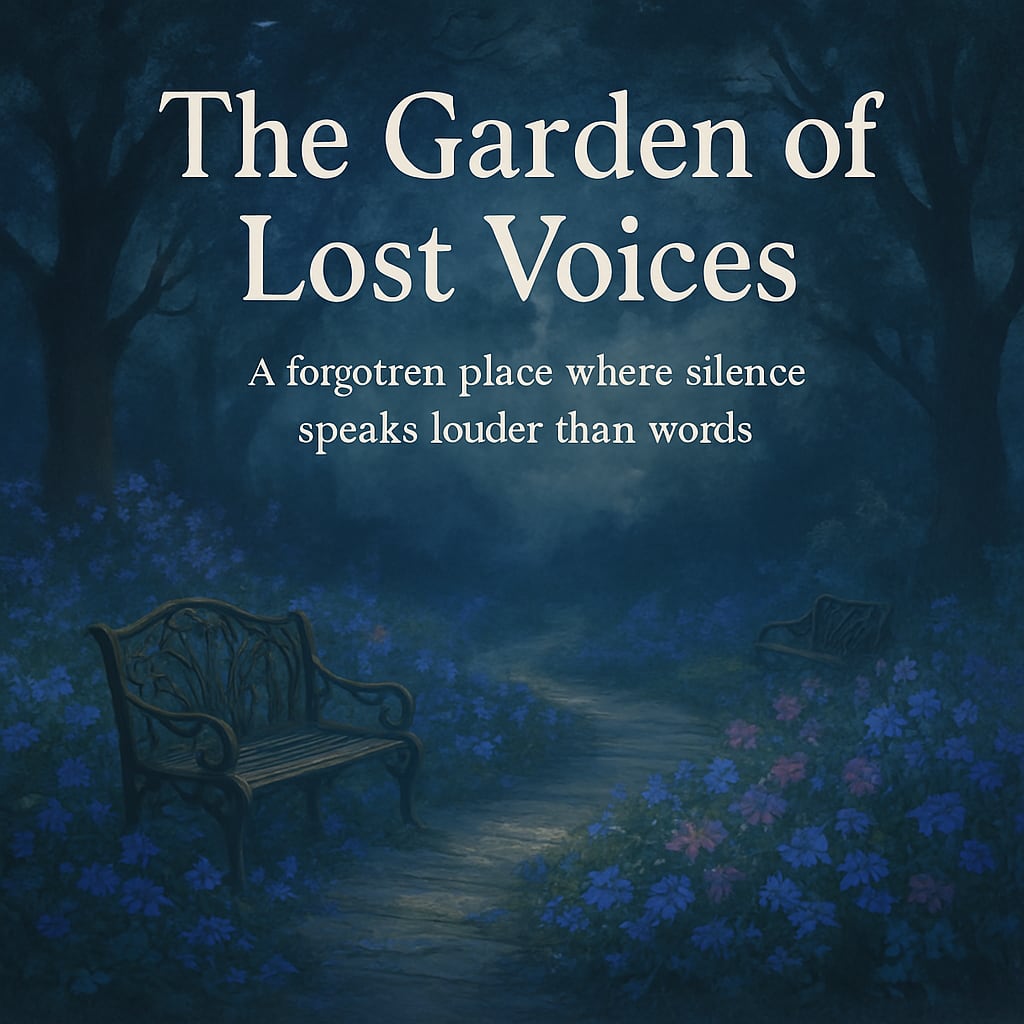
The iron gate groaned as Lila pushed it open, its rusted hinges protesting like the throat of a creature long dormant. She hesitated, her fingers brushing the cold metal. The symbol etched into the arch above—a crescent moon cradling a wilted rose—matched the locket her grandmother had left her. “When the world feels too loud,” the old woman had whispered on her deathbed, “follow the path where shadows hum.” Lila hadn’t understood then. But now, standing at the threshold of this forgotten garden, the weight of her grief felt lighter, as if the air itself had swallowed it whole.
The garden was a cathedral of decay and defiance. Stone arches, cloaked in ivy so thick it seemed to pulse, framed overgrown pathways choked with weeds and silver-threaded flowers. Their petals glowed faintly, like bioluminescent tears, casting shadows that danced in time with Lila’s heartbeat. She stepped forward, and the gate slammed shut behind her. When she turned, it had vanished, replaced by a wall of thorns studded with bone-white roses.
“Okay,” she muttered, clutching her grandmother’s locket. “No turning back.”
The deeper she wandered, the stranger the garden became. Fireflies flickered in the twilight air, their golden light coalescing into fleeting words: “Forgive me…” “I loved—” “Why didn’t I—” The phrases dissolved before she could finish them, leaving trails of embers. Ahead, a sundial tilted precariously in a clearing, its surface cracked and stained with lichen. Its shadow stretched unnaturally long, frozen at the hour between day and night.
And then she saw them—the echoes.
Translucent figures drifted among the flowers, their forms shimmering like heat haze. A child chasing a butterfly that crumbled to dust in her hands. A man kneeling, mouth open in a silent scream. A woman humming a lullaby, her voice swallowed by the wind. Their faces were blurred, their edges fraying, as if the garden were slowly unraveling their memories.
Lila’s chest tightened. She recognized the woman’s posture—the slope of her shoulders, the way she tucked her hair behind her ear. “Grandma?” she whispered. The figure turned, but her features were smudged, like a watercolor painting left in the rain.
A cold hand gripped Lila’s wrist.
She yelped, stumbling back. A young boy stood beside her, his echo flickering weakly. He pointed to a weathered notebook half-buried in the soil near the sundial. Its pages fluttered in a breeze Lila couldn’t feel. When she picked it up, the leather cover disintegrated, revealing blank sheets. But as her fingers brushed the paper, voices erupted in her mind—whispers, shouts, laughter, sobs—all overlapping in a cacophony that made her knees buckle.
“Stop!” she gasped, dropping the book. The voices ceased instantly. The boy tilted his head, his expression pleading. Show me, she thought. Carefully, she opened the notebook again.
This time, the pages filled with words as she touched them.
Entry 1: I never told him I was sorry. Now the cancer’s taken his voice, and mine is trapped here…
Entry 2: The accident was my fault. If I could just say it aloud, maybe I could breathe again…
Entry 3: I lied about the fire. All these years, and the guilt is eating me alive…
Lila’s breath hitched. These were confessions. Regrets. Words left unsaid, festering in the hearts of those who’d wandered here. The garden wasn’t just a relic—it was a prison for voices that had never escaped their owners’ throats.
The boy gestured to the sundial. Its fractured face began to shift, the shadow inching backward. Lila’s vision blurred. Suddenly, she was no longer herself.
She was a soldier, crouched in a trench, scribbling a letter to his mother as artillery shook the earth. “I’m scared,” he wrote. The page went blank. He crumpled it, swallowing the words.
She was a girl at a funeral, clutching a eulogy she’d been too numb to read. The paper slipped from her hands into the grave.
She was her grandmother, young and radiant, standing in this very garden, tears streaming as she whispered to the wind: “I should have fought for her. My daughter… my fault…”
Lila jerked back, the notebook falling from her hands. The boy’s echo watched her, tears glinting like stardust. “You’re all… stuck here?” she asked. “Because you never spoke?”
He nodded, then pointed to her locket.
Her grandmother’s voice echoed in her memory. “The loudest words are the ones we bury.” Lila unclasped the locket. Inside was a tiny key, its purpose unknown—until now. She pressed it into the sundial’s crack.
The garden shuddered.
The ivy retreated. The fireflies blazed brighter, weaving words into the air: “I forgive you.” “I’m proud of you.” “I remember.” The echoes began to glow, their fragmented edges knitting together. The humming woman turned to Lila, her features sharpening into clarity—her grandmother’s smile, her wrinkles, her warm hazel eyes.
“You found it,” the echo said, her voice clear and resonant. “This place… it’s for the living, not the dead. To let go of what we carry.” She cupped Lila’s face. “Tell your mother I’m sorry. Tell her I loved her… even when I couldn’t say it.”
“I will,” Lila choked out.
One by one, the echoes dissolved, their voices rising in a chorus that shook the petals from the flowers. The soldier’s laugh. The girl’s eulogy, finally spoken. The boy, whispering, “Thank you.”
As the garden faded, Lila clutched the empty notebook. The pages were no longer blank—they brimmed with inky, sprawling stories, each ending with a single phrase: “I am free.”
When she blinked, she was back at the gate, the locket warm against her chest. The garden was gone, replaced by an ordinary field. But in her pocket, the notebook remained.
That night, Lila knocked on her mother’s door.
About the Creator
Keep reading
More stories from Think & Learn and writers in Education and other communities.
Bravery and Innocence
Once upon a time, in a land where the sun kissed golden meadows and the breeze whispered through the tall trees, there existed a forest untouched by cruelty. Birds sang songs of hope, rivers flowed with wisdom, and all creatures, great and small, lived in harmony—except for one unspoken rule: the lion and the lamb never crossed paths.
By Think & Learn11 months ago in Education
Why Mississippi Small Businesses Are Finally Taking Their Websites Seriously
For many years, having a website in Mississippi was more about appearance than performance. It was something businesses created simply so they could say they had an online presence. A basic page with a phone number, a short description, and maybe a photo was often considered enough.
By Jhones Benna day ago in Education
Are You Planning College the Smart Way?
When students and parents start thinking about college, the first number that usually comes to mind is tuition. But have you ever wondered if tuition is actually the biggest expense of higher education? Surprisingly, the total cost of attending college often goes far beyond just tuition fees.
By Michael Petruska7 days ago in Education
The First Rainbow Baby
Pitter-patter, pitter-patter. The rain fell in rhythmic splatters, slowly slowing, but still constant. Mira rolled onto her side pulling the blanket tight against her ears, but still she could hear chitter-chatter and scurrying feet of the creatures that refused to sleep in the lower decks.
By A. J. Schoenfelda day ago in Fiction



Comments
There are no comments for this story
Be the first to respond and start the conversation.