
The Frozen Terminal
Leo's world was a constant assault of sensory input, where colors weren't just seen, but tasted, a secret burden he carried.
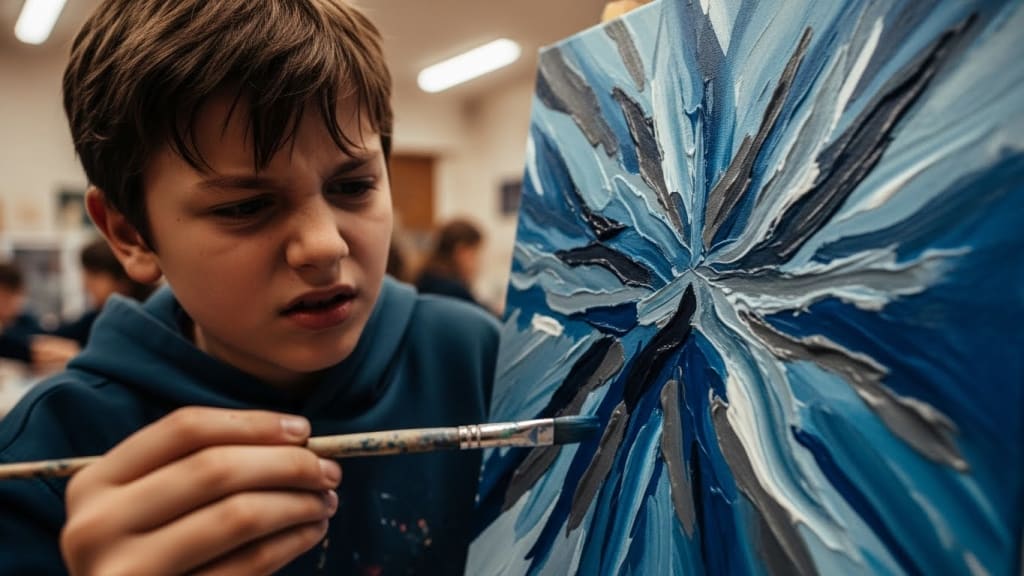
Leo hunched over the art table, a small fortress of solitude built around his straining shoulders. The air, thick with the scent of tempera paint and damp construction paper, usually didn't bother him. But today, the cerulean pot sat there, a menacing pool, shimmering under the fluorescent lights, just waiting. He watched the other kids dip their brushes in, flicking the blue onto construction paper oceans and skies, faces placid. Leo's stomach churned, a cold knot tightening with every splash of that particular shade.
Mrs. Albright, her voice a little sandpaper-rough from years of classroom management, appeared over his shoulder. "Leo? You haven't touched your blue. Your ocean's looking a bit... colorless, isn't it?" Her tone was patient, but a thread of expectation ran through it, thin and sharp. He felt it, always did. It felt like all the adults wanted him to see the world one way, a way that made no sense to him at all.
He pressed his lips together, tasting a phantom static, metallic and icy. He couldn't. He just couldn't. He tried to explain once, back in kindergarten, how yellow fizzed like lemon soda and red was warm, sweet like a cherry left in the sun. But blue. Blue tasted like licking a frozen battery terminal, all sour, bitter electricity and a bone-deep cold. It was a flavor that made his tongue seize, his teeth ache. No one understood. They just looked at him with that same confused pity, the one that said, *Oh, what an imagination.*
"I don't like it," he mumbled, picking at a loose thread on his sleeve. His small fingers, usually so quick with a crayon, felt clumsy, heavy. He hated the way his voice sounded, small and whiny, not at all what he heard inside his head. Inside, it was a battle, a desperate fight against the overwhelming sensation of that blue, its sharp, metallic tang already coating his mouth just from looking at it.
Mrs. Albright sighed, a puff of air that rustled his messy hair. "Leo, it's just paint. You need to finish your seascape." She nudged the brush towards him, its bristles stiff and dry. He flinched. He knew she meant well, that she thought he was being difficult. But how could he make her understand that for him, it wasn't just visual? It was a full-body experience, a jolt to his system. Painting blue was like eating something truly awful, then being told to smile and say it was delicious.
He spent the rest of art class pushing green and purple around, trying to make an abstract, stormy sea that hinted at the blue without actually using it. His grade for the 'seascapes' unit wasn't great. Mrs. Albright sent a note home. Leo's mom, bless her heart, tried to talk to him, but her concern felt like another wall between them, another person trying to fix something that wasn't broken, just different.
A few days later, during silent reading, Mrs. Albright called him over to her desk. His heart did a quick, anxious thump. Was she going to scold him again? She didn't look mad, though. Just... tired, maybe. She pushed a printout across the desk. It was an article, he saw, about something called 'synesthesia.' He squinted at the big words, trying to make sense of them. "Some people," she said softly, "experience senses in a different way. They might hear colors, or taste sounds."
He looked up at her, a flicker of something he hadn't felt in a long time—hope—igniting in his chest. "You mean... like... blue tastes bad?" he whispered, the words tumbling out before he could catch them. Mrs. Albright nodded, a slow, gentle movement. "It's possible, Leo. Can you tell me what yellow tastes like?"
A rush of relief, warm and bright like the sun, flooded through him. "Yellow's fizzy! Like a lollipop, but if it was made of light." He talked about the sweet crunch of red, the earthy green of moss and damp soil. He talked and talked, about the sharp, piercing white, the smooth, dark purple, and the heavy, dusty brown. He even tried to describe the bitter, metallic tang of blue again, but it was still hard. The words just fell short, clunky things compared to the actual sensation.
Mrs. Albright listened, really listened, her head tilted, a furrow in her brow that wasn't frustration, but concentration. "Okay," she said, after he finished, a long quiet settling between them. "Tomorrow, in art. No seascapes. No expectations of what a sky should look like. I just want you to paint the taste of blue. Any blue. All the blues. Paint it how it feels on your tongue, in your stomach. Paint the taste."
The next day, Leo stood before a fresh canvas, a small collection of blue paints – sky blue, navy, sapphire, indigo – laid out on his palette. His hand shook a little as he picked up the brush. It still felt wrong, the color staring back at him, challenging him. But this time, it was different. Mrs. Albright was across the room, watching, but not judging. She wasn't telling him what to do, just giving him permission to feel, to translate. He dipped the brush into the deep navy, a particularly icy shade.
He closed his eyes for a moment, letting the metallic chill wash over him. He started with sharp, jagged lines, a dark, angry cobalt in the middle, then streaked outwards with lighter, colder blues, like static electricity sparking off a frozen surface. He added thin, almost invisible strokes of gray, to mimic the dull, dead weight that settled in his gut. It wasn't a pretty painting. It wasn't a sky or an ocean. It was a jumble of lines and blotches, cold and sharp and unsettling. It was the taste.
When he stepped back, the bristles of his brush still cold and damp, Mrs. Albright came over. She looked at the canvas, then at Leo, then back at the painting. She didn't say it was good. She didn't say it was bad. She just looked, a quiet understanding dawning in her eyes. It was still there, the sour cold. But for the first time, it was out, for someone else to see, even if they couldn't taste it.
He ran his thumb over the edge of his palette, the faint scent of paint clinging to his skin, and the phantom metallic taste lingered, not as strong now, but present. Like a memory, finally given a shape.
About the Creator
HAADI
Dark Side Of Our Society
Cutting for Impact: How Film Editing Shapes Powerful Stories Behind the Scenes
When audiences watch a great film, they rarely think about the countless decisions made in the editing room. Performances feel seamless, scenes flow naturally, and emotions rise at precisely the right moments. Yet behind this smooth experience lies a complex creative process. Film editing is often called the invisible art because, when done well, it goes unnoticed. However, its influence on storytelling is profound and far-reaching.
By Nigel Sinclair3 days ago in Education
This Is What I Do When People Throw Rocks At Me
Rocks have been thrown at me for a greater part of my life. Some have been small and missed hitting me. When people don't get a reaction from me, they throw bigger rocks with a better aim. Many have been hurled at me with precision over the years. For a long time, I thought my only options were to dodge them or be crushed by them.
By Margaret Minnicks6 days ago in Confessions


Comments
There are no comments for this story
Be the first to respond and start the conversation.