

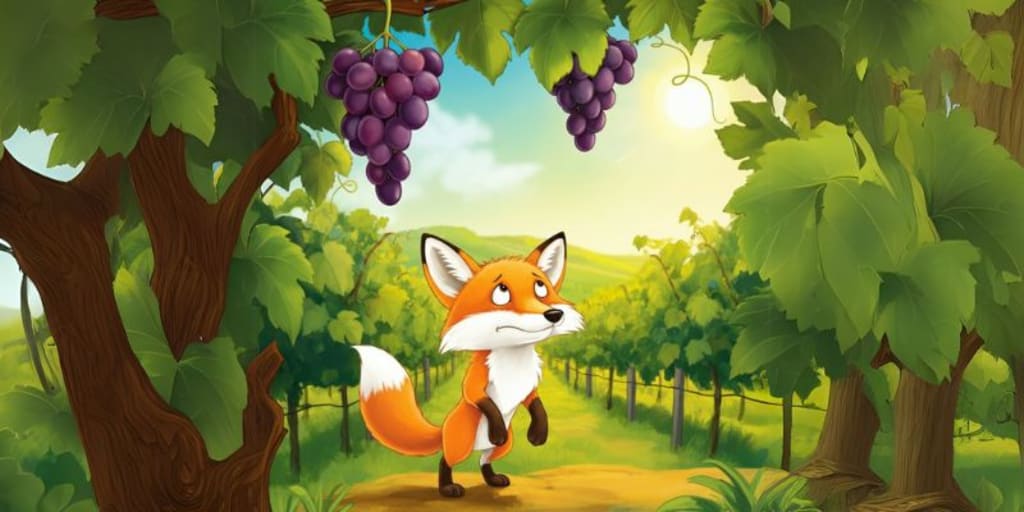
The Fox and the Grapes
On a warm summer afternoon, in the heart of a lush green forest, a fox wandered alone, his paws dusty from walking and his tongue dry with thirst. The sun was high, casting golden rays through the trees, and the forest buzzed with the sounds of birds and insects. But for the fox, there was only one thing on his mind — food.
It had been a long day, and he had yet to catch anything. Rabbits were too fast, birds too high, and even the lazy lizard he spotted earlier had slipped away under a rock. As he trudged along a narrow path lined with wildflowers and tall grass, something suddenly caught his eye — a vineyard.
The vineyard stood behind an old wooden fence, its posts leaning in various directions, and the vines within were heavy with ripe, plump grapes. The fruit hung in thick bunches, their purple skins glistening in the sunlight. The sight stopped the fox in his tracks. His eyes widened, and his empty stomach growled louder than ever.
He licked his lips. “Ah, now that’s a treat,” he muttered. “Those grapes look delicious.”
He glanced around. There was no farmer in sight, no dog barking, no bird warning. It was the perfect opportunity. He trotted closer, tail twitching with excitement.
But there was one problem.
The grapes were hanging from a high trellis — far too high for the fox to reach. Undeterred, he backed up a few steps, then ran forward and leapt.
His paws slapped the air. He landed awkwardly on the grass, the grapes still untouched.
“Hmm,” he said, brushing off his fur. “That was just a warm-up.”
He tried again — this time jumping from a small rock nearby. He stretched his body as far as it could go, claws grasping at nothing. He missed again.
Again and again, he tried. He climbed a nearby tree stump and launched himself. He stood on his hind legs and hopped. He even stacked a few fallen branches to get a bit of height. But nothing worked. The grapes were always just out of reach.
Finally, exhausted and panting, the fox flopped down beneath the trellis, eyes squinting up at the forbidden fruit. His tongue lolled out of his mouth. His sides rose and fell with each heavy breath.
He stared at the grapes.
And then he frowned.
“What’s the big deal with those grapes, anyway?” he said aloud, his voice sharp. “They probably aren’t even ripe. I bet they’re sour. That’s right — sour and bitter. Not worth eating at all.”
He stood up, tail flicking with frustration, and turned away from the vineyard. “I didn’t want them anyway,” he added with a huff. “Let the birds have them. I’m too clever to waste my time on sour grapes.”
And with that, the fox trotted off into the forest, his pride intact but his stomach still empty.
Behind him, the grapes swayed gently in the breeze, untouched and perfectly sweet.
---
Moral of the Story:
It’s easy to despise what you can’t have.
Expanded Message:
This simple tale of the fox and the grapes teaches a powerful lesson that applies even in our modern lives. Often, when we are unable to get something we desire — whether it’s a goal, an object, or even a relationship — we tend to convince ourselves it wasn’t worth it in the first place. This defense mechanism protects our ego but can also prevent us from acknowledging our limitations or working harder to improve.
The fox in the story had the desire, but not the means — and rather than accept that, he chose to change his perspective and diminish the value of what he couldn’t attain. This is known as "cognitive dissonance", a term used in psychology to describe the discomfort we feel when our beliefs and actions are in conflict. Instead of facing the truth, we often adjust our beliefs to reduce that discomfort.
But what if the fox had asked for help? What if he had waited for a better opportunity or come back with a new plan? The story also serves as a reminder not to give up too easily or to let pride cloud our judgment. It’s okay to fail — but there’s always another way to reach your goal if you’re willing to try again.
So next time you feel like something is out of reach, don’t turn away and call it "sour grapes." Reflect, regroup, and try again — because some of the best things in life are worth reaching for.
About the Creator
Karen Solie’s Wellwater Wins the TS Eliot Poetry Prize: A Quiet Triumph of Modern Verse
In a literary world often dominated by loud headlines and fast-moving trends, poetry still finds ways to stop time. That pause arrived powerfully with the announcement that Karen Solie’s poetry collection Wellwater has won the TS Eliot Poetry Prize, one of the most prestigious honors in contemporary poetry. The award is not only a personal milestone for Solie but also a reminder of poetry’s enduring ability to explore the human condition with depth, restraint, and emotional clarity. A Prize That Shapes the Poetry World The TS Eliot Poetry Prize, awarded annually in the United Kingdom, is considered one of the highest accolades a poet can receive. It recognizes the best new poetry collection published in the UK or Ireland, often setting the tone for literary discussions in the year ahead. Past winners have included some of the most influential poetic voices of modern times, making Solie’s victory a significant cultural moment. What sets this prize apart is its emphasis on craft, originality, and emotional intelligence—qualities that Wellwater embodies fully. Who Is Karen Solie? Karen Solie is a Canadian poet known for her sharp intellect, grounded observations, and emotionally resonant language. Over the years, she has earned respect for writing poetry that feels both deeply personal and socially aware. Her work often navigates themes such as place, memory, climate anxiety, labor, aging, and quiet resilience, avoiding grand statements in favor of carefully observed truths. Solie’s poetry does not shout; it listens. That listening quality is precisely what makes Wellwater stand out. Inside Wellwater: Poetry of Depth and Reflection Wellwater is a collection that moves deliberately, inviting readers to slow down and pay attention. The title itself suggests hidden depths—water drawn from below the surface, shaped by time and pressure. This metaphor runs throughout the collection, as Solie explores lives shaped by unseen forces: economic uncertainty, environmental change, personal history, and emotional endurance. The poems are rooted in everyday experiences, yet they carry philosophical weight. Solie writes about landscapes both natural and human-made, finding meaning in small moments: a shift in weather, a conversation overheard, a memory resurfacing unexpectedly. Her language is precise but never cold, intellectual without being inaccessible. Why Wellwater Resonated With Judges The TS Eliot Prize judges praised Wellwater for its quiet authority and emotional honesty. In a time when many works aim for immediacy or spectacle, Solie’s collection was recognized for its patience and depth. The poems do not rush toward conclusions; instead, they allow complexity to remain unresolved, mirroring real life. This approach reflects a broader shift in contemporary poetry, where subtlety and reflection are gaining renewed appreciation. Solie’s work demonstrates that poetry can be powerful without being performative, political without being loud, and personal without being confessional. Poetry in a Restless World The success of Wellwater also speaks to the role of poetry in today’s fast-paced, digitally saturated culture. As attention spans shrink, poetry offers a counterbalance—a space where readers can slow down, sit with uncertainty, and engage with language thoughtfully. Solie’s poems address modern anxieties without sensationalism. Climate change, economic instability, and emotional fatigue are present, but they are woven into lived experience rather than treated as abstract concepts. This grounding makes Wellwater especially relevant to contemporary readers seeking meaning rather than noise. What This Win Means for Contemporary Poetry Karen Solie’s TS Eliot Prize win reinforces the idea that poetry still matters, even—perhaps especially—in uncertain times. It highlights the value of work that prioritizes depth over trendiness and reflection over reaction. For emerging poets, Solie’s success is encouraging. It suggests that careful craftsmanship, intellectual honesty, and emotional restraint can still find recognition in a competitive literary landscape. For readers, Wellwater offers an invitation: to read slowly, to think deeply, and to reconnect with the quieter aspects of being human. A Lasting Literary Moment Karen Solie’s Wellwater winning the TS Eliot Poetry Prize is more than an award announcement—it is a celebration of poetry’s ability to endure, adapt, and illuminate. In drawing from the deep wells of observation and experience, Solie has created a collection that will likely be read and discussed for years to come. In an age hungry for instant answers, Wellwater reminds us that some truths are best discovered slowly.
By Fiaz Ahmed Brohi4 days ago in Education




Comments
There are no comments for this story
Be the first to respond and start the conversation.