
The Evolution of Digital Marketing: From SEO to AI-Driven Campaigns
From Keywords to AI: The Future of Marketing is Now

Introduction: The Digital Marketing Revolution
Digital marketing has undergone a seismic transformation over the past two decades. What began as simple search engine optimization (SEO) tactics has evolved into a sophisticated, AI-driven ecosystem where data, automation, and predictive analytics dominate. Businesses that once relied on keyword stuffing and manual ad placements now harness artificial intelligence (AI) to personalize customer experiences, optimize ad spend, and predict consumer behavior with unprecedented accuracy.
How Digital Marketing Evolved: From Basic SEO to AI Domination
1. The Age of SEO (1990s–Early 2000s)
Keyword-Centric Strategies: Early digital marketing relied heavily on keyword optimization, meta tags, and backlinks.
Google’s Algorithm Updates: The introduction of PageRank (1998) and later Panda (2011) and Penguin (2012) forced marketers to prioritize quality content over manipulation.
Limitations: SEO was slow, reactive, and lacked personalization.
2. The Rise of Social Media & Content Marketing (Mid-2000s–2010s)
Facebook, Twitter, and YouTube shifted focus from search engines to social engagement.
Content Marketing emerged as brands realized storytelling and value-driven content outperformed pure SEO.
Paid Advertising (PPC & Social Ads) allowed precise audience targeting but required manual optimization.
3. The Data & Automation Boom (2010s–2020)
Programmatic Advertising automated ad buying, using real-time bidding (RTB) to place ads efficiently.
Marketing Automation Tools (HubSpot, Marketo) streamlined email campaigns, lead nurturing, and CRM integration.
Big Data Analytics enabled hyper-targeting based on user behavior, demographics, and purchase history.
4. The AI Revolution (2020–Present)
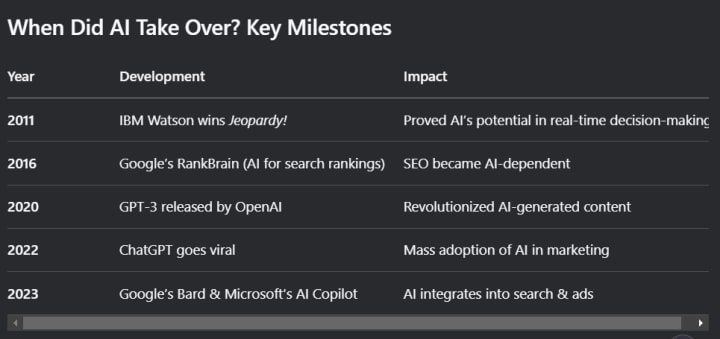
AI-Powered Personalization: Tools like ChatGPT, Jasper, and Persado generate dynamic content tailored to individual users.
Predictive Analytics: AI forecasts customer behavior, optimizing ad spend before clicks even happen.
Voice & Visual Search: AI-driven assistants (Siri, Alexa) and image recognition (Google Lens) reshape SEO strategies.
Generative AI in Advertising: Platforms like Google Performance Max & Meta Advantage+ automate creative ad generation.
Why AI is Dominating Digital Marketing
1. Unmatched Efficiency & Cost Savings
AI automates repetitive tasks (A/B testing, bid adjustments, content generation), reducing labor costs.
Example: Programmatic AI reduces wasted ad spend by targeting only high-intent users.
2. Hyper-Personalization at Scale
AI analyzes behavioral data to deliver individualized recommendations (Netflix, Amazon).
Dynamic Email Marketing: AI adjusts subject lines, send times, and content based on user engagement patterns.
3. Predictive & Real-Time Decision Making
AI predicts customer churn, lifetime value (LTV), and conversion likelihood before manual analysts can.
Example: AI-powered chatbots (Drift, Intercom) engage leads 24/7 with human-like interactions.
4. Enhanced Creativity & Content Production
Generative AI (DALL·E, Midjourney, GPT-4) creates ad copy, visuals, and video scripts in seconds.
AI Video Tools (Synthesia, Pictory) automate video marketing without actors or studios.
Future Goals: Where AI-Driven Marketing is Headed
1. Fully Autonomous Campaigns
AI will soon self-optimize entire marketing funnels with minimal human input.
Example: AI could auto-generate landing pages, ads, and emails while adjusting budgets in real time.
2. Emotion & Sentiment AI
Tools will analyze facial expressions, voice tones, and biometric data to gauge emotional responses.
Example: AI could alter ad creatives mid-campaign based on user mood detection.
3. AI-Generated Virtual Influencers
Virtual personas (like Lil Miquela) will dominate influencer marketing, reducing reliance on human talent.
4. Blockchain + AI for Transparent Advertising
Combating ad fraud with AI-powered blockchain verification to ensure genuine engagement.
5. The Death of Traditional SEO?
As AI answers queries directly (Google’s SGE), marketers must pivot to zero-click content strategies.
Conclusion: Adapt or Get Left Behind
The shift from SEO to AI-driven marketing is irreversible. Businesses that fail to integrate AI risk losing competitive edge in targeting, personalization, and efficiency. The future belongs to marketers who leverage AI + human creativity—blending data-driven automation with strategic storytelling.
FAQ: The Future of AI in Digital Marketing
Q1: Will AI replace digital marketers?
A: No—AI enhances marketers by automating repetitive tasks, but strategy, creativity, and ethics still require human oversight.
Q2: How can small businesses use AI marketing affordably?
A: Tools like ChatGPT (free), Canva AI, and HubSpot’s AI features offer low-cost automation for SMBs.
Q3: Is SEO still important in the AI era?
A: Yes, but it’s evolving. E-E-A-T (Experience, Expertise, Authority, Trustworthiness) matters more than ever as AI rewards high-quality content.
Q4: What’s the biggest risk of AI in marketing?
A: Over-reliance on automation can lead to generic messaging—brands must balance AI efficiency with authentic engagement.
Q5: Which AI tools are best for digital marketers?
A: Top picks:
Content: ChatGPT, Jasper
Ads: Google Performance Max, Meta Advantage+
Analytics: Adobe Sensei, IBM Watson
SEO: SurferSEO, Frase
Q6: How will AI change social media marketing?
A: Expect AI-curated feeds, auto-generated posts, and AI-driven influencer partnerships to dominate.
Final Thought
The evolution from SEO to AI-driven campaigns marks the most significant shift in digital marketing history. The winners will be those who adapt fast, experiment boldly, and merge AI’s power with human ingenuity.
About the Creator
Jacky Kapadia
Driven by a passion for digital innovation, I am a social media influencer & digital marketer with a talent for simplifying the complexities of the digital world. Let’s connect & explore the future together—follow me on LinkedIn And Medium
Keep reading
More stories from Jacky Kapadia and writers in Education and other communities.
Next-Gen Jet Engine Breakthrough: Direct Electricity To Thrust Conversion Revolutionizes Flight
For over a century, jet engines have relied on burning fossil fuels to generate thrust, powering humanity’s ability to traverse continents and oceans. But this dependency has come at a steep cost: aviation accounts for 2.5% of global CO₂ emissions and contributes to noise pollution, air quality degradation, and geopolitical tensions over oil resources. Enter the next-generation jet engine—a groundbreaking innovation that converts electricity directly into thrust, bypassing combustion entirely. This technology promises to rewrite the rules of aviation, offering a cleaner, quieter, and more efficient future. Here’s how it works, why it matters, and what it means for the planet.
By Jacky Kapadia11 months ago in Education
Why the Sun Will Become a Red Giant: The Future of Our Solar System Explained
Every morning, the Sun rises as it has for billions of years, bathing Earth in light and warmth. To us, it feels permanent and unchanging. Yet in the vast timeline of the universe, the Sun is only halfway through its life.
By shahkar jalala day ago in Education
Purpose Driven Leadership: How Corporate Success Is Fueling Social Change
Business leaders are often recognized for their ability to build organizations, create economic growth, and guide companies through competitive markets. Yet in recent years, a growing number of executives and entrepreneurs have chosen to extend their influence beyond corporate success. Many are investing their time, expertise, and resources into philanthropic efforts that address social challenges and strengthen communities. This evolution reflects a broader understanding that leadership carries responsibilities not only to shareholders but also to society.
By John Olin Killgore7 days ago in Education



Comments
There are no comments for this story
Be the first to respond and start the conversation.