
The Egyptian Symbol of Ankh Meaning
The Egyptian symbol of Ankh meaning “life” in hieroglyph, is one of the most frequently used symbols in ancient Egyptian iconography. The Egyptian Cross, also known as the Ankh Cross (because of the oval-shaped top, ring, handle, or ring) or the key to life, represents eternal life and rebirth.
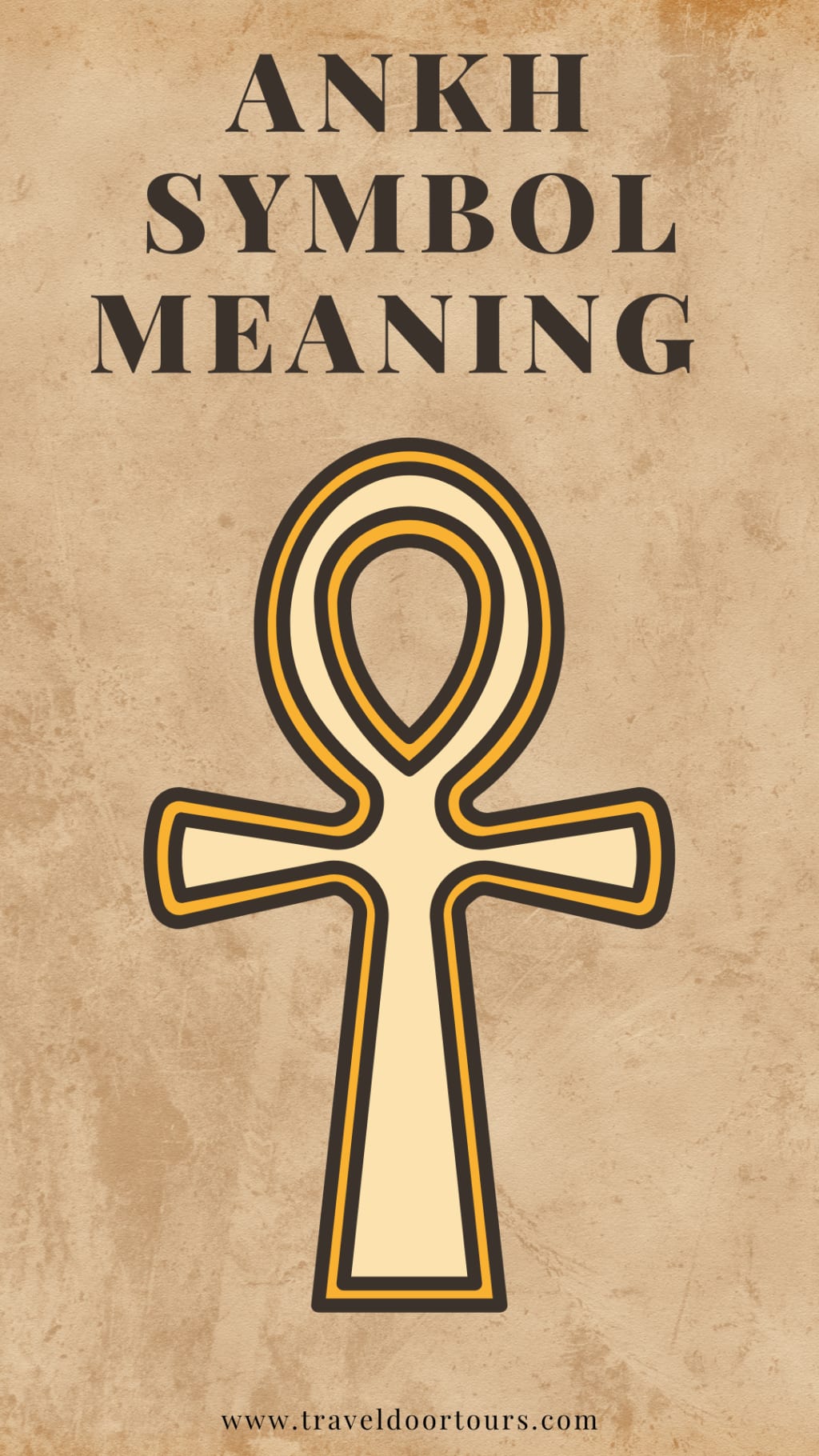
The Egyptians believed life on earth was only part of eternal life, with the symbol of Ankh meaning earthly life and the afterlife. Its significance was such that many of the deities of the Egyptian gods (whose main attribute was immortality) were represented with this cross in their hands or chests.
In the ancient Egyptian kingdom, only the pharaoh was worthy of wearing it. Still, already in the New Ancient Egyptian kingdom, it was a sign that all Egyptians could use to avoid curses and witchcraft and was displayed on the lips of the pharaoh as a symbol of the self or breath of life. It was even used as an amulet for the dead. Mummies were found to contain this key of life in their wrappings to protect the deceased’s soul from the dangers he had to overcome during his journey to the underworld and access to eternal life.
Explore more of the ancient Egyptian secrets with Travel Door Tours. Book now one of our All-Inclusive Egypt Vacation Packages and enjoy the trip of a lifetime in the land of the Pharaohs with our professional tour guides and the best deals ever!
The symbol of Ankh was so powerful and long-lived in Egyptian culture (dating back to the early dynastic period of Egypt, circa 3150 – 2613 BC) that it was not surprising that they included it in Christian doctrine in the fourth century. CE as a symbol of their god.
The origin of the ankh symbol is unknown. Still, Egyptologist E.A. Wallis Budge claims that it may have evolved from the tjet, the “Isis knot,” a similar collateral symbol associated with the goddess. In early Egyptian history, female deities were equally shared and considered more powerful (as in the example of the goddess Neith). Ankh may have evolved from tjet, but this theory is only sometimes accepted.
However, the Egyptian Symbol of Ankh was often associated with the cult of Isis, and as its popularity increased, so did the symbol. Many different deities are depicted holding an ankh. It appears, along with the ancestor symbol, on nearly every type of Egyptian art, from coffins to tomb paintings, palace ornaments, statues, and reliefs. As an amulet, the Ankh symbol was almost as famous as the scarab beetle and the ancestor.
What does the Egyptian Symbol of Ankh Meaning?
The Egyptian symbol of Ankh meaning needs to be made clear by the symbol’s origin, and that’s why it’s essential to look at the etymological origin of this term, which explains every part of the word. So “ankh” means “life,” and any other meaning beyond that is already part of the symbolism of the Ansata cross.
The Ankh Symbol Meaning in Egyptian Culture
The Ankh Symbol in Ancient Egypt.
In the Egyptian hieroglyphic system, the Ankh meaning stands for the set of three consonants: Ꜥ-n-ḫ. This string of consonants appears in different words in the ancient Egyptian language. “life” is the most critical word in ancient Egyptian that uses these three consonants. This string of letters is also used to name a mirror or a bunch of flowers. Even though this hieroglyph is very important in Egyptian writing, experts still need to agree on where it came from.
Egyptian hieroglyphs always showed something that existed in the real world, like a fish, horse, bird, etc. No one can agree on what this hieroglyph was trying to show, and some experts say this hieroglyph was an essential knot in ancient Egyptian culture. The oldest versions of this hieroglyph have arms of different lengths.
Other ideas say this hieroglyph could have been a sandal strap, a mirror, or a combination of male and female sexual characteristics. The Ankh symbol is often a sign of life in Egyptian art. So, it is common to see Egyptian gods holding an Ankh symbol by their upper handles. This meant that the gods were in charge of life.
It was also expected to show a god holding a cross symbol near the mouth or nose of another god or a pharaoh. This scene showed how the gods could give life to the pharaohs and ensure they would live forever.
One of the deities often depicted carrying this cross is the goddess Hathor. In Egyptian mythology, the goddess Hathor played an important role. Hathor was considered the mother of the god Horus and the god Ra, which made her associated with the feminine aspects of the god Ra. Some of her major roles have been associated with joy, dance, music, and sex.
You may also be interested to know more about the Temple of Hathor at the Dendera Temple complex.
Atum and Sejmet were usually represented by holding ankhs, and Atum was considered the first god capable of creating himself. For her part, Sejmet was considered the goddess of war, and her representation with the ankh represented the protection she provided to the pharaohs during the war.
The ankh symbol was preserved during the Christianization of Egypt from the fourth century AD. In this new context, the symbol became known as crux ansata due to its cross-shaped shape with a handle. The origin of the Ansata’s essence within Christianity was also influenced by another of its most important symbols, the stereogram. This symbol is formed from the letters Tau I Ro, short for stauros, which in Greek means cross.
As a symbol, the Ansata cross has also had great significance within the Coptic Orthodox Church. It is also likely that the Celtic and Armenian cross were motifs initially inspired by the Ansata cross.
Let’s understand what else the Ankh meaning can represent besides “life.” The central symbolism of Ankh is immortality. In this concept, the oldest cross can also be seen as a symbol of life, death, and resurrection. But there is another interpretation of the Ansata cross. In Egypt, she was associated with the deities Atum and Ra, who are directly related to the Sun. Today, this symbolism has morphed, and many people use the Ankh to represent sunrise.
Other gods associated with the symbol were Osiris and Ma’at, who were part of the myth of the final judgment, which would lead a person to the afterlife. The deities related to the Ansata cross are linked to life, death, and resurrection, reinforcing the object’s symbolism.
A final interpretation of the Ankh states that it represents the duality between male and female, represented by the loop at the top of the cross. This kind of strap is believed to unite two opposite sides, such as man and woman, through fertility. However, the ankh symbolism has another aspect making it so popular today. It is believed that when this symbol is used in an environment or on a person’s skin, it confers the protection of the Egyptian gods.
It would be better if you imagined using it to get eternal life or protect yourself from harm. Depending on your beliefs, this could happen. The Ansata cross can be used as a talisman if you want protection in the afterlife or to ensure a peaceful life even after your death on another plane of existence. You can add it to a necklace, bracelet, or earrings. This same user is also perfect for those who want to ward off negative vibrations. However, if you’ll always have more effective protection with you, a tattoo with this symbol is the best option, plus it lasts forever. Another important use of the Egyptian ankh symbol is to gain intimacy with another person, not only on a physical level but also on an emotional level. You can put this symbol in your bedroom or use it inside your wallet on a date.
The Ankh and the Goddess Isis
Many of the gods of Egypt are depicted holding the Ankh symbol. Still, Isis more often than most, so this cross became widespread in Egypt during the Archaic Dynastic Period with the rise of the cults of this powerful magician, wife of Osiris, the god of the dead, and mother of Horus.
She is considered the first great sorceress of all time. She is strongly linked to this symbol because she was the one who brought Osiris, her brother, and husband, back to life. With her magical knowledge, she managed to resurrect her husband and protect little Horus from the murderer of his father, the god Set.
There are Several Theories About Her Form:
The ribbon of the upper part is associated with feminine energy and the mother goddess Isis, and the lower part is related to male power and the god Osiris. Some attribute the shape of the lower part of the cross to the male reproductive system (associated with the god Osiris) and the upper part to the woman’s uterus.
It is said that it represents the air and water as essential elements to give life—the union of heaven and earth.
Also, the Sun’s death by the night’s arrival and its rebirth and formed, starting from the top, by a circle or oval, a symbol of that which has no beginning and no end and represents the celestial world, the spirit of Ra, the Sun for the Egyptians.
This circle also serves as the key’s handle, from which the gods and the pharaohs who carry it take it. This circle rests on a horizontal line that symbolizes the earth, resembling when the Sun sets on the horizon. This association with the Sun means that the Ankh is traditionally drawn in gold – the color of the Sun – and never in silver, which is associated with the moon.
In the modern Western culture of the 20th century, the Egyptian cross meaning appeared as a symbol and was often used in tattoos and jewelry designs. In this sense, it has mainly been used as a vitality and immortality symbol. The Egyptian symbol of Ankh has been significant in some of the current subcultural movements. Among them is the Gothic movement. It was also the main symbol of Egyptian Kemiteism or Neopaganism, a modern religion based on the practices of ancient Egyptian mythology. Now that you know about the Egyptian Ankh symbol, you know how to use it in Egyptian culture. Whoever you are, your faith symbol can bring you more energy and willpower in any situation in life.
About the Creator
Keep reading
More stories from writers in Education and other communities.
Role of Technology in Modern Islamic Education
Islamic education has always been a cornerstone of Muslim life, guiding children and adults alike in spiritual, moral, and academic growth. Traditionally, learning took place in mosques, madrasas, or homes with direct guidance from teachers.
By Arslan Shahbaz6 days ago in Education
Quiet Power and the Role of Privacy Architecture in the World’s Most Expensive Homes
Invisible fortresses now define the highest level of residential luxury. In the world’s most expensive homes, owners no longer seek attention or display. They seek control, calm, and protection. Privacy architecture makes this possible. It shapes homes that guard personal life without appearing closed or aggressive.
By Inspirata Group2 days ago in Education
One Hard Thing
Stop me if you’ve heard this one before: You have the number, you know your schedule- you’ve even picked out the perfect day and time to make this appointment. Shoot, you’ve even picked out alternative days and times just in case their schedules can’t accommodate you!
By Taylor Rigsby2 days ago in Motivation


Comments