
The Day Science Stopped Light: How Physicists Captured and Restarted the Fastest Thing in the Universe
How physicists froze a beam of light inside an ultracold cloud of atoms — and then brought it back to life, opening the door to quantum memories and the future of light-based technology
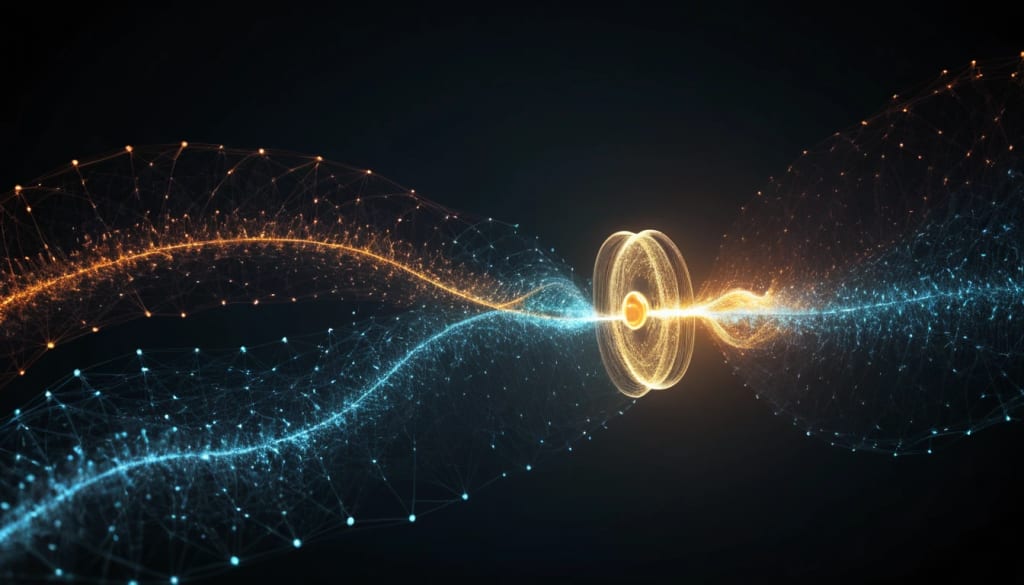
For over a century, light was believed to be the ultimate speed limit of the universe — nothing, not even information itself, could travel faster than 299,792 kilometers per second. But in a quiet laboratory in Massachusetts in 1999, scientists achieved what once seemed impossible: they stopped light completely. And a few years later, they learned how to bring it back to life — to release it again, as if pressing play on the universe’s fastest signal.
This revolutionary feat didn’t defy Einstein’s theory of relativity. Instead, it used quantum mechanics to tame the very behavior of light.
The Experiment That Stopped Light
The first successful “stopping” of light was performed by Lene Hau, a Danish physicist at Harvard University. Her team used a strange state of matter called a Bose–Einstein condensate (BEC) — a form of gas cooled to just billionths of a degree above absolute zero. At such an extreme temperature, atoms lose their individuality and behave as one giant quantum entity, moving in perfect synchrony.
Hau’s group shined a laser beam through this ultracold cloud of sodium atoms while using another laser to manipulate how the atoms absorbed and released light. By carefully adjusting the control laser, they could make the cloud slow the light down — from its usual cosmic speed to just a few meters per second. Then, with another precise adjustment, they could bring it to a complete stop.
The light pulse didn’t vanish — its information (phase, amplitude, and polarization) became imprinted in the atomic cloud itself, like a memory frozen in time.
Restarting the Light
Astonishingly, the team found that by switching the control laser back on, they could release the stored light pulse, allowing it to continue traveling as though nothing had happened. The light resumed its journey exactly where it left off, carrying the same quantum information it had before being halted.
In essence, the atoms acted as a kind of quantum storage medium — a temporary home for light. The process could even be repeated, with the same pulse being stopped and restarted multiple times.
Later experiments, such as those at the Australian National University and in Germany, refined this technique, managing to store light for longer durations and even transfer it between two separate clouds of atoms — a crucial step toward quantum communication.
Why Stopping Light Matters
Stopping and restarting light isn’t just a scientific curiosity — it’s a cornerstone of quantum information technology. If light can be trapped, stored, and released at will, it could revolutionize how we process and transmit data.
Quantum Memory: Stopped light can serve as a memory bank for quantum computers, storing quantum bits (qubits) that travel as photons.
Secure Communication: Light storage enables ultra-secure information transfer using quantum encryption, where any attempt to intercept the message destroys it.
Slow-Light Devices: Controlling light speed could lead to more efficient optical networks, where signals are delayed, synchronized, or rerouted without converting to electricity.
The concept also reshapes our philosophical view of time and motion. For a brief instant, the fastest entity in the universe can be frozen — and then awakened, carrying with it the memory of its own journey.
From Frozen Light to the Future
Today, researchers are extending these principles beyond gases to solid-state materials and photonic crystals, aiming for practical “light-based memory chips.” While the idea of holding a beam of light in your hand still belongs to science fiction, laboratories around the world are inching closer to controlling photons with the same precision once reserved for electrons.
By stopping and restarting light, humanity has achieved a symbolic triumph: mastering the flow of information itself. The ability to capture and revive light doesn’t just slow down a beam — it illuminates a new era in physics, where speed, time, and information can be sculpted at will.
About the Creator
Creating a Calm and Confident Path Toward Retirement
Retirement planning often feels intimidating, especially when people imagine complex calculations and uncertain outcomes. However, when you approach the process with clarity and patience, it becomes far more manageable. Instead of focusing on stress, thoughtful planning helps you feel confident about the future you are building.
By Michael Petruska5 days ago in Education




Comments
There are no comments for this story
Be the first to respond and start the conversation.