
"The Day I Taught My Mother to Read: Breaking Generational Barriers through Education"
A heartwarming story of love, literacy, and the power of breaking cycles through one small act of learning.

The Day I Taught My Mother to Read: Breaking Generational Barriers through Education
A heartwarming story of love, literacy, and the power of breaking cycles through one small act of learning.
She always carried a quiet strength in her eyes.
A strength built not from schooling, but from survival.
My mother was never taught to read.
Not because she wasn’t smart.
But because the village said, "Girls don’t need school."
She learned to cook at 7.
She was married at 16.
She gave birth to me at 18.
And all those years, she hid her illiteracy behind smiles, memory, and instinct.
She could make the softest roti with her eyes closed, but she couldn’t read the label on the wheat bag.
She could sing lullabies by heart, but couldn’t read my report card.
As a child, I never noticed it much.
But as I grew older, I started seeing the gaps.
I saw her struggling with bus signs, unable to fill a form at the clinic, or silently passing me the phone when an English message popped up.
At first, I felt embarrassed.
Then I felt ashamed of myself for feeling that way.
And one day, I felt something stronger: a deep urge to help her.
It was a Sunday morning.
The kitchen smelled of cardamom tea and love.
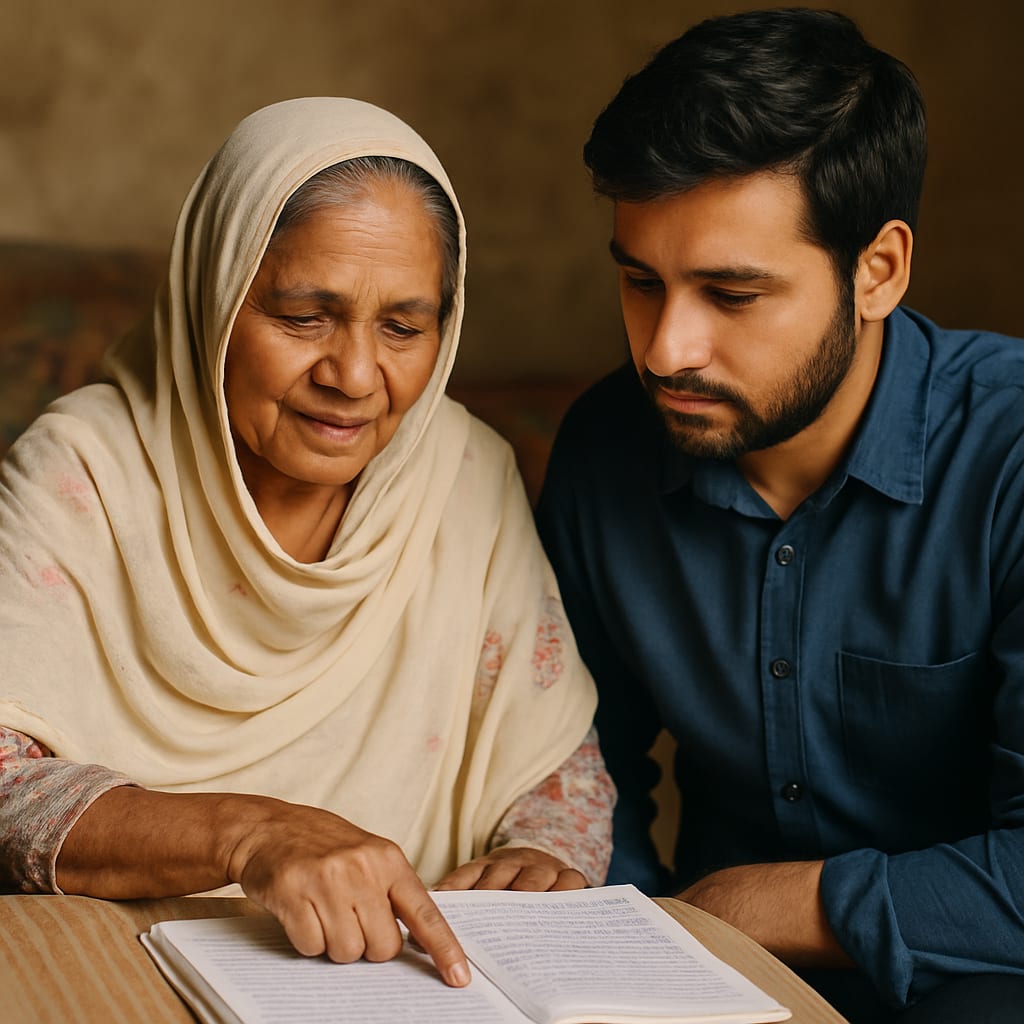
I sat next to her at the wooden table.
And I whispered, “Ammi, will you let me teach you to read?”
She paused.
Her eyes softened.
Then, without a word, she nodded.
And so, we began.
With the Urdu alphabet.
Alif.
Bay.
Pay.
We laughed when she confused jeem with chay.
We cried quietly the first time she read the word “Ammi” by herself.
I wasn’t just teaching her letters.
I was watching her reclaim something stolen.
The joy on her face when she read her own name — “Sughra” — was unlike anything I’d seen.
Each day, she’d ask me, “Aaj kaun sa lafz seekhna hai, beta?”
She started recognizing shop names.
She started texting me in short Urdu phrases.
She read the expiry dates on medicine bottles.
It wasn’t just about reading.
It was about freedom.
For the first time, she didn’t need anyone to explain things to her.
She no longer felt invisible at banks or markets.
She stood taller, smiled deeper.
Neighbors noticed.
One auntie said, “Tumhari Ammi toh bilkul school ki bachi lagti hain ab.”
Another woman asked if I could teach her too.
And just like that, a ripple began.
My mother’s courage became a catalyst.
In a small living room, lit by one bulb and hearts full of hope, four women sat every evening learning to read.
They giggled like schoolgirls when they read their first sentence.
They shared stories — of regrets, of lost letters they couldn’t read, of dreams still alive.
I realized something that year.
Education isn’t just about books or classrooms.
It’s about dignity.
It’s about choice.
And sometimes, it’s about going back to the beginning — at 45, 50, even 60 — and saying: “I deserve this.”
The day my mother read her first short story was the day I felt truly proud.
Not just of her.
But of us.
We had broken a cycle.
One where women were told their role was only in the kitchen.
One where silence was expected and ignorance accepted.
She taught me that courage isn’t loud.
Sometimes, it’s soft, like her voice sounding out a new word.
Today, she reads the newspaper every morning.
She writes down her favorite recipes.
She even corrects my spellings sometimes — with a cheeky smile.
When people ask me the most important thing I’ve ever done, I don’t mention my degree or job.
I say this:
“I taught my mother to read.”
And in doing so, we both learned how to live better.
Together.
❤️ Final Words
This story is not just about literacy.
It’s about healing.
It’s about honoring our mothers by giving back what society took from them.
If you have someone in your home who never had the chance to learn, ask them gently:
“Would you like to try now?”
You may be surprised how far one small act of love can go.
Because sometimes, the greatest revolutions begin not in protests…
…but around a kitchen table, with an open notebook and an open heart.
About the Creator
Keep reading
More stories from Abuzar Khan and writers in Education and other communities.
The Hidden Truth About Smartphone Addiction – How It’s Damaging Your Brain in 2025
Every morning, before we open our eyes fully, our hands search for one thing — the smartphone. We scroll through messages, check notifications, and dive into the screen without realizing the trap we've fallen into.
By Abuzar Khan6 months ago in Education
How Global Experiences Shape Smarter, More Creative Leaders
Leadership today demands more than experience and technical skill. It requires imagination, empathy, and the ability to see problems from new angles. One of the most potent ways leaders develop these qualities is through travel. When leaders step outside familiar routines, they gain insight that books and meetings cannot offer. Exposure to new cultures, environments, and ways of thinking shows clearly how creative leadership through travel can unlock ideas that change how leaders think, decide, and inspire others.
By Nathalie Kyriakou3 days ago in Education
Can You Really Earn Money With Transcription? The Real Income Reality
The short answer is yes—you can earn money with transcription. But the more honest, useful answer is this: transcription only becomes worthwhile when you understand how the income actually works, not how it’s often presented online.
By Mahesh Kumar4 days ago in Education
Ludacris and Nelly draw backlash over bookings at MAGA-coded music festival
Ludacris and Nelly headlining a mostly right-wing event is good for them. It’s also great for the genre of hip hop. The two rap veterans have showcased their talents on other stages. Why can’t they perform for mostly MAGA folks and grab that bag?
By Skyler Saunders4 days ago in Beat



Comments
There are no comments for this story
Be the first to respond and start the conversation.