
The Curious Mysteries of Pi: Unveiling the Enigma of the Most Famous Mathematical Constant
Pi = 3.14

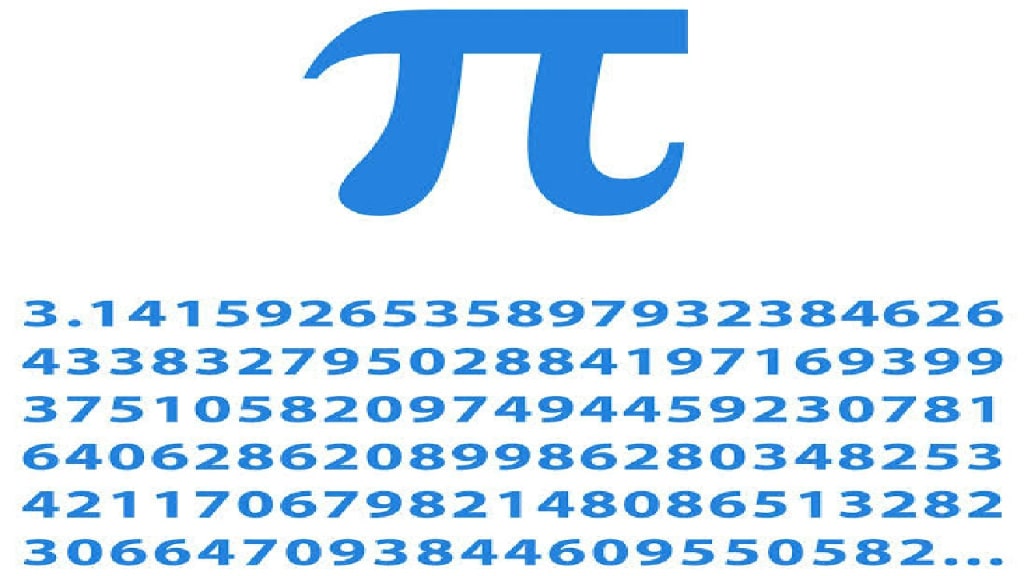
Pi: a mathematical constant.
Pi (π) is a mathematical constant that represents the ratio of a circle's circumference to its diameter. It is a non-repeating and non-terminating decimal, which means that its decimal expansion goes on forever without any pattern. Pi is an irrational number, which means that it cannot be expressed as a ratio of two integers.
The value of pi is approximately 3.14159265358979323846, but it can be calculated to an infinite number of decimal places using various mathematical formulas and algorithms. The symbol π was first used to represent this constant by the Welsh mathematician William Jones in 1706.
Pi is an essential mathematical constant that appears in many areas of mathematics, science, and engineering. It is used to calculate the area and circumference of a circle, the volume and surface area of a sphere, and the frequency and wavelength of a sine wave. It is also used in probability theory, statistics, and many other fields.
Pi has been studied for thousands of years, with some of the earliest known approximations dating back to ancient Egypt and Babylon. The Greek mathematician Archimedes is credited with developing a method for approximating pi by using inscribed and circumscribed polygons. However, it wasn't until the development of calculus in the 17th century that mathematicians were able to derive infinite series and other formulas for calculating pi to arbitrary precision.
Pi is celebrated on March 14th (3/14) every year in the United States as Pi Day. This day is a fun way to promote mathematics and to celebrate the many ways in which pi appears in our lives. Many people celebrate Pi Day by eating pie or participating in pi-related activities, such as reciting pi to as many decimal places as possible.
In conclusion, pi is an important and fascinating mathematical constant that has captured the imaginations of mathematicians, scientists, and laypeople alike for thousands of years. Its infinite decimal expansion and its ubiquitous presence in mathematics and science make it a subject of ongoing research and fascination.
Pi has some interesting properties that have been discovered and studied over the years. One of the most remarkable properties of pi is that it is a transcendental number, which means that it is not the root of any non-zero polynomial equation with rational coefficients. This implies that pi cannot be expressed as the solution of any algebraic equation, which makes it a truly unique and mysterious number.
Another interesting property of pi is that it is a mathematical constant, which means that its value is the same in all mathematical contexts. This property makes pi an essential tool for solving a wide range of mathematical problems, and it is used in many different branches of mathematics and science.
Pi is also related to many other mathematical constants and functions, including the natural logarithm, the gamma function, and the trigonometric functions. These relationships have led to the discovery of many new mathematical identities and formulas, and they continue to be an active area of research in mathematics and physics.
Despite its importance and many fascinating properties, pi remains a deeply mysterious number. Its decimal expansion is completely unpredictable and seemingly random, and it is not known whether there are any patterns or structure hidden within its digits. This mystery has inspired countless mathematicians and scientists to study pi and to search for new ways of understanding this fascinating constant.
In recent years, pi has become a subject of interest in the field of computer science and artificial intelligence. Researchers have used deep learning algorithms to calculate pi to trillions of digits, and they have discovered new patterns and properties hidden within its digits. These discoveries have opened up new avenues of research in mathematics and computer science, and they promise to shed new light on this timeless and mysterious number.
Pi also has cultural significance and has been referenced in many works of art, literature, and music. It has been featured in films, television shows, and even video games. For example, the film "Pi" by director Darren Aronofsky explores the mystical and obsessive nature of mathematics and features a protagonist who is trying to find patterns in the decimal expansion of pi.
In literature, pi has been referenced in many famous works, including the novel "Life of Pi" by Yann Martel, which tells the story of a young boy stranded on a lifeboat with a Bengal tiger. Pi is also referenced in the poem "The Love Song of J. Alfred Prufrock" by T.S. Eliot, and in the classic children's book "Sir Cumference and the Dragon of Pi" by Cindy Neuschwander.
Pi has also been used in music, particularly in the realm of experimental and avant-garde music. The composer John Cage created a piece called "Fontana Mix" that uses the digits of pi to generate musical patterns, while the composer David Cope used pi as the basis for a musical composition called "Pi Symphony."
Pi has even been referenced in popular culture, with many people memorizing its digits and participating in contests to see who can recite the most digits of pi. The current world record for reciting the most digits of pi belongs to Rajveer Meena, who recited 70,000 decimal places of pi in 2015.
In conclusion, pi is a fascinating and important mathematical constant that has captured the imagination of people for thousands of years. Its infinite decimal expansion, mysterious properties, and cultural significance make it a subject of ongoing study and fascination, and it will continue to inspire mathematicians, scientists, artists, and enthusiasts for many years to come.
About the Creator
Sikandar prasad
I am content writer specializing in creating impactful and results-driven content tailored to diverse business needs. With expertise in blog posts, articles, social media content, website copy, and product descriptions.
Keep reading
More stories from Sikandar prasad and writers in Education and other communities.
The Comfort of Arrival: Why Certain Destinations Instantly Feel Familiar
There are moments in travel that defy logic. You arrive in a place you have never visited before, step onto its streets, breathe in its air, and suddenly feel at ease. There is no adjustment period, no sense of being out of place. Instead, there is a quiet recognition, as if the destination has been waiting for you. This feeling of instant belonging is not accidental, nor is it purely romantic imagination. It is the result of emotional, cultural, psychological, and environmental factors working together to create a sense of home far from home.
By Producer James Simon7 days ago in Education
The Proven Natural Skincare Secret with Healthy Skin
Healthy skin does not come from harsh products or complicated routines. It comes from working with nature, not against it. The natural skincare secret that many people overlook is the power of raw honey as a daily skin ally. This simple ingredient has been used for generations, yet many still do not understand its effectiveness. When used correctly, raw honey can change how your skin looks and feels.
By Kelln Small7 days ago in Education


Comments
There are no comments for this story
Be the first to respond and start the conversation.