
The Clockmaker's Paradox
Time is his masterpiece—and his curse.

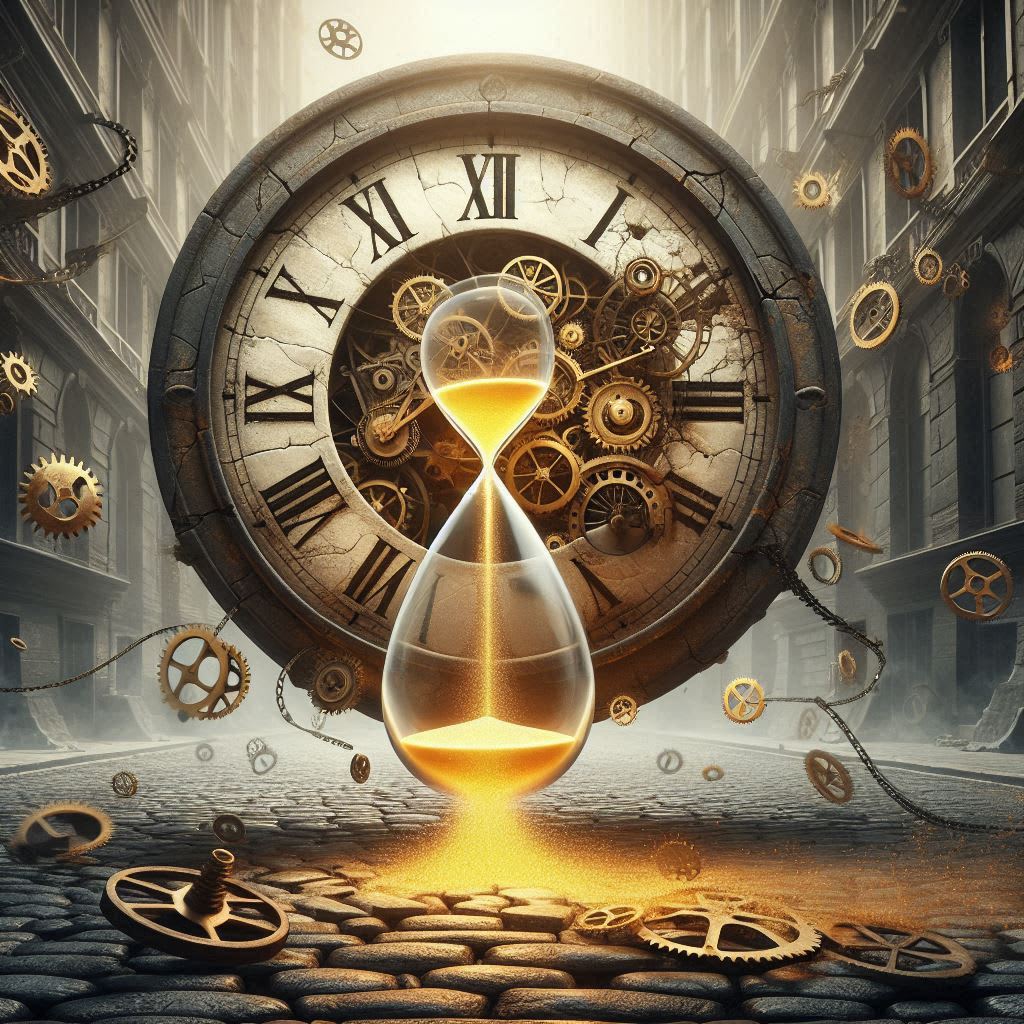
In the heart of Eldhollow, nestled between crooked cobblestone streets and ivy-choked alleyways, stood an ancient clock shop. “Virelli & Sons,” the faded sign read, though no one alive could recall a time when it had more than one occupant. Behind its dust-stained windows, the ticking never ceased—hundreds of clocks synchronized in unnatural harmony.
The townsfolk knew little of the man within. They called him “The Clockmaker,” with equal parts respect and unease. He was tall, draped in brown leathers and brass buckles, with eyes like frozen time—gray, steady, and utterly detached. They said he hadn't aged a day in fifty years.
His name was Lucien Virelli, and he had once been a genius.
Once.
Lucien had dedicated his youth to mastering chronomechanics, a rare discipline that merged engineering with arcane science. While others made watches, Lucien chased the concept of time itself—believing it could be not only measured but shaped. After decades of research, he succeeded. He built the Chronoheart, a clock unlike any other. It didn’t just mark time—it bent it.
It was a magnificent, glowing mechanism embedded in the heart of his shop. With its golden arms and ever-turning gears, the Chronoheart could reverse seconds, slow hours, even pause a moment mid-breath. But the heart came at a price.
Lucien had tested it on himself.
The day he activated the Chronoheart, he attempted to reverse time by ten minutes—to save a bird that had struck his window and died. The bird lived again. But the side effects were immediate. Lucien stopped aging. And the world around him began to fray.
Small things, at first: flowers bloomed in winter, people recalled events that hadn’t yet happened, memories faded or repeated like broken records. But soon, entire days collapsed. A man would go to sleep on Wednesday and wake up on Monday. Time bent in on itself.
Lucien, horrified, tried to dismantle the Chronoheart—but its power had entwined itself with his body, his blood, and even the town itself. He couldn’t destroy it. So he became its keeper. Its prisoner.
Fifty years passed, though none could truly say how many. In Eldhollow, time was no longer linear—it folded like parchment, and no one but Lucien knew why.
One stormy evening, a girl named Maera entered the shop. She was no older than seventeen, soaked from the rain, holding a shattered pocket watch.
Lucien looked up from his workbench. “You shouldn’t be here,” he said.
“But I am,” she replied. “And so are you.”
He frowned. There was something familiar about her—her eyes, blue like rain on glass. “What is it you want?”
“This,” she said, placing the broken watch on the counter. “It was my father's. He said you could fix anything. He said you saved his life—twice. Once in 1972. Once in 2028.”
Lucien stiffened. That was impossible.
Unless...
“Your name?” he asked.
“Maera Virelli,” she said quietly.
Lucien froze.
A tremor passed through the Chronoheart.
He turned, stunned. “You’re my—granddaughter?”
She nodded. “I’ve come to finish what you started. To fix what you broke.”
Lucien laughed bitterly. “You think you can do in one day what I’ve failed to do in fifty years?”
“I don’t need a day,” she said. “I need a choice.”
Maera reached into her coat and pulled out a device—a small, compact cube of glowing brass. A failsafe. Something Lucien himself had designed but never dared to use. It could collapse the Chronoheart—undo all of it. But at the cost of everything tied to its power.
“You’ll erase me,” Lucien whispered.
Maera stepped forward, tears in her eyes. “You’re already fading. Every tick of that machine twists you further out of time. This isn’t living.”
The Chronoheart pulsed. Lucien felt it—its defiance, its hunger to endure. But he also felt something else: warmth. Legacy. The idea that someone else could carry his story—not his curse.
He placed a hand over Maera’s. Together, they activated the failsafe.
A soft whirring began.
The Chronoheart convulsed, gears snapping, gold fracturing into light. Time reeled backward, forward, inward—all at once.
Then silence.
Eldhollow woke the next day to birdsong and the gentle tick of ordinary clocks. The world felt... right.
The shop was gone. In its place, an empty lot with wildflowers swaying in the breeze.
Only Maera remained, standing in the field with a single keepsake in her hand: a repaired pocket watch.
She wound it once.
Tick.
And walked on.
About the Creator
Keep reading
More stories from Zabeeh Ullah and writers in Education and other communities.
The Clockmaker's Paradox
In a land where time once obeyed, a silent force begins to unravel its very rhythm. In the forgotten village of Nareth Hollow, time was not merely measured — it was revered. For centuries, a great tower stood at its center, known only as the Tempus Spire. Built by the long-dead clockmaker Elian Voss, it held a mechanism unlike any other. Villagers said the clock inside it didn’t follow time — it commanded it. Rain fell when the minute hand passed twelve, crops sprouted on the third chime of dawn, and no one ever aged a day beyond their allotted span. Time, in Nareth Hollow, was exact. Perfect.
By Zabeeh Ullah10 months ago in Art
Atlas Aluminum Corp Parts Catalog: Aerospace Manufacturing, Aviation Hardware, and Industrial Aluminum Components
Introduction: My Research Into Atlas Aluminum Corp Parts Catalog While exploring aerospace hardware suppliers and industrial component manufacturers, I came across the Atlas Aluminum Corp Parts Catalog listed on the NSN platform. What fascinated me most was how manufacturers like Atlas contribute to the broader ecosystem of aerospace engineering, aviation structures, and industrial aluminum components.
By Beckett Dowhan4 days ago in Education
AI-Driven Drug Discovery: Transforming the Future of Medical Innovation
Developing new medicines has long been one of the most challenging and resource-intensive processes in the healthcare industry. The traditional drug discovery pipeline often involves years of laboratory experiments, extensive data analysis, and multiple stages of clinical trials. Despite these efforts, the majority of potential drug candidates fail before reaching the market. This high rate of failure makes drug development both costly and time-consuming, limiting the speed at which new treatments become available to patients.
By Abba Leffler4 days ago in Education
Silken Chains
Silhouettes of the female form were given flesh and bone. Silken skin glistened under the spotlight. Dry ice rose around our Icons as they danced atop their podiums in the Square. Heralded for their beauty, their movements were slight, powerful, and sensual.
By Paul Stewart6 days ago in Fiction


Comments
There are no comments for this story
Be the first to respond and start the conversation.