
The Classroom Without Walls: What Charlie Kirk Taught the World About Education
A story about learning, influence, and the power of ideas outside school gates
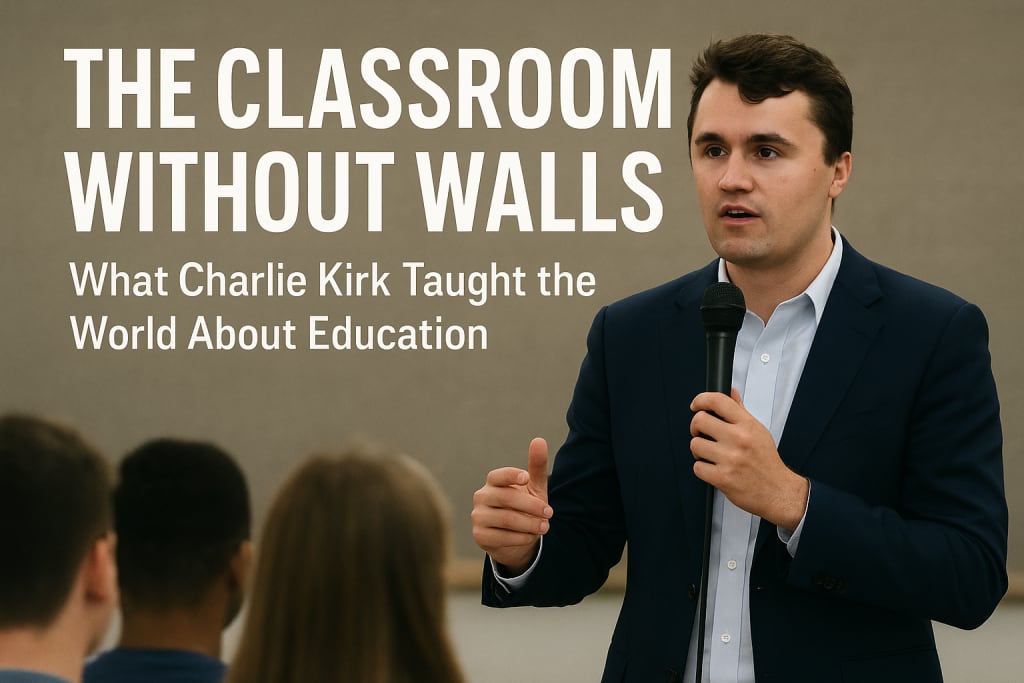
In most classrooms, learning begins with textbooks.
In Charlie Kirk’s classroom, it began with questions.
Before he became a national figure, Kirk was a student who felt that his voice didn’t belong in the lecture halls of modern education. He believed campuses had turned into echo chambers instead of arenas of ideas. So, instead of complaining, he created his own kind of classroom — one that stretched across the nation and beyond.
That classroom became Turning Point USA, a student movement that encouraged young people to debate, question, and think differently. Whether people agreed with his views or not, one thing was certain: Charlie Kirk made education exciting again.
He spoke in cafeterias, gymnasiums, and open auditoriums that were never designed to be classrooms. His blackboard was a stage. His chalk was a microphone. And his lessons? They weren’t about equations or essays — they were about conviction, courage, and communication.
Students came not just to learn politics, but to learn presence. How to argue, how to stand, how to speak with certainty when the world tried to silence them. Kirk taught them that education wasn’t about memorizing facts; it was about understanding why those facts mattered.
In every campus he visited, you could feel energy — the kind that textbooks rarely spark. He treated students like thinkers, not followers. That was his gift, and also his controversy.
Education has always been about transformation. But Charlie Kirk challenged who gets to transform us.
He asked a question that still shakes classrooms today:
“If schools teach information, who teaches conviction?”
In a generation that scrolls more than it studies, he offered something rare — a sense of mission. Young people began to see themselves not just as learners, but as voices. He made them feel that opinions mattered, that standing up wasn’t rebellion — it was responsibility.
For every student who felt invisible, Kirk’s movement said, You belong in the conversation.
That message — more than any political speech — was an educational revolution.
Still, his lessons were not without conflict. Critics accused him of spreading division, saying his classroom fueled confrontation rather than curiosity. And maybe, in part, they were right. But every great classroom has debate, tension, and opposing views. True learning doesn’t happen in comfort; it happens in challenge.
Charlie Kirk’s legacy forces education to confront a hard truth:
Are we teaching students what to think or how to think?
He didn’t fit neatly into academic molds, and perhaps that was the point. His movement reminded us that ideas, once freed, cannot be contained by walls or approval.
His life became a syllabus of modern education itself:
Lesson One: Knowledge is power, but conviction gives it purpose.
Lesson Two: Every voice matters — especially when it’s unpopular.
Lesson Three: The future of learning doesn’t belong to buildings; it belongs to ideas.
When news of his death broke, campuses across the country fell silent. Some mourned; others reflected. But in that silence, a deeper thought grew:
Education isn’t just about what’s taught — it’s about who dares to teach.
Because whether you loved him or questioned him, he showed that learning begins when someone challenges the ordinary.
Charlie Kirk may never have written a textbook, but he wrote something far greater — a living reminder that education cannot be confined to a classroom. It breathes in questions, thrives in conversation, and survives in courage.
He wasn’t a professor by title, but by impact. His words, for better or worse, lit sparks in minds that had gone dim. And in a world drowning in information, he reminded students that belief is the beginning of knowledge.
So perhaps that’s his final lesson:
Education is not about perfection — it’s about participation.
It’s about daring to think, even when it’s unpopular.
It’s about standing in front of the world and saying, “I will learn, I will speak, and I will lead.”
That’s the classroom Charlie Kirk built — one without walls, without limits, and without permission.
And maybe that’s the kind of education the world needs most today.
About the Creator
OWOYELE JEREMIAH
I am passionate about writing stories and information that will enhance vast enlightenment and literal entertainment. Please subscribe to my page. GOD BLESS YOU AND I LOVE YOU ALL
Keep reading
More stories from OWOYELE JEREMIAH and writers in Education and other communities.
Speak and Be Heard: A Beginner’s Guide to Becoming a Podcast Host and Growing Your Audience
Becoming a podcast host is an exciting way to share your ideas, inspire others, and build a strong community. Whether you want to teach, entertain, or have great conversations, podcasting gives you a voice that can reach people around the world. But starting a podcast and growing an audience takes more than just a microphone. It requires planning, patience, and a real connection with your listeners. In this guide, you'll learn how to become a podcast host and grow your audience step by step.
By Spencer Hakimian4 days ago in Education
Beyond Deals: Building Alliances That Truly Scale
Strategic partnerships for growth help companies expand faster and smarter. They enable two or more businesses to work together to create shared value. Each partner brings skills, reach, or resources that the other lacks. When done right, strategic partnerships create long-term growth that feels natural and steady.
By Rushi Manche7 days ago in Education




Comments
There are no comments for this story
Be the first to respond and start the conversation.