
The Changing Face of Fast Food: A Journey Through Time
From Drive-Thrus to Plant-Based: The Changing Face of Convenience Food


Fast food is more than just a quick bite—it’s a mirror of our culture, reflecting how we live, work, and eat. From its humble beginnings to today’s drive-thrus and delivery apps, the fast food industry has transformed dramatically, shaped by innovation, economics, and shifting tastes. Let’s take a stroll through its evolution and see how it’s become a defining part of modern life.
The story starts in the early 20th century. In 1921, White Castle opened its doors in Wichita, Kansas, serving sliders for a nickel. It was a revelation: affordable, consistent, and fast. People flocked to the counter, drawn by the novelty of a meal that didn’t require a kitchen or hours of prep.
White Castle’s success laid the groundwork for what fast food would become—a system built on speed and scale. By the 1940s, drive-in restaurants like A&W were popping up, catering to a car-crazy America. Families piled into their Fords, ordering root beer floats from carhops on roller skates. It was less about the food and more about the experience—a slice of Americana.
Then came the game-changer: McDonald’s. In 1948, the McDonald brothers retooled their San Bernardino diner, stripping the menu to burgers, fries, and shakes. They introduced the “Speedee Service System,” a production-line approach that churned out meals in minutes. It was efficient, repeatable, and wildly profitable.
When Ray Kroc franchised the concept in the 1950s, McDonald’s exploded, turning fast food into a global phenomenon. Suddenly, golden arches were everywhere, and competitors like Burger King and Wendy’s raced to keep up. The formula was simple: cheap, familiar food served at lightning speed.
But the 1980s brought new pressures. As Americans grew busier, fast food became a daily ritual for millions. Chains diversified—think Taco Bell’s tacos or Pizza Hut’s personal pans. At the same time, critics started pointing fingers. Fast food was blamed for everything from obesity to environmental waste.
The industry didn’t sit still. By the 1990s, McDonald’s was experimenting with salads, and Subway leaned hard into its “healthy” image. It wasn’t perfect, but it showed fast food could adapt to changing expectations.
The 2000s marked a turning point. Documentaries like Super Size Me put fast food under a microscope, forcing chains to rethink their menus. Consumers wanted fresher options, and brands listened. Chipotle burst onto the scene with its build-your-own burritos, emphasizing fresh ingredients and transparency.
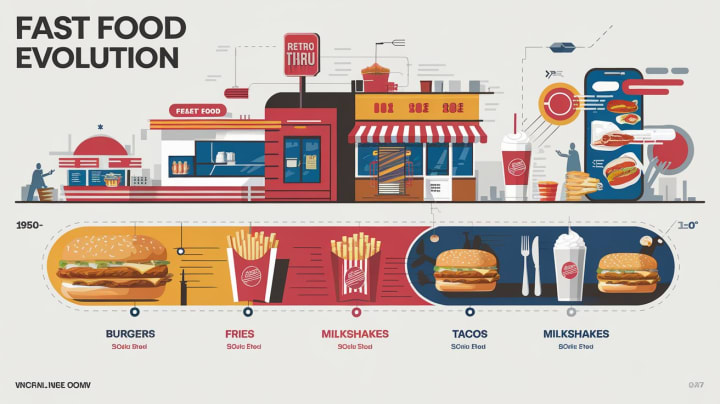
Panera Bread offered cozy vibes and Wi-Fi, blurring the line between fast food and casual dining. Even McDonald’s swapped out trans fats and added apple slices. The message was clear: fast food had to evolve or risk being left behind.
Today, the industry is unrecognizable from its White Castle days. Technology runs the show—touchscreen kiosks, mobile apps, and delivery services like DoorDash have made ordering seamless. Chains are also grappling with sustainability, rolling out plant-based burgers and recyclable packaging to appease eco-conscious diners.
Then there’s the rise of “fast casual” spots like Shake Shack, where people happily pay a premium for a better burger and a craft-beer vibe. Yet, the core of fast food remains: convenience. Whether it’s a $5 combo or a gourmet poke bowl, the goal is still to get food into your hands quickly.
What’s next? As labor costs climb and automation advances, we’re seeing more self-service machines and even robotic fry cooks. Chains are also doubling down on nostalgia—think retro diner aesthetics or limited-time menu items that tug at childhood memories.
At the same time, health and ethics are bigger priorities than ever. Vegan options, lab-grown meat, and locally sourced ingredients are no longer niche—they’re mainstream.
Fast food’s journey reflects our own: a constant balancing act between convenience and quality, tradition and progress. It’s not just about feeding people; it’s about understanding what they value. From nickel burgers to avocado toast, fast food has always found a way to keep up. And as long as we’re hungry and in a hurry, it’ll keep evolving.
About the Creator
Jenny Hunt
I write about everything food. Other things I love to do are cook, explore new food places, and rearrange my furniture. I'm content, I'm blessed!
Keep reading
More stories from Jenny Hunt and writers in Education and other communities.
Is Wendy’s New AI Drive-Thru the Future—Or a Fast Food Fail?
Fast food has always been about speed and convenience, but what happens when technology takes over the drive-thru window? Wendy’s is rolling out its new system, called FreshAI, to take orders at hundreds of its locations by the end of 2025. This setup, developed with Google, listens to customers, responds, and processes orders in real time. It’s already active in nearly 100 spots across 19 states, with plans to expand to 500 or 600 more this year. But while some see this as a big step forward, others are calling it a big flop. So, what’s the real story?
By Jenny Hunt11 months ago in Futurism
Unlocking Value: A Strategic Guide to Opportunities in the Foreclosure Market
The foreclosure market develops when property owners fail to meet mortgage obligations, and lenders initiate legal processes to recover unpaid loans. As a result, these properties often return to the market under different conditions than traditional listings. Moreover, lenders typically aim to sell quickly to minimize losses, creating pricing advantages for informed buyers. Because of this structure, foreclosure properties may present opportunities for investors who approach them with preparation and discipline.
By Michael O'Sullivan Hamptonabout 10 hours ago in Education
Free Laptop with GED Classes 2026: How Low-Income Adults & Students Can Get One
Earning your GED is a powerful step toward better jobs, higher pay, and long-term stability — but trying to study without a reliable laptop makes everything harder. The good news? In 2026, several legitimate programs and nonprofits are still giving free laptops specifically to people working on their GED or HiSET.
By Free Laptops From Governmentabout 6 hours ago in Education


Comments
There are no comments for this story
Be the first to respond and start the conversation.