
“The Chalkboard Revolution: How One Teacher Changed a Village”
A powerful story about the impact of education in the most unexpected place.

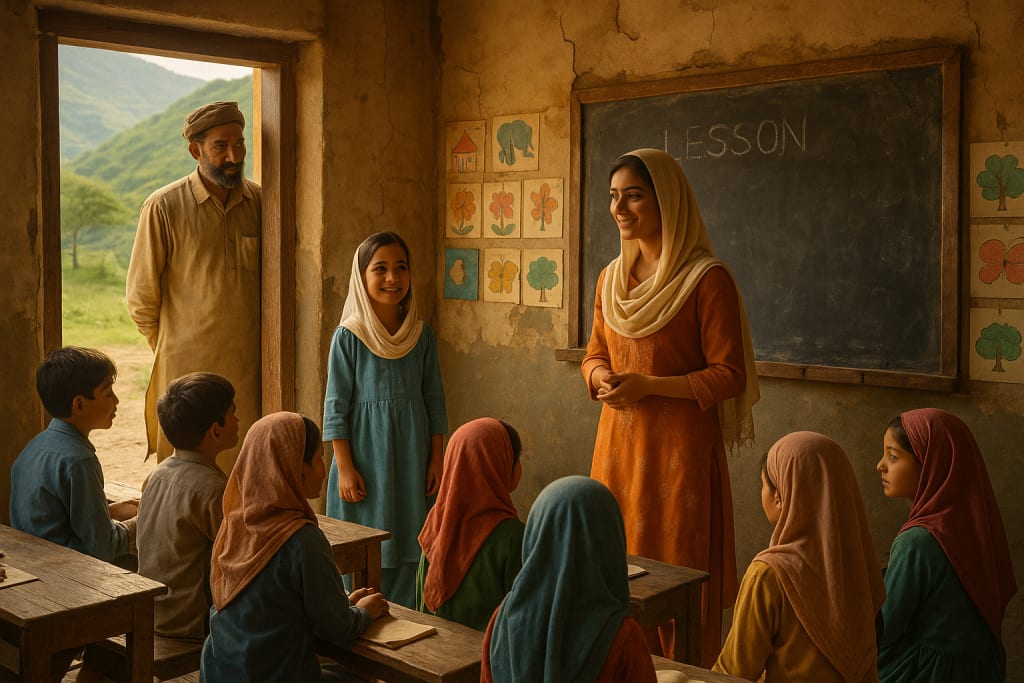
In a small, forgotten village tucked deep into the green hills of a developing country, there stood a crumbling school building with faded paint, broken windows, and a roof that threatened to collapse every monsoon. The students sat on rough wooden benches, their feet often dusty and bare. Books were scarce, electricity unreliable, and teachers even scarcer. It was a place where hope had slowly drained away — until Miss Salma arrived.
Miss Salma was not from the village. She was a young, energetic teacher from the city, full of dreams and ideas. When she accepted a government teaching post in the village, many questioned her decision. “You’ll waste your talent,” her university friends had said. But Salma saw something they didn’t — potential.
On her first day, only twelve children showed up. Most of the students were boys; the girls were missing. Their parents believed education was not necessary for daughters who would eventually be married off. Salma didn't argue. She just smiled and began her work.
She started by changing the classroom — not physically, but emotionally. She introduced storytelling, song-based lessons, and colorful chalk drawings. She brought maps, handmade flashcards, and even a globe she bought with her own savings. The children were mesmerized. For the first time, they weren’t being shouted at or punished for mistakes. They were being heard. They were being encouraged.
Word spread. The next week, eighteen students arrived. Then twenty-four. Then thirty. Even a few girls started peeking through the windows, curious. Salma noticed and welcomed them with open arms. She visited homes, met parents, and explained — gently, respectfully — why girls deserved to learn too. At first, the resistance was strong. But one by one, parents gave in, seeing how excited their children were to go to school.
Months passed, and the classroom became alive with energy. Students began reading out loud, solving math problems on the board, and even asking questions — something unheard of before. Salma created a reading corner with donated books, a wall of drawings by students, and even a “question box” where children could write anonymous queries they were too shy to ask aloud.
One day, a young girl named Noor stood up and said, “Miss, I want to be a teacher like you.” The room fell silent. Noor’s father, a strict farmer, had once forbidden her from going to school. Now, he waited outside every day just to see her smile as she walked out of class.
The school became more than a building. It became a heartbeat of the village. Parents who had never been to school started sitting in the back, watching. Farmers learned to write their names. Mothers began to help their children with homework. A new kind of revolution had begun — not with protests or politics, but with chalk, paper, and care.
After two years, the school’s enrollment had tripled. The education department noticed. Officials visited. A donor offered to rebuild the classrooms. New books arrived. Another teacher was hired. And Miss Salma? She was offered a promotion and transfer to a better city school. But she declined.
“This,” she said, “is where the real change is.”
She stayed.
Because she knew that education was not just about textbooks or exams — it was about dignity, dreams, and the power to transform lives.
---
Final Message: Education doesn’t always need smartboards or big buildings. Sometimes, all it takes is a chalkboard, a caring teacher, and a belief that every child matters. In forgotten corners of the world, revolutions are quietly happening — one lesson at a time.
About the Creator
The Energy Pivot The State of Russia’s Oil and Gas in 2026
For decades, this was the "world's gas station": Russia's pipeline network to Europe was the veins of the world economy. By 2026, that aura is dull and those veins are rerouted out of Europe. Since the collapse of the Soviet Union, the Russian oil and gas sector is facing the largest structural change.
By Neeraj kumar3 days ago in Education
What’s the best position to sleep in?
In the 1970s, psychoanalyst Samuel Dunkell proposed a curious, albeit almost completely unsubstantiated, theory that the position you sleep in reflects your personality. For example, preferring to snooze in the so-called royal position indicated self-confidence, while sleeping semi-fetal meant you’re sensible and well adjusted. While Dunkell’s ideas lack any definitive proof, how we sleep can impact our health. So, what’s the best position to sleep in? Sleep positions go by countless creative names—
By Munesh Yadava day ago in Education


Comments (1)
Good one