
The Chalk That Changed a Village
How one teacher and a piece of chalk lit the fire of learning in a forgotten town

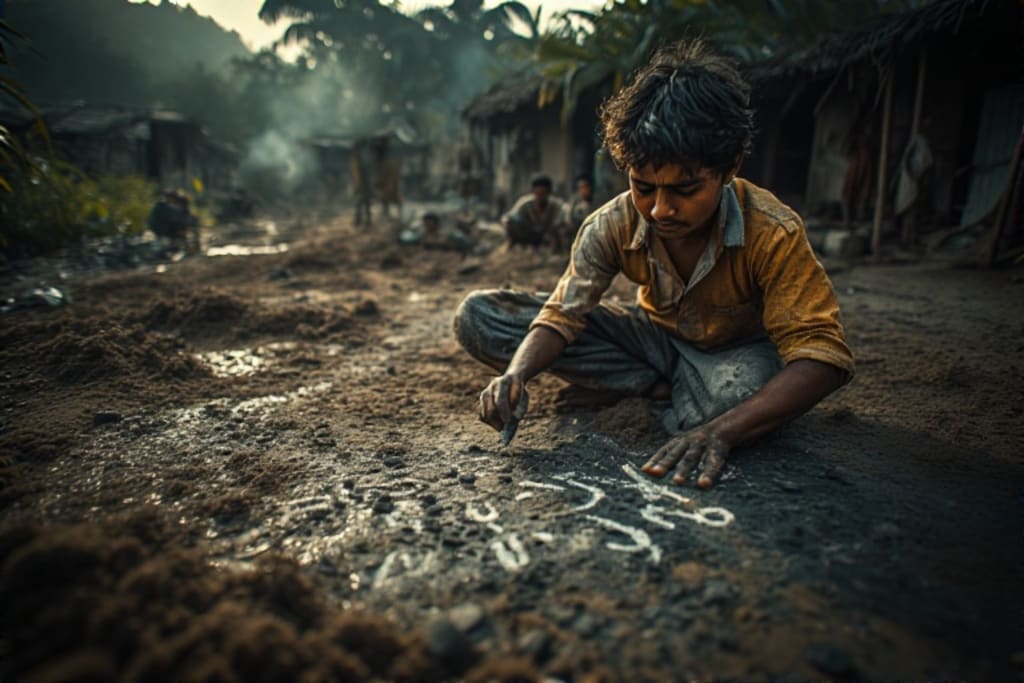
In the quiet village of Daryaabad, nestled between green hills and winding rivers, time moved slowly. Children played in the dust, women carried pots of water on their heads, and men worked the fields from sunrise to sunset. But one thing remained painfully missing—education.
There was a school building, once bright and hopeful, now faded and cracked like an old memory. The roof leaked during monsoons, the desks were broken, and worst of all, there were no teachers willing to stay. With no school to attend, most children learned to sow seeds before they could read, and counted rupees before they could count numbers.
That was until Rehan arrived.
Rehan was a young man from the city who had been sent to Daryaabad by a small non-profit organization. He was to stay for just three months and teach basic literacy to the children. He carried a worn backpack filled with a few notebooks, some pencils, and a single, long white stick of chalk.
The villagers were skeptical.
“What can he do with just one piece of chalk?” asked old Master Karim, the retired headman.
“He will leave like the others,” mumbled Parveen, a mother of four. “They all promise change and disappear.”
But Rehan was different.
The next morning, he walked to the abandoned school, swept the dusty floor, and set up a blackboard using a piece of wood he found behind the building. Then he wrote one word in big, bold letters: "HOPE."
Children peered through the windows, giggling, whispering, their eyes full of curiosity. Rehan called out, “Come in. This place is yours.”
And so, five children stepped in that first day.
With just one piece of chalk, Rehan began. He taught them the alphabet, numbers, and how to write their names. He used the chalk carefully, writing slowly, erasing gently. When the board was full, he used the other side. When that was filled too, he used the floor.
He told stories while teaching—tales of lions who learned to read, girls who became doctors, and farmers who calculated harvests using math. Word spread quickly. The next day, ten children came. Then twenty.
By the end of the week, nearly every child in Daryaabad sat cross-legged on the dusty floor, eyes glued to Rehan, waiting to see what he would draw or write next with his magical chalk.
He divided the chalk into smaller pieces so each child could hold one. They practiced writing in the dirt outside. They learned addition using pebbles and subtraction with leaves. Even the adults started peeking through the door. Some began sitting in the back, learning quietly.
Rehan didn’t just teach from books—he showed the children how learning could change their lives. He explained how numbers helped in measuring grain, how reading signs could save lives, and how writing letters could bring jobs and opportunities.
One day, during a particularly heavy storm, Rehan’s chalk finally broke into dust. The children looked up, worried.
“It’s gone,” said Ayaan, the oldest student.
But Rehan smiled. “No,” he said, “it lives in you now.”
The next morning, the villagers found Rehan painting the old school walls with leftover whitewash. Using a stick dipped in black ink, he painted alphabets, numbers, and poems directly onto the walls. The children helped. The school became a place of color and learning again.
Touched by Rehan’s efforts, the villagers began pitching in. A carpenter fixed the benches. Mothers brought water and food for the children. A group of elders contacted the district office and requested a permanent teacher.
Within months, the government responded. Seeing the school active again, they agreed to renovate it and assign teachers. Books arrived, new desks were delivered, and most importantly, a full-time teacher was hired from a nearby town.
On Rehan’s last day, the village held a small celebration. The children performed songs and recited poems. The adults, once doubtful, now thanked him with tears in their eyes.
Rehan stood in front of the crowd and said, “I didn’t bring anything magical. Just a piece of chalk. But change doesn’t need big things. Sometimes, it only takes a small start and a lot of heart.”
He handed the last tiny piece of chalk to little Zara, the youngest student, and said, “Pass it on. Let the learning never stop.”
From that day onward, the villagers often spoke of the time when a single piece of chalk rewrote their future. And every year, on the day Rehan left, the children of Daryaabad celebrate Education Day, honoring the chalk that changed their village forever.
Moral: True change often begins with something small. Education, no matter how simple it starts, has the power to transform lives and communities.
About the Creator
Keep reading
More stories from Najeeb Scholer and writers in Education and other communities.
"Words that Win"
They say actions speak louder than words. But sometimes, the right words are the very thing that inspire action. Whether it’s a speech that stirs a nation, a conversation that mends a broken heart, or a sentence that changes someone’s direction in life—words have the power to win. Not just arguments, but people. Not just battles, but trust, love, and opportunity.
By Najeeb Scholer7 months ago in Education
Advanced Instrument Flight: Flying Beyond Sight with Skill and Control
Instrument flight is the foundation of safe flying in poor visibility. When pilots cannot see the horizon, the runway, or the ground below, they must rely fully on cockpit instruments. Instrument flight allows aircraft to move safely through clouds, rain, haze, and darkness. It is a skill that demands focus, steady hands, and strong decision making.
By Duke Valentour7 days ago in Education
Why Products Get Ignored on Retail Shelves (And How Brands Can Fix It)
Today, when you walk through any retail store, they have a very cluttered retail display design. You will see shelves packed with products. Most of them are decent. Some are even excellent. But have you wondered why they are never picked up or made into the cash-out zone? Many are well-made, reasonably priced and even thoughtfully designed. And yet, a large number of them never get picked up. This is one of retail's quietest problems. It's because customers don't notice them. It's very natural that shoppers scan shelves in seconds. Products must communicate value instantly.
By Hazel Taylor6 days ago in Education




Comments
There are no comments for this story
Be the first to respond and start the conversation.