
The Boy Who Traded His Books for Bricks
A boy’s journey through hardship, dignity, and unbroken dreams.

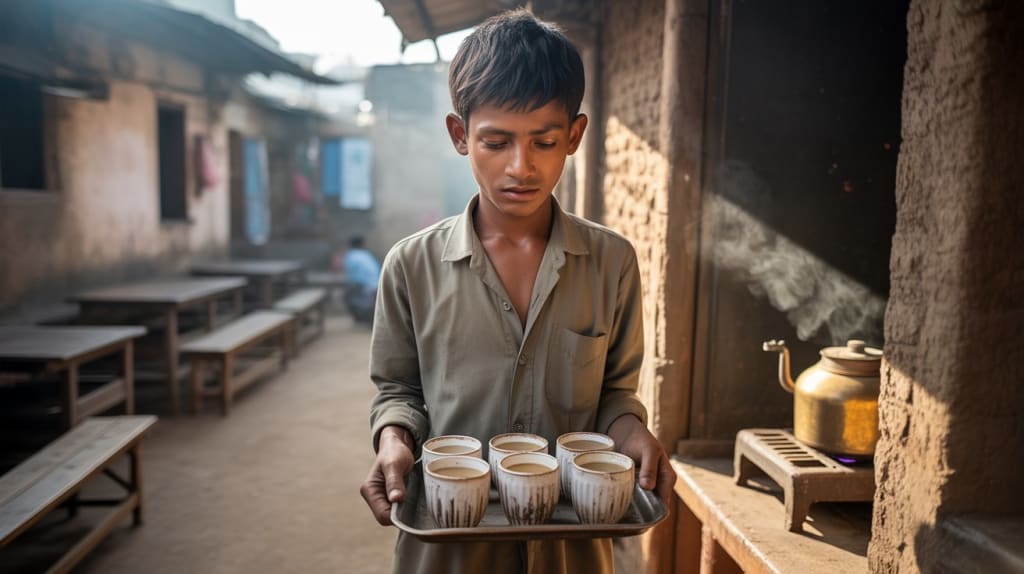
Sajid's hands at seventeen had more practice of the feel of the weight of bricks than of books, but his eyes still chased a lost dream. It was in a little tea hotel set into a comer of a dirty street in Rawalpindi that the narrator first saw him. He was rushing from table to table with a tray of chipped cups and half-filled glasses of chai. His eyes cast respectfully downwards, his tone polite, but his smile was weighted and spoke of years of unuttered suffering.
Sajid’s world was altered when he was twelve years old. The youngest of four brothers, he had enjoyed school—not because he was bright, but because he was curious. He had once posed his Urdu teacher the question of whether poets ever went hungry for literature. At home, dreams were a privilege. His father was a cook who toiled for endless hours earning minimal wages. His mother suffered from diabetes and spent more time lying on the floor, breathing shallowly, beckoning Sajid with feeble whispers. His older brothers did not assist much.
His medicine shop refused him credit for his mother's insulin. That night, Sajid sat beside her and watched her shiver. His textbooks lay open, unmarked. His uniform was packed in the cupboard back by afternoon, replaced with secondhand clothes taken off a cousin. He was to work.
He began as a shuttering helper on construction sites—building wooden and steel frameworks to shape concrete walls and columns. The work was dangerous, dirty, and physically exhausting. By six a.m., he was climbing rickety scaffolding, carrying heavy planks, and hammering nails into boards. The summer heat burned his feet; his shirt clung to his back, soaked in sweat and dust. Rusty nails cut his palms, yet the foreman’s only advice was to return to work. He earned 300 rupees a day—barely enough for a few injections or vegetables—but he continued, driven by necessity and love for his mother.
Months went by, and Sajid became thinner. His back hurt all the time, and a slight fall caused him to limp. His fingers stained with rust; his face lost a little of its glow. Childhood, companions, and playthings had been exchanged for dust from the cement and abiding toil. One evening, having dragged himself home, he discovered his mother asleep upon the floor. He sat down next to her and silently wept.
The next day, hurting and tired, Sajid went into a little roadside hotel and asked for a job. The owner looked at his skinny arms and dirty clothes and asked could he haul trays and recall tables. Sajid nodded. It was low pay—five thousand rupees a month, no meals, no rests—but it was less demanding than construction work. And he was weary.
Now a waiter, he stands for ten hours a day, refilling cups, wiping down tables, and yelling out orders. Clients sometimes chastise him for nothing; once a man tossed a plate right in his feet because the chai was too sweet. Nonetheless, Sajid grins, apologizes, and moves along. At the close of the day, he walks home with minimal rupes, a sore back, and a man of learning's spirit that will not perish. He still envisions school—the aroma of new books, the satisfaction of a puzzle solved, the remembrance of his Urdu instructor saying to him, “Even the poorest child is able to contain a library within his heart.”
The narrator remained till the end of Sajid’s shift. Observing him pile up empty cups, the narrator cautioned gently, “You are still young. You still have light in your eyes. Don’t let this world rob you of your dreams.” Sajid gazed into his face and smiled—a smile of sadness and hope. “Education is light,” the narrator continued. “If it is the will of Allah, your door will reopen.” Sajid murmured the words to himself, sealing a prayer.
There are thousands of Sajids in our cities—children who should be in schools and not carrying cement and steel; who should laugh and not toil. Poverty and rejection push them into alleys where childhood is lost in a moment. If the world doesn't sit up and take notice, their stories turn to dust and cement. Learning is a right and not a privilege. And sometimes, it is the only solace from native misery. Let's provide a bridge of hope for children like Sajid—not only to sustain them, but to enable them to live, pursue their aspirations, and regain the childhood that was not destined to be lost.
About the Creator
Shehzad Anjum
I’m Shehzad Khan, a proud Pashtun 🏔️, living with faith and purpose 🌙. Guided by the Qur'an & Sunnah 📖, I share stories that inspire ✨, uplift 🔥, and spread positivity 🌱. Join me on this meaningful journey 👣
Keep reading
More stories from Shehzad Anjum and writers in Education and other communities.
Shattered Wings
I remember him clearly — a quiet boy with fire in his eyes. The kind of fire only children have, fueled by dreams untouched by disappointment. He would sit in the second row of the classroom, his well-worn notebook always open, his blue pen carefully refilled because buying a new one wasn’t always possible.
By Shehzad Anjum6 months ago in Education
NCLEX Study Plan: A Step-by-Step Guide for Nursing Students
Preparing for the NCLEX-RN is one of the most important milestones in the nursing students’ career. This is because the NCLEX is the final step before nursing students can become licensed nurses. However, it is not as easy as simply reading nursing textbooks and taking notes from class lectures. This is because the NCLEX is designed to test the nursing students’ clinical judgment and decision-making skills.
By Sulcus Learning4 days ago in Education
How Gamified Learning Platforms Are Transforming Modern Education
Education has entered a new digital era where traditional classroom methods are being supported by innovative technologies. Instead of relying solely on textbooks, lectures, and written exams, educators are now exploring interactive tools that make learning more engaging and effective. One of the most important innovations in modern education is the concept of gamified learning, which blends academic content with elements commonly found in digital games.
By Backlinks Cart4 days ago in Education




Comments
There are no comments for this story
Be the first to respond and start the conversation.