
The Book Keeper
"Lost Connections, Found Adventures: The Story of Santanu and the Forgotten Library

Although he was trying to keep everyone calm, the children could tell that even Mr Williams was nervous. He kept fiddling with his own dead phone until he eventually walked out of assembly looking completely bewildered.
The bell rang and the children were herded into their classrooms, still restless and afraid. The whiteboards didn’t work. The computers didn’t work. The teachers tried to make the children practise their handwriting skills instead but they were all terrible at writing. Nobody used pens any more! It was, however, a rare treat for Santanu whose writing was well-practised and very neat.
The days drifted from one to another. Nobody knew when the computers would come back on. Parents were getting annoyed with their troublesome children because they were no longer distracted by television programmes and computer games and mobile phones. The children did not know what to do with themselves. They wandered out into the streets but they did not know where their friends lived because they only ever talked to them over the phone or online.
Eventually word got around the school that Santanu had an encyclopedia of information in his little book: names and addresses and phone numbers. One day, an older boy called Kai followed Santanu home and demanded to know 6 friend’s address which Santanu had meticulously noted on the inside cover of his book. Santanu agreed to give the boy the address if he could go with him and play. That is how it started. That is how Santanu met lots of friends and made up new games for them all. He enjoyed playing face to face. He enjoyed the real world instead of computers.
His book was a source of amusement for all of the children. Their phones and screens, once full of colour and information, now stared out blankly at the world – dead. Televisions and computer screens were a stubborn dull grey. And now the book was especially useful! It was full of names and addresses, full of ideas for games that Santanu had invented over the years, full of stories that he had made up and now read to his friends.
One day, the children were all playing in a deserted part of town when it started raining. They all ran for shelter beside the door to a big orange brick building. One by one they piled against the door to protect themselves from the rain, until there was a terrible creaking sound and the door caved inwards so that the children all fell inside, one on top of the other in a huge bundle.
The building was dark inside with high ceilings. It was full of dust and cobwebs, and it was very dark so it was hard to make out very much detail in the shadows. It smelled musty and old.
Santanu was the first to get to his feet. He rubbed his eyes and looked around.
‘Books! Look at all these books!’ he cried. ‘What is this place?’
‘I don’t know,’ replied his friend Crystal. ‘It’s like an old house.’
There was a large desk in the centre of the room and above the desk there was a sign. It said ‘Returns and Issuing Desk’. Above that there was an even bigger sign hanging from the ceiling. It said ‘Public Library’.
None of the children knew what the word library meant but it did not matter. Santanu could not believe his eyes. He wandered down the aisles touching the spines of all the books. It was like a forbidden palace, a secret place only the children knew about.
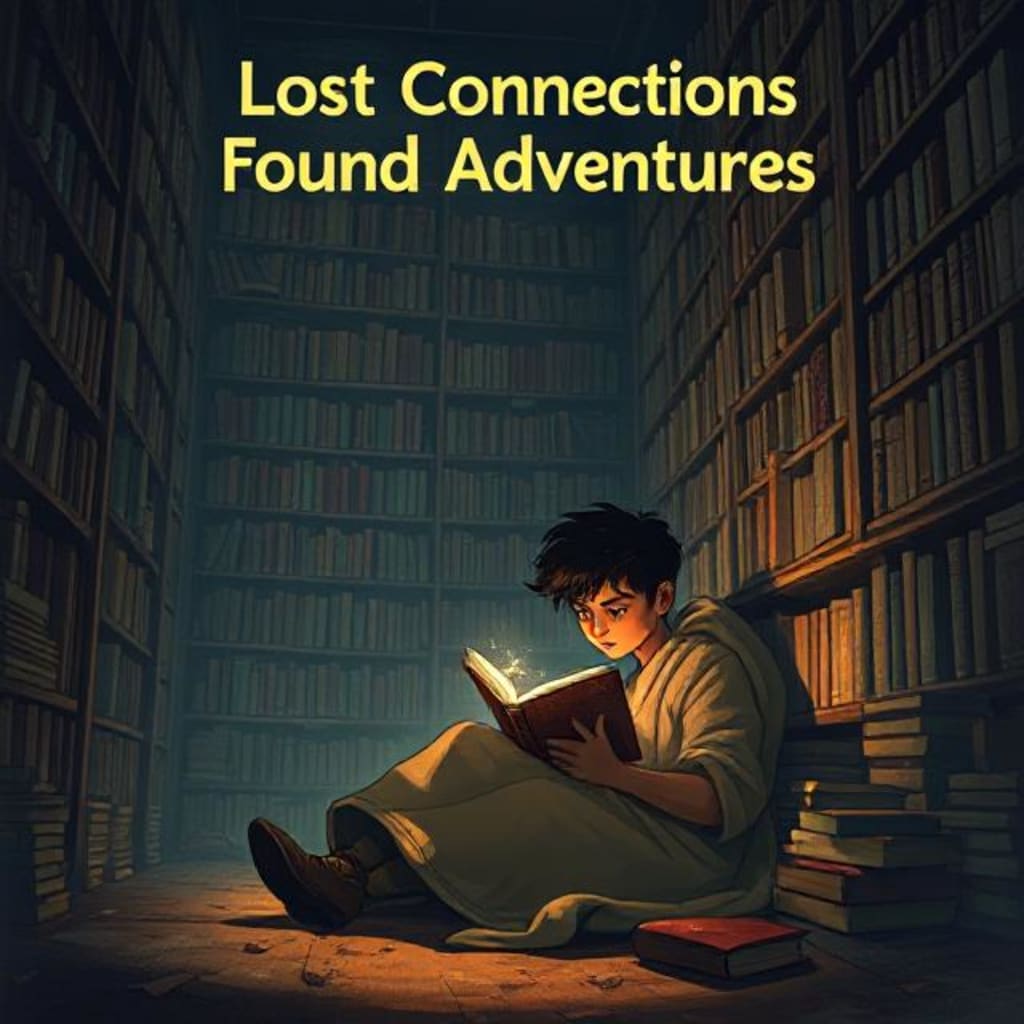
As the weeks passed, more and more children arrived at the library after school. They would read to each other or read quietly to themselves curled up under blankets. They would play chase and hide and seek and make up stories of their own.
Santanu liked to roam the aisles reading just a few sentences from each book. He read bits of The History of the World in 100 Objects, A Brief History of Time, 1000 Leagues Under the Sea, and even Thomas The Tank Engine. Anything he could get his hands on.
He was just putting Thomas back on the shelf in the ‘childrens’ section when he spotted a leatherbound book which looked just like his own book from back home. It was exactly the same in every detail except that it was written in English. Finally he knew what his book was about. It was called Matilda and it was written by a man called Roald Dahl. It was a story about a little girl who loved reading and Santanu did not put the book down until he had reached the very last page. He thought it was the most wonderful, entertaining and naughty book he had ever read.
He compared the English version of Matilda to the Bengali version he had carried around for so long. He read and reread the book, and very slowly he came to understand the Bengali script. He spent hours in the library, tucked away in a corner by himself, comparing the two texts until he grew more and more confident with the Bengali script. He also found a book in the ‘education’ section of the library which helped him to learn more and more about the Bengali language.
One Saturday, when Santanu arrived at the library late in the morning, he noticed how silent it was. There were no children anywhere. Santanu wondered if they had all been caught by a grownup and thrown out. Then Crystal emerged meekly from behind the ‘travel’ section.
‘They’ve fixed the problem,’ she said. ‘The computers and internet are all working again. Everybody has gone home.’
She asked Santanu for her passwords and then, rather sheepishly, she walked out of the door leaving Santanu alone with all of the books.
The young boy stared at the rows of shelves all lined with books. He thought about all of the stories inside the books and felt sad that nobody would ever take the time to read them. But then he smiled to himself and took a book from the nearest shelf and curled up under a blanket in his favourite corner of the library. The book was called The Hobbit and Santanu was sure it would be a great read.
About the Creator
Keep reading
More stories from IRSHAD MUHAMMAD and writers in Education and other communities.
Building Stronger Teams Through Diversity
Diversity in the workplace is more than a trend. It is a key part of building strong and creative teams. Companies today serve people from many cultures, backgrounds, and life experiences. Because of this, businesses need teams that reflect the world around them.
By Aaron Khieu7 days ago in Education
How Long the Sun Has Left: The Future Life and Death of Our Star Explained
Every day, the Sun rises and sets with remarkable consistency. It has illuminated Earth for billions of years, sustaining life and shaping the environment of our planet. Because the Sun appears stable and unchanging, it is easy to imagine that it will shine forever.
By shahkar jalal2 days ago in Education




Comments
There are no comments for this story
Be the first to respond and start the conversation.