
The Azure Palate
In Ms. Sharma's class, learning wasn't about facts; it was about the nuanced, emotional symphony of color, starting with the deep, resonant taste of blue.

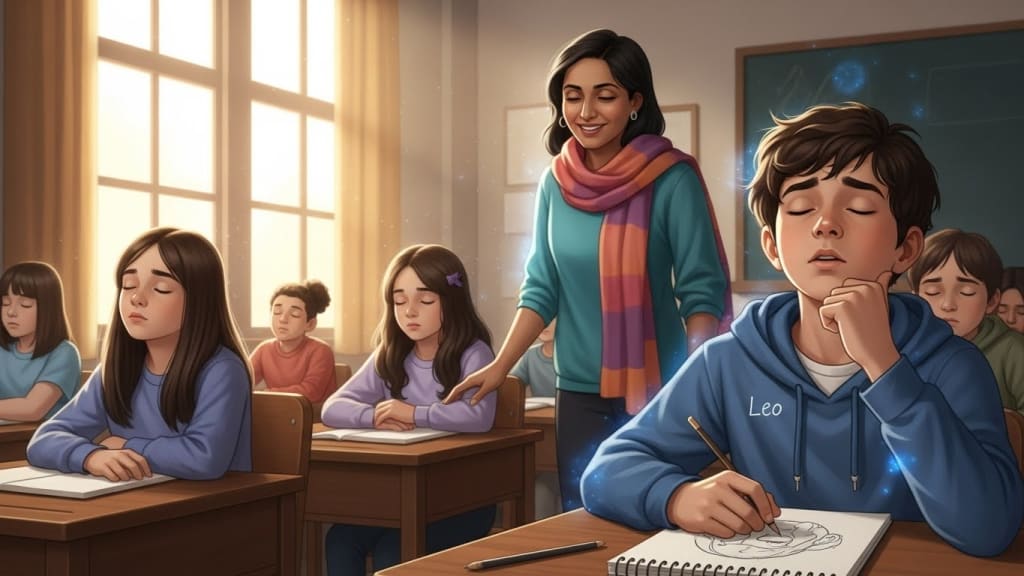
The fluorescent hum of Room 207 usually cast a pallor over the students, mirroring the drab textbooks and the even drabber drone of Mr. Henderson's history lessons. But today, a new energy vibrated in the air. Ms. Anya Sharma, with her kaleidoscope scarves and eyes that seemed to hold both starlight and deep ocean currents, stood before them. She wasn't like Mr. Henderson. She didn't begin with dates or names; she began with a question that hung in the air like a shimmering, impossible soap bubble: "Class, what does the color blue taste like to you?"
A ripple of bewildered silence, then a nervous cough from the back. Leo, a boy whose world was usually confined to the precise lines of his sketchbook, felt a strange flutter in his chest. Taste blue? He looked around. Some faces were scrunched in confusion, others in outright amusement. The girl in the front row, Sarah, ever the pragmatist, raised a hand. "Ms. Sharma, colors don't have tastes. Taste is for food."
Anya smiled, a gentle, knowing curve of her lips. "And yet, don't we say a song is 'sweet'? Or a mood is 'bitter'? Language, my dears, is a bridge between the tangible and the ineffable. And learning, true learning, is about building those bridges, not just memorizing the bricks. Today, our first lesson is to taste blue. Not with your tongue, but with your whole being. Close your eyes. Imagine the color blue. What does it evoke? What sensations? What memories? What hidden nuances?"
Hesitantly, students closed their eyes. Leo squeezed his shut, picturing blue. He thought of the deep cobalt of his grandmother's teacup, chipped at the rim, holding the warmth of her chamomile tea. He thought of the crisp, biting blue of a winter morning sky, just before the sun broke through, promising a new, cold day. He thought of the bruised, purplish-blue under his eye after he fell off his bike, a sharp, metallic tang in the memory. It wasn't one blue; it was a thousand blues, each with its own tiny universe of feeling.
Anya's voice was soft, guiding them. "Is it the vast, silent blue of the deep ocean, holding ancient secrets? Is it the sharp, electric blue of a sudden storm? The comforting, endless blue of a cloudless summer sky? Or perhaps the melancholic, fading blue of twilight? Don't think about what you *should* feel. Feel what you *do* feel. Connect it to a sensation, an emotion, a memory. What flavor does that sensation, that emotion, translate into?"
Leo opened his eyes. He saw a flicker of understanding in Sarah's usually analytical gaze. He felt a sudden, inexplicable urge to speak. "It… it tastes like quiet," he began, his voice barely a whisper, "but not an empty quiet. It's the quiet of deep water, where sound travels differently, where everything is muffled but still profoundly *there*. And it tastes... a little like salt. Not the sharp salt of the sea, but the kind that lingers on your tongue after you've cried a long time. It's a vast, cool, slightly mournful salt."
Anya's eyes shone. "Beautiful, Leo. Absolutely beautiful." She turned to the class. "You see? Leo didn't just 'taste' blue. He felt its depth, its history, its emotional weight. He connected it to vulnerability and vastness. That, class, is how we learn. Not by simply absorbing facts, but by allowing ourselves to be immersed, to feel the texture, the temperature, the emotional resonance of a concept. When you understand the taste of blue, you begin to truly understand the vastness of the world, the depth of human experience, the complexity of history, the intricate patterns of mathematics. You learn to *feel* knowledge, to internalize it beyond the surface."
Over the next few weeks, Room 207 transformed. The hum of the fluorescent lights seemed less oppressive, replaced by the excited chatter of students describing the "spicy yellow" of a desert landscape in their geography lesson, or the "bitter green" of political corruption in civics, or the "effervescent pink" of a chemical reaction. They learned about the French Revolution, not just as dates and names, but as the "fiery red" of passion and rebellion, the "cold grey" of betrayal, and the "bright white" of new ideals. They weren't just memorizing; they were experiencing, forming personal connections, building those bridges Anya had spoken of.
Leo, once quiet and reserved, found his voice in these sensory explorations. His sketchbook filled with vibrant, expressive drawings, each line infused with the tastes and textures he now perceived in everything. He understood now. The 'taste of blue' wasn't about synesthesia, or literal flavor. It was about empathy, about seeking the soul of a subject, about allowing intuition and emotion to deepen understanding. It was about recognizing that the world, in all its educational complexities, was a rich, multi-sensory feast, waiting to be savored. And for the first time, learning felt not like a chore, but like a profound, ongoing discovery, a continuous, delicious tasting of the world's myriad hues.
About the Creator
The 9x Fawdi
Dark Science Of Society — welcome to The 9x Fawdi’s world.
Keep reading
More stories from The 9x Fawdi and writers in Education and other communities.
Silence Between Words
Dr. Ethan Park had listened to thousands of confessions, but he'd never shared his own. For twelve years, he'd sat in the therapist's chair, guiding others through their darkness while his own remained carefully locked away. His colleagues called him gifted. His patients called him a lifeline. His ex-wife called him "emotionally unavailable," which was probably the most honest assessment anyone had given him.
By The 9x Fawdi3 months ago in Education
AI-Driven Drug Discovery: Transforming the Future of Medical Innovation
Developing new medicines has long been one of the most challenging and resource-intensive processes in the healthcare industry. The traditional drug discovery pipeline often involves years of laboratory experiments, extensive data analysis, and multiple stages of clinical trials. Despite these efforts, the majority of potential drug candidates fail before reaching the market. This high rate of failure makes drug development both costly and time-consuming, limiting the speed at which new treatments become available to patients.
By Abba Leffler5 days ago in Education
When Learning Feels Like War: A Child’s Hidden Struggle With Words
Every morning, the school bell sounded like the beginning of a battle. For most children, school was a place of friends, laughter, and learning. But for nine-year-old Arman, it felt like stepping onto a battlefield where he was already losing.
By imtiazalamabout 12 hours ago in Education


Comments
There are no comments for this story
Be the first to respond and start the conversation.