
The Art and Science of Raising a Labrador: 5 Secrets to Surviving the First Year
They aren't just pets; they are a partnership forged in ice and water. Here's the roadmap to raising a balanced, devoted companion.

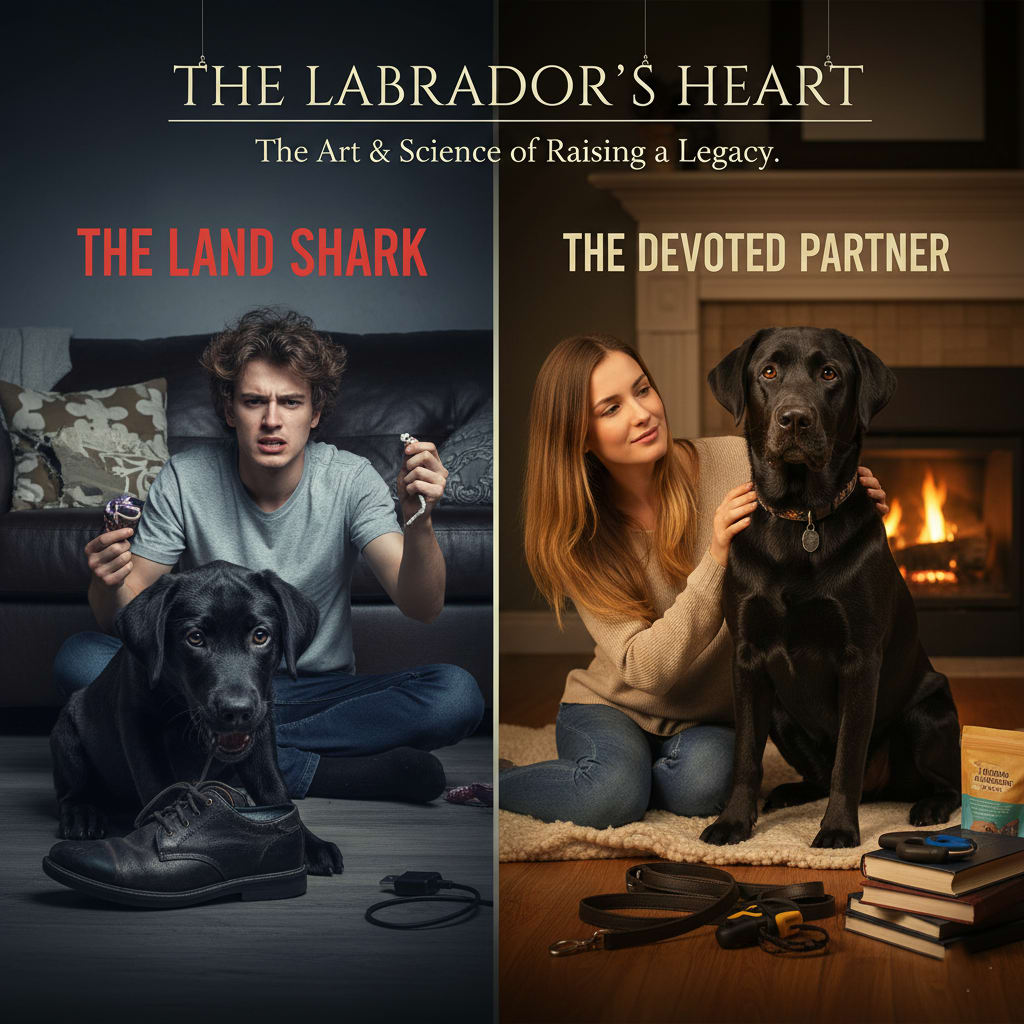
The first week I brought my Labrador puppy home, I was certain I had made a terrible mistake.
This wasn't the calm, noble dog I had seen in movies. This was a 15-pound ball of needles, chaos, and boundless, chaotic energy. He was a "Land Shark," a title he earned by systematically attempting to chew my hands, my furniture, and every electrical cord he could find.
I was exhausted, frustrated, and felt completely in over my head.
What I didn't know then, and what I want to share with you now, is that raising a Labrador puppy is both an art and a science. The art is in the relationship. The science is in understanding the creature you've brought into your home.
I dove into the research—the history, the psychology, the genetics—and what I found changed everything. I compiled a 5,000-word manual for myself, and from that, I extracted the five core truths that truly matter.
If you are a new (and tired) Labrador owner, this is for you.
1. You're Not Raising a Pet; You're Honoring a History
My puppy wasn't being "bad." He was unemployed.
The Labrador's ancestor, the St. John's Water Dog, was a marvel of genetic engineering. These dogs were bred by fishermen in the icy waters of Newfoundland to work all day. They hauled nets, retrieved fish, and swam for miles in freezing conditions. They were bred for drive, biddability, and a relentless work ethic.
Now, look at your puppy. He is the descendant of that 19th-century workaholic.
When he chews your drywall, he's not being malicious. He's telling you he is bored. That relentless drive hasn't disappeared in 200 years; it's just been re-homed into your living room.
The Science: Acknowledge their DNA. The Art: Give them a job. Don't just walk your Lab; make them work. Engage in "scent work" by hiding their food. Teach them to retrieve the mail. A 15-minute training session will tire them out more than a 30-minute walk, because it satisfies the mind.
2. The "Golden Window" is Real (And It Closes Fast)
From the moment you bring your puppy home (around 8 weeks) until about 12-16 weeks, you are in the "Golden Window" of socialization. This is the single most important period in your dog's life.
What happens in this window will define your dog's adult temperament.
Most people get this wrong. They think "socialization" means taking their puppy to a dog park to be mobbed by other dogs. This is the fastest way to create a fearful or reactive adult.
The Science: A puppy's brain is a sponge. The Art: Socialization is not interaction; it is neutral exposure. Your goal is to teach your puppy that the world is a normal, non-scary place.
Let them sit on a mat and watch traffic.
Let them hear a thunderstorm on YouTube (at low volume).
Let them walk on grass, gravel, and wet pavement.
Let them see people in hats, people with canes, and men with beards.
You are building a foundation of resilience. Don't waste this window.
3. Stop Saying "No." Start Saying "Yes! This Instead!"
A Labrador lives for your approval. Their "will to please" is legendary, but it's a double-edged sword. A harsh word or a physical correction can crush their biddable spirit, creating anxiety and confusion.
For the first month, I felt like all I said was "No!" "No bite!" "No jump!" "No chew!"
It wasn't working.
I had to reframe my entire approach. This is the core of Positive Reinforcement, and it's the only way to train a Lab effectively.
The Science: Behavior that gets rewarded gets repeated. The Art: Be a "positive interrupter." The moment your puppy does the "wrong" thing (like biting your hand), yelp like a littermate, stop all play, and immediately offer the "right" thing (a legal chew toy). The moment they chew the toy, throw a party. Lavish them with praise.
They learn, "Biting mom stops all fun. Chewing this toy makes me the best boy in the world." You are not just stopping a bad behavior; you are actively building a good one.
4. Your Dog is Genetically Wired to Beg (You Must Be Stronger)
This isn't your imagination. Many Labradors have a specific genetic mutation (in the POMC gene) that affects their ability to feel "full." They are, quite literally, hard-wired to be hungry.
This makes them easy to train with food, but it also puts them at extreme risk for obesity.
The Science: You cannot "free-feed" a Labrador. You must feed a high-quality, large-breed puppy formula to protect their rapidly growing joints. The Art: You must be their advocate, even when they turn those sad, "I'm starving" eyes on you. You are their only defense against their own appetite.
A lean Labrador is a healthy Labrador. A healthy Labrador lives, on average, two years longer than an overweight one. Your ability to say "no" to that extra treat is a direct act of love.
5. The "Teenage" Phase Will Break You (If You Let It)
Around 6-8 months, something terrible will happen. Your cute, compliant puppy will vanish.
In its place will be a lanky, hormonal, and energetic teenager who suddenly seems to have forgotten everything you ever taught them. Their recall will become "optional." They will test every single boundary.
This is the adolescent phase. This is the hardest part. This is when most people give up.
The Science: Their brains are being re-wired by hormones. They are confused, energetic, and testing their place in the world. The Art: Be the lighthouse. Your job is not to fight them; your job is to be the calm, consistent, unshakeable guide in their hormonal storm.
Go back to basics. Put them back on a leash in the yard. Re-train "Sit" and "Stay." Double down on exercise (both physical and mental). But most of all, be patient.
The Enduring Bond
One day, around 18 months old, you will wake up. The Land Shark will be gone. The "Deaf" Teenager will be gone.
In their place, you will find a dog. A calm, steady, knowing companion who looks at you with absolute devotion. You will realize you have forged one of the most profound bonds possible in the canine world.
You won't have just raised a dog. You will have earned a partner. And that is the true art of the Labrador's heart.
About the Creator
Stefano D'angello
✍️ Writer. 🧠 Dreamer. 💎 Creator of digital beauty & soul-centered art. Supporting children with leukemia through art and blockchain innovation. 🖼️ NFT Collector | 📚 Author | ⚡️ Founder @ https://linktr.ee/stefanodangello
Keep reading
More stories from Stefano D'angello and writers in Education and other communities.
Awaken Your Inner Warrior: How to Transform Hidden Fear into Unbreakable Calm and Lasting Strength
Introduction: Society’s Myth of Unshakable Strength We live in a world that often confuses the performance of confidence with true inner peace. At school, in the workplace, and even on social media, we are taught to show strength—to project boldness, certainty, and control. And yet, beneath even the most iron-willed exteriors, many struggle with private, persistent fears. Sometimes, it’s a sudden anxiety before a big meeting, a shaky voice during conflict, or a restless heart at night. Fear, though deeply human, is still mistakenly seen as a flaw. But what if fear were not our enemy? What if it could become our most powerful inner ally?
By Stefano D'angelloExclusive • 6 months ago
Education Summit’s Experts Share How AI Can Help Identify Learning Disabilities Early
The early identification of learning disabilities has long been a challenge for educators, parents, and healthcare professionals. Traditional assessment methods, while effective in many cases, often rely on observable behaviors and academic performance over time, which can delay interventions.
By Education 2.0 Conference5 days ago in Education
A Knight of the Seven Kingdoms Series Review (Season 1)
As one of the biggest properties in fantasy, A Song of Ice and Fire remains immensely popular with audiences. After reaching far into the past with House of the Dragon, a second spin-off was on the cards. A Knight of the Seven Kingdoms serves up a bite-sized slice of action and drama, but it still claims a spot among the best small-screen titles.
By Robert Cainabout 23 hours ago in Geeks




Comments (1)
There’s something different about how you write. In that place you'll find a dog . I'll fs