
The Aftermath of Kurukshetra
A Tale of Redemption and Liberation

Part 1: The Triumph of the Pandavas
The battlefield of Kurukshetra lay barren and stained with the blood of fallen warriors. The Pandavas had emerged victorious in the epic war against the Kauravas, but the victory came at a heavy cost. As the smoke cleared, the surviving Pandava brothers, Yudhishthira, Bhima, Arjuna, Nakula, and Sahadeva, stood in silence, grief-stricken at the loss of countless lives, including their own kinsmen and teachers.
Yudhishthira, the rightful heir to the throne of Hastinapura, was torn between joy for his triumph and sorrow for the devastation the war had brought. He mourned the loss of his dear cousin, Karna, who had turned out to be his long-lost brother. He was deeply troubled by the fact that he had killed his own kin to establish dharma.
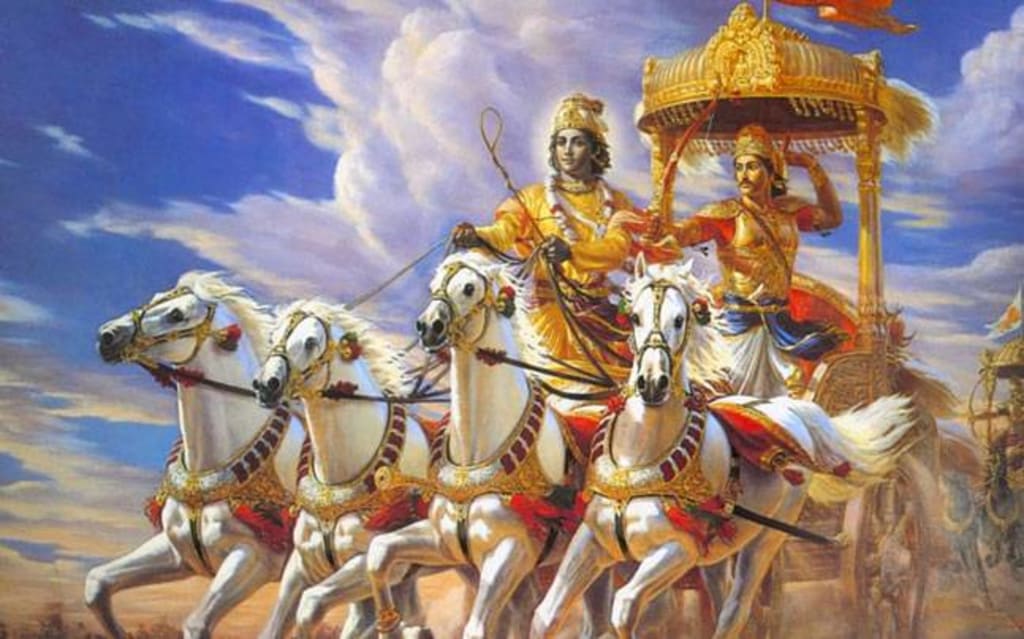
Krishna, who had been the charioteer and advisor to the Pandavas, approached Yudhishthira with a serene smile. "Arise, O King Yudhishthira, for you have fulfilled your duty. You have established dharma and brought justice to the land. But do not let grief cloud your heart, for it was destiny that led to this war. The time has come for you to assume your rightful place as the ruler of Hastinapura."
With Krishna's words of wisdom, Yudhishthira felt a newfound sense of purpose. He ascended the throne of Hastinapura, surrounded by his brothers and the citizens who hailed him as a just and compassionate king.
Part 2: Gandhari's Lament
Amid the celebration of the Pandavas' victory, there was one person whose heart remained heavy with grief – Gandhari, the mother of the Kauravas. She had lost all her sons in the war, and her sorrow knew no bounds.
In her palace, dressed in simple white robes, Gandhari sat in meditation, seeking solace from her pain. Through her tears, she uttered a curse, "O Krishna, you who have always been the protector of dharma, I hold you responsible for this tragedy. May your clan suffer the same fate as mine! May the Yadavas face destruction, just as my beloved sons did!"
Krishna, who had foreseen the consequences of the war, remained calm. He approached Gandhari and said, "O noble lady, I understand your grief and anger. The war was inevitable, and destiny played its role. Your curse shall come to pass, but fear not, for it is the will of the divine."
Part 3: Departure of Lord Krishna
Having fulfilled his purpose on Earth, Krishna decided that the time had come for him to return to his heavenly abode. He bid farewell to the Pandavas and Draupadi, knowing that they would face trials and tribulations even after the war.
As Krishna left, Arjuna was overcome with sorrow. He had formed a deep bond with Krishna during their time together. "How will I live without your guidance, O Krishna? You have been my charioteer, my friend, and my philosopher. My heart aches at the thought of parting from you," Arjuna said with tears in his eyes.
Krishna smiled warmly and replied, "Do not grieve, Arjuna. I will always be with you, in your heart and soul. Remember the lessons I have imparted to you and the dharma I have shown you. Face the challenges ahead with courage and righteousness, and you shall find your way."
With these parting words, Krishna ascended to the heavens, leaving the Pandavas to navigate the complexities of ruling a kingdom and upholding dharma on their own.
Part 4: Yudhishthira's Rule and the Rajasuya Yagna
As Yudhishthira settled into his role as the king of Hastinapura, he sought to establish his authority and unify the kingdoms of Bharata Varsha. He decided to perform the Rajasuya Yagna, a grand ceremony to demonstrate his supremacy as the Chakravartin, the universal ruler.
Rulers and dignitaries from various lands were invited to the Yagna. The ceremony was elaborate and magnificent, and the Pandavas' prosperity and benevolence were evident to all. The Yagna showcased the power and might of the Pandavas' rule, as kingdoms pledged allegiance to Yudhishthira, recognizing him as the true sovereign.
Part 5: The Final Journey of the Pandavas
While Yudhishthira's rule brought prosperity to the land, the burden of the war and its consequences continued to weigh heavily on his heart. He sought counsel from the sage Vyasa, who advised him to embark on a pilgrimage to seek answers to his questions about dharma and life's purpose.
Yudhishthira, along with his brothers and Draupadi, set out on a journey that would lead them to the Himalayas. As they traversed the rugged terrain, they faced numerous trials and tests. Draupadi, who had been a pillar of strength throughout their journey, left her mortal body during this pilgrimage. Each of the Pandavas, in turn, fell to their vices or fate.
Yudhishthira, the paragon of virtue, was the only one who remained steadfast in his pursuit of truth. As he reached the mythical Mount Meru, he was greeted by none other than Lord Indra, who praised his unwavering commitment to dharma. "O Yudhishthira, you have passed the final test of your virtues. You have earned a place in heaven. I invite you to join the celestial realms," said Lord Indra.
Part 6: The Yadavas' Doom
Back in Dwarka, the Yadava clan, including the descendants of Lord Krishna, lived in harmony. However, Gandhari's curse loomed over them like a dark cloud. The Yadavas, intoxicated during a festival, began quarreling amongst themselves, and the quarrels soon turned violent. In their delirium, they mistook one another for enemies, and chaos engulfed the once-thriving city.
Vajra, the valiant grandson of Krishna, tried to intervene and stop the bloodshed, but he could do little to prevent the catastrophe. Eventually, the Yadava clan faced annihilation, just as Gandhari had foretold. The city of Dwarka submerged into the sea, leaving behind only a few survivors to carry the tales of the once-mighty Yadavas.
Part 7: Parikshit's Reign and the Preservation of the Mahabharata
With the Yadavas gone, and the Pandavas' time on Earth reaching its end, the next generation took charge. Parikshit, the son of Abhimanyu, succeeded Yudhishthira as the king of Hastinapura. He was known for his wisdom and just rule, carrying forward the legacy of his ancestors.
Veda Vyasa, the sage who had witnessed and documented the entire saga of the Mahabharata, knew the importance of preserving this sacred text for posterity. He approached his disciple, Vaisampayana, and instructed him to narrate the epic to the next generation. In this way, the Mahabharata was passed down from one generation to the next, preserving the invaluable lessons of dharma, righteousness, and karma.
Conclusion:
The aftermath of the Mahabharata war was marked by the triumph of the Pandavas, the sorrow of Gandhari, the departure of Lord Krishna, and the eventual ascension of the Pandavas and Draupadi to the heavens. The curse of Gandhari brought doom to the Yadava clan, while Parikshit's reign ensured the continuation of the Pandavas' legacy.
The epic of the Mahabharata serves as a timeless reminder of the consequences of human actions, the complexities of dharma, and the importance of seeking truth and righteousness. It continues to be a beacon of moral guidance and spiritual wisdom for generations to come.
About the Creator
Curious Conundrums
Curious Conundrums: Unravel enigmatic puzzles and perplexing riddles in history, science, and beyond. Join the quest to decipher captivating mysteries. Engage, subscribe, and embrace curiosity!
Keep reading
More stories from Curious Conundrums and writers in Education and other communities.
A Beacon of Strength
In the tapestry of my life, there's a thread woven with resilience, dedication, and unwavering love - that thread belongs to my mother. As we celebrate International Women's Day in the Year of the Dragon 2024, I find myself reflecting on the woman who has been my guiding light, my source of inspiration, and my pillar of strength: my mom.
By Curious Conundrums2 years ago in Families
Why Certification Protects Transcription Careers in the Age of AI
Artificial Intelligence has rapidly transformed the transcription industry. Speech-to-text tools now promise instant results, lower costs, and effortless productivity. For businesses focused purely on speed, AI often appears to be the perfect solution. However, beneath this promise lies a critical reality: speed without accuracy creates risk.
By Mahesh Kumara day ago in Education
What It Really Takes to Get a Wikipedia Page Approved in 2026
These days, Wikipedia isn't like the one some folks recall. Back then, an okay article often made it through with just small tweaks. Now things feel tighter, more intense. Every day brings thousands of fresh entries. Most vanish fast, blocked before they stick around. Getting turned down used to be rare. Lately, that's just how it goes.
By Hillshire Media7 days ago in Education
The Dryads are Calling
They say the forest by Phoenix River sings. Perhaps it is just the wind howling through the leaves, or a particular birdsong. But Percy Fisher knows better; he knows what lies in those woods, and he knows that the forest sings of his demise.
By Leigh Hooperabout 16 hours ago in Fiction




Comments
There are no comments for this story
Be the first to respond and start the conversation.