
The 6 Biggest Megalodon Enemies That Ever Existed
Education

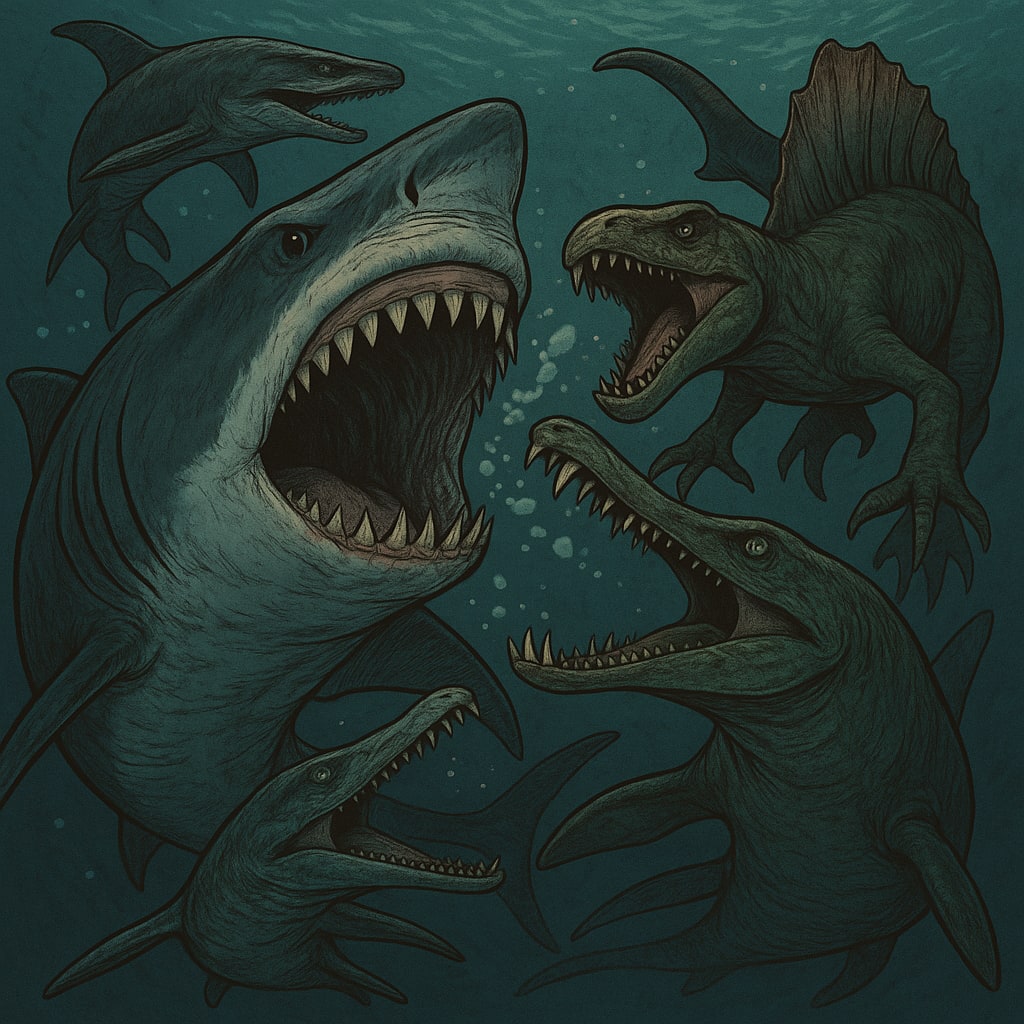
For over 20 million years, the Megalodon was the undisputed apex predator of Earth’s oceans. This colossal prehistoric shark could reach lengths of 60 feet and had a bite force strong enough to crush bone with ease. Its serrated, hand-sized teeth made it a terrifying presence during the Miocene to Pliocene epochs.
But even the most powerful predator faces challenges. Despite its dominance, Megalodon encountered rivals—some that competed for the same prey, others that could pose a direct threat, and still others that quietly reshaped its world. These forces collectively contributed to its eventual downfall.
Here are six of the greatest threats Megalodon ever faced.
1. Livyatan melvillei – The Monster-Whale Rival
Livyatan melvillei was a giant predatory sperm whale, rivaling Megalodon in size and ferocity. Measuring up to 57 feet, Livyatan had enormous, functional teeth in both its upper and lower jaws—some over a foot long.
Unlike today’s squid-eating sperm whales, Livyatan hunted large prey, including marine mammals and possibly juvenile Megalodons. Both predators thrived during the Miocene and inhabited overlapping coastal zones in South America and Africa, likely competing for the same resources.
Though direct fossil evidence of conflict is scarce, their coexistence suggests tense, potentially violent encounters between two top-tier hunters.
2. Megalodon Itself – Cannibalistic Competition
Megalodon’s threat wasn’t always external. Like many shark species today, it may have exhibited cannibalistic behavior.
Fossil evidence from coastal nursery sites reveals juvenile Megalodon teeth and bones bearing bite marks consistent with attacks by larger individuals. In a harsh marine world, even newborns faced predation from their own kind.
Cannibalism likely served as both a survival strategy and a population control mechanism. It highlights the brutal reality that in Megalodon's world, danger sometimes came from within.
3. Brygmophyseter – The Coordinated Killer
Predating Livyatan, Brygmophyseter was another formidable sperm whale species, though smaller—around 23 to 25 feet in length. What it lacked in size, it made up for in toothy aggression and pack behavior.
These whales likely hunted in coordinated groups, much like modern orcas. This made them particularly dangerous to isolated or juvenile Megalodons. A well-organized attack could overwhelm even larger prey.
Brygmophyseter’s emergence marked an evolutionary turning point—the rise of intelligent, social marine predators capable of challenging even the largest solitary hunters.
4. Basilosaurus – The Apex of a Previous Era
Though it lived some 10 million years before Megalodon, Basilosaurus earns a place here for its ecological significance. This ancient whale stretched up to 60 feet and had a long, serpentine body, preying on large fish and smaller marine mammals.
Basilosaurus didn’t directly threaten Megalodon, but it played a key role in shaping marine predator evolution. It was part of the early wave of whale species that set the stage for more advanced, tooth-bearing predators like Livyatan.
In this way, Basilosaurus represents a shift in oceanic power—a transition from reptilian rulers to mammalian contenders.
5. Early Orcas – The Intelligent Upstarts
By the late Pliocene, early orcas (genus Orcinus) began to emerge. Though not as large as today’s killer whales, these ancestors were increasingly intelligent and social, bringing new tactics to marine predation.
Unlike Megalodon’s solitary ambush style, early orcas likely relied on group coordination and strategy. This allowed them to exploit prey and habitats that Megalodon couldn’t access, particularly in colder waters as global temperatures dropped.
Though not a direct threat in terms of combat, orcas represent an evolutionary shift—one that favored adaptability and intelligence over sheer size.
6. Climate Change – The Silent Killer
The most devastating enemy Megalodon faced wasn’t a predator—it was environmental transformation.
Around 3.6 million years ago, Earth began to cool. Ocean temperatures dropped, sea levels receded, and coastal habitats vital for Megalodon’s breeding and hunting began to vanish. Many of its prey species migrated to colder waters—regions Megalodon, being a warm-water shark, could not easily follow.
As food sources dwindled and competition intensified, Megalodon’s range shrank. It was not one catastrophic event but a series of slow, ecological shifts that ultimately led to the species' extinction.
Conclusion: The Fall of a Giant
Megalodon’s story is one of dominance—followed by decline. It reigned as a super-predator for millions of years, shaping marine ecosystems with its presence. But no species is immune to change. Whether challenged by rival predators, pressured by internal competition, or slowly undone by climate, Megalodon eventually faded from Earth’s oceans.
Its extinction wasn’t a dramatic final battle—it was a gradual surrender to forces it could not overcome.
About the Creator
Bobi Dutch
I'm passionate about exploring educational phenomena, focusing on innovation, equity, and the evolving dynamics of learning. I analyze trends, strategies that shape modern education and aim to drive impactful, research-based improvements.
Keep reading
More stories from Bobi Dutch and writers in Education and other communities.
The Resolution of the Great Pyramid Enigma
For over 4,500 years, the Great Pyramid of Giza remained one of history's most perplexing enigmas. How did the ancient Egyptians manage to transport massive limestone blocks—some weighing over 80 tons—without the benefit of wheels, engines, or steel tools? While speculation abounded, ranging from alien interventions to anti-gravity technologies, it was not until 2025 that a multidisciplinary team of archaeologists, engineers, and physicists finally unraveled the puzzle.
By Bobi Dutch10 months ago in Education
The Value of Hard Work
Hard work is one of the most important qualities for success in life. It means putting effort, time, and dedication into our tasks and responsibilities. Many people dream of becoming successful, but success does not come easily. It requires patience, determination, and continuous effort. Hard work helps people achieve their goals and build a better future. It also teaches discipline and responsibility, which are necessary for personal and professional growth.
By aadam khan3 days ago in Education
A School Morning Assembly
Morning assembly is an important activity in many schools. It is a daily gathering of students and teachers before the start of classes. Usually, the assembly takes place in the school ground or in a large hall. All the students stand in lines according to their classes while teachers supervise them. Morning assembly helps students begin their day in a disciplined and organized way. It also creates a positive environment for learning. The morning assembly usually begins with a prayer. The prayer helps students feel calm and focused. It gives them a peaceful start to the day. In many schools, the national anthem is also sung during the assembly. Singing the national anthem together creates a feeling of respect and love for the country. It also helps students feel united as members of the same school community.
By aadam khan2 days ago in Education
Review of 'Man on the Run'
My wife and I saw Man on the Run, a nearly 2-hour documentary on Amazon Prime, about Wings, Paul McCartney's group that flew around the world from shortly after The Beatles broke up in early 1970 to shortly after John Lennon was murdered at the end of 1980, making a Beatles reunion forever impossible.
By Paul Levinson7 days ago in Beat




Comments