


Location: Thanjavur Big Temple, on Google Maps
Thanjavur Temple Timings: 6:00 am – 12:30 pm & 4:00 pm – 8:30 pm (Everyday)
Architect: Raja Raja Perunthachan & Raja Raja Cholan
Architectural style: Dravidian architecture
Thanjavur Temple Built On: 1010 AD
Thanjavur Temple Festivals: Chithirai Brahmotsavam, Shivaratri Function, Sadhaya Vizha
Distance From Trichy: 55 Kms (1 hour Travel Time)
Nearest Airport: Trichy
UNLISTED WONDER OF THE WORLD:
The Thanjavur Big Temple or Thanjavur Brihadeeswarar Temple, is one of the unsung world wonders with many unknown architectural secrets that still keeps the people excited after 1000 years. There are boundless wonders inside the Thanjavur Temple, which will definitely realign the list of world wonders in the upcoming days. It is one of the most attractive tourist places in Tamil Nadu which makes people from other countries know about the Chola Kingdom and their advanced architectural mind. The most surprising factor is that the shadow of the vimana or kalasam of the Thanjavur temple will not fall on the ground. It is still a mystery for the researchers how the shadow is not falling.
THANJAVUR TEMPLE HISTORY:
The Tanjore Big Temple is a stunning monument built by Raja Raja Cholan, greatest king of Chola Dynasty. It was constructed between the year AD 985 and 1014, completed around 1010 AD. The temple is popularly known as the Big Temple, Rajarajesvaram Temple or Peruvudaiyār Kōvil temple. It highlights the architectural mastery of the Chola era. The Thanjavur temple is mainly dedicated to Lord Shiva because the Raja Raja Cholan is the ardent devotee of Lord Shiva. The great temple was built to signify the Chola’s brilliant achievements in architecture, painting, bronze casting and sculpture. Brihadeeswarar temple is one of the few temples that have Ashta-dikpalakas (dik – direction & palakas – ruler. Dikpalakas – ruler of the directions). Brihadeeswarar temple Thanjavur, is the first complete granite temple in the world with more than 130,000 tons.
INTERESTING FACTS OF THANJAVUR TEMPLE HEIGHT & NANDHI SHRINE:
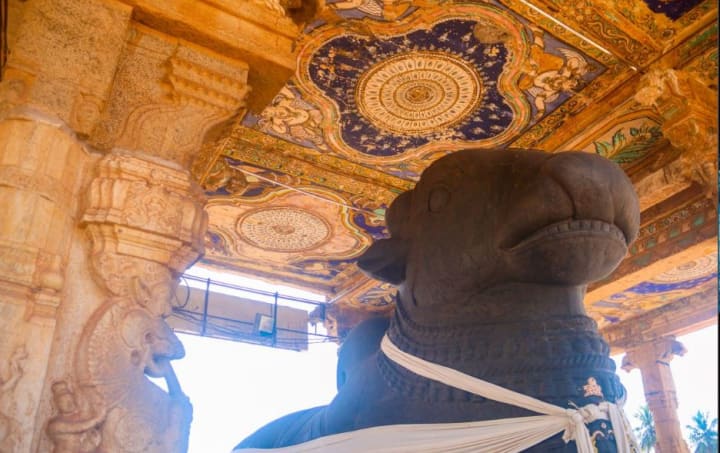
Thanjavur temple height is 212 ft towering Shiva temple, which is home to one of the largest Shiva Lingas of the country. A great Nandhi Shrine (sacred bull), carved out of a single rock at 16 ft long & 13 ft high and standing tall at the entrance. This is the second largest Nandhi in India. The Chola dynasty were Shaivites and so they built the temple specially for Lord Shiva.
THE VIMANAM:
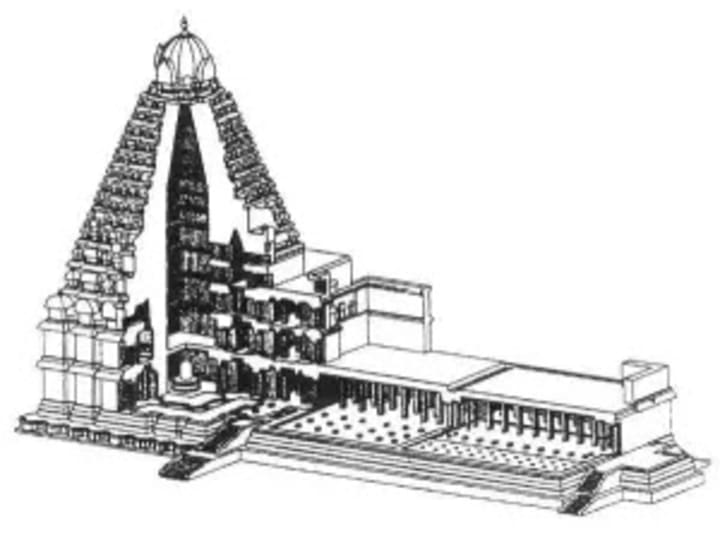
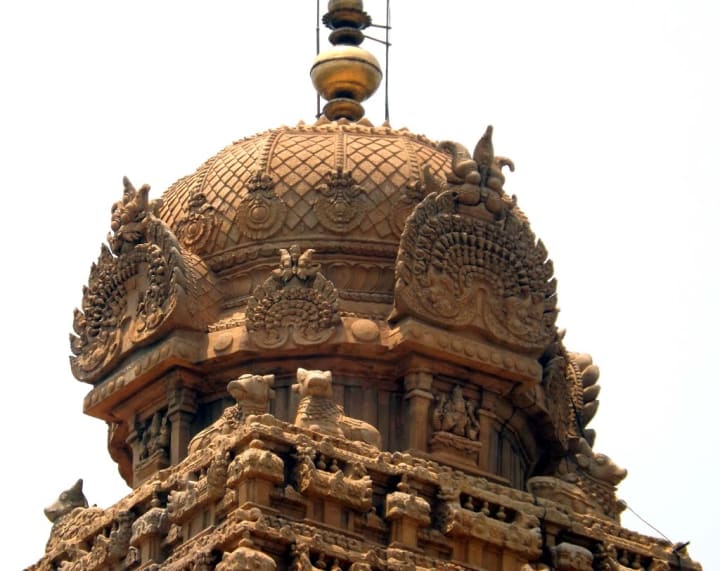
Another stunning architectural feat is the Vimanam (temple tower) is 200 ft high and is the tallest in the world. The Kumba of the temple is carved out of a single rock and weighs around 80 tons & managed to hoist it up to a 212 feet tower back in the 11th century without heavy cranes and modern equipment. It shows the Engineering mastermind of king Raja Raja Cholan. It is hard to imagine but it is not the imagination but the unavoidable truth.
CHIEF ARCHITECT OF THANJAVUR BIG TEMPLE:
The chief architect of the temple was Raja Raja Perunthachan. The layout of the temple is based on the principles of Vastu Shastra. The ancient Hindus science of architecture & the ancient scripts explains the principles behind the temple.
HOW THANJAVUR BRIHADEESWARAR TEMPLE IS RELATED TO TAMIL LETTERS:
The distance and height of the Brihadeeswarar temple is designed with the number of alphabets in Tamil. The Tamil language has totally 247 tamil letters which are followed as
Uyir Ezhuthu – 12
Mei Ezhuthu – 18
Uyir-Mei Ezhuthu – 216
Ayutha Ezhuthu – 1
The height of Gopuram is 216 feet (Uyir Mei Ezhuthu)
The height of Lord Shiva (Lingam inside the temple) is 12 feet (Uyir Ezhuthu)
The height of Sivalinga peedam is 18 feet (Mei Ezhuthu)
The distance between the Sivalingam and the Nandhi is 247 feet (Total no of Tamil letters includes Ayutha Ezhuthu)
HONOURS OF TANJAVUR BRIHADESHWARA TEMPLE:
This temple is part of the UNESCO World Heritage Site “Great Living Chola Temples”.
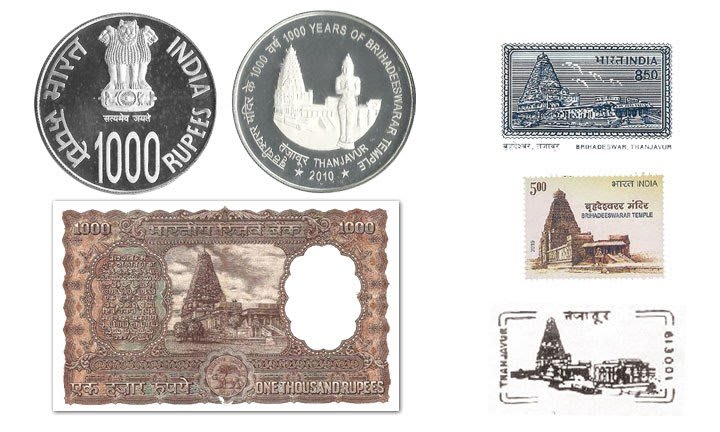
A rupees postage stamp, featuring the 216 feet tall Raja Gopuram (Vimana) was released by the India Post.
In April 1954, the Reserve Bank of India had released a 1000 rupees currency note with a panoramic view of the Brihadeshwara temple.
Paintings;
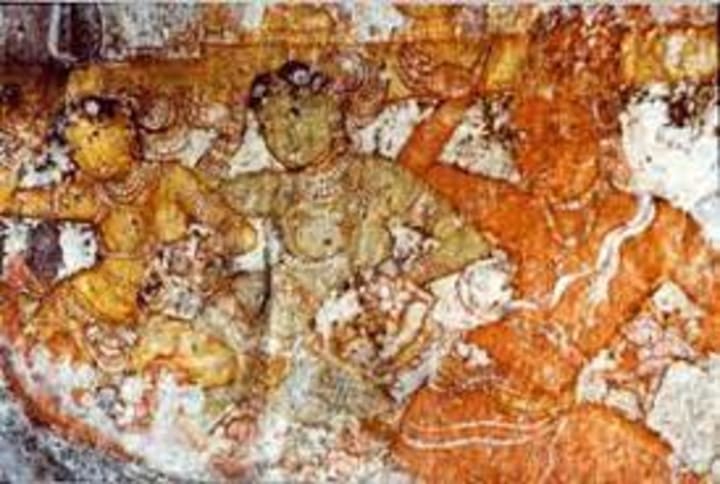
A Thanjavur Painting was generally made on a canvas pasted over a plank of wood (Jackfruit or teak) with Arabic gum. The canvas was then evenly coated with a paste of French chalk (gopi) or powdered limestone and a binding medium and dried. The artist then drew or traced using a stencil, a detailed outline of the main and subsidiary subjects on the canvas. A paste, made of limestone powder and a binding medium called sukkan or makku, was used for creating the Gesso work. Gold leaves and gems of varied hues were inlaid in selected areas like pillars, arches, thrones, dresses, etc. Finally, colours were applied on the sketch.
In the past, artists used natural colours like vegetable and mineral dyes, whereas the present day artists use chemical paints. For outlines dark brown or red was usually used. Red was favoured for the background, though blue and green were also used. Lord Vishnu, was coloured blue, and Lord Nataraja chalk white, and his consort Goddess Sivakami was green. The sky, of course, was blue, but black was also employed on occasions. The portrayal of figures in the paintings was also typical with almost all the figures having rounded faces with almond-shaped eyes and smooth, streamlined bodies. The composition is static and two-dimensional with the figures placed within arches, curtains and decorative borders. The main subject is much larger than the other subjects and occupies the centre of the painting. Seraphs or angels resembling those in European paintings and Islamic miniatures were also shown flanking the main figure. The figures were painted with bright flat colours except for the face where shading was shown. The shading in Thanjavur art was more to create a feeling of depth than to conform to the European conventions of lighting and perspective.
There are some examples of this art in the Saraswathi Mahal Library,[9] in Tanjore built by Serfoji II. The Sanskrit work Prabotha Chandrodayam in the library has a few pages of Tanjore art as also Marathi translations of Mahabharata & Bhagavatham in which are found the works of the painter Madhava swami dated 1824 AD. Faint traces of Maratha style paintings inset with glass are found on the walls of the Thiruvaiyaru Chatram built by Serfoji after his pilgrimage to Kashi. Many other buildings in and around Thanjavur have fine examples of the paintings on the roofs and walls, though many are gradually disappearing and dying due to serious neglect and acts of vandalism.
The British and Victoria & Albert museums in England also house a large collection of Thanjavur paintings in the company and traditional styles. The National Museum of Copenhagen also houses a fine collection of 17th century Thanjavur paintings. King Christian IV of Denmark had received permission to build a fort at Tranquebar (Tharangambadi in Tamil) which led to the building of the Danesborg fort as also a Danish relationship with Thanjavur which resulted in the museum collection.
Without destroying the painting, there was no way to identify the original, but the original work could be identified using Raman spectroscopy without destroying the painting. Raman spectroscopy is a non-destructive technique for distinguishing genuine Tanjore paintings from fakes. The presence of actual 22 carat gold in the painting is confirmed by the energy-dispersed X-ray measurement
CONCLUSION:
The marvellous Thanjavur Temple is one of the best identities of South India. The modern day architects are still curious about the structure of Big temple and how it was built without equipment. The Chola kingdom is finished but the temple built by them was still ruling the people heart with many mysterious facts and wonders inside it. Lot of positivity in the temple will make you cherish and fresh while visiting it.
About the Creator
Naadodii
we make stories about ancient history that may be used by people.
history of Art-Architectures-Build-Paint-Horror-Success-Believes.................
Role of Technology in Modern Islamic Education
Islamic education has always been a cornerstone of Muslim life, guiding children and adults alike in spiritual, moral, and academic growth. Traditionally, learning took place in mosques, madrasas, or homes with direct guidance from teachers.
By Arslan Shahbazabout 10 hours ago in Education
Best Advice for Home Buying in 2026
If you're considering buying a home in 2026, this is probably the top advice you could have. Whether this is your first home or your last home or anywhere in between, some of these things might be a given, some you probably already know, but some are important for 2026. Regardless, here's the best advice for home buying in 2026.
By Tammy Emineth2 days ago in Education


Comments
There are no comments for this story
Be the first to respond and start the conversation.