
Teleportation Is Real (Sort Of): The First Experiments in Real Life
Teleportation

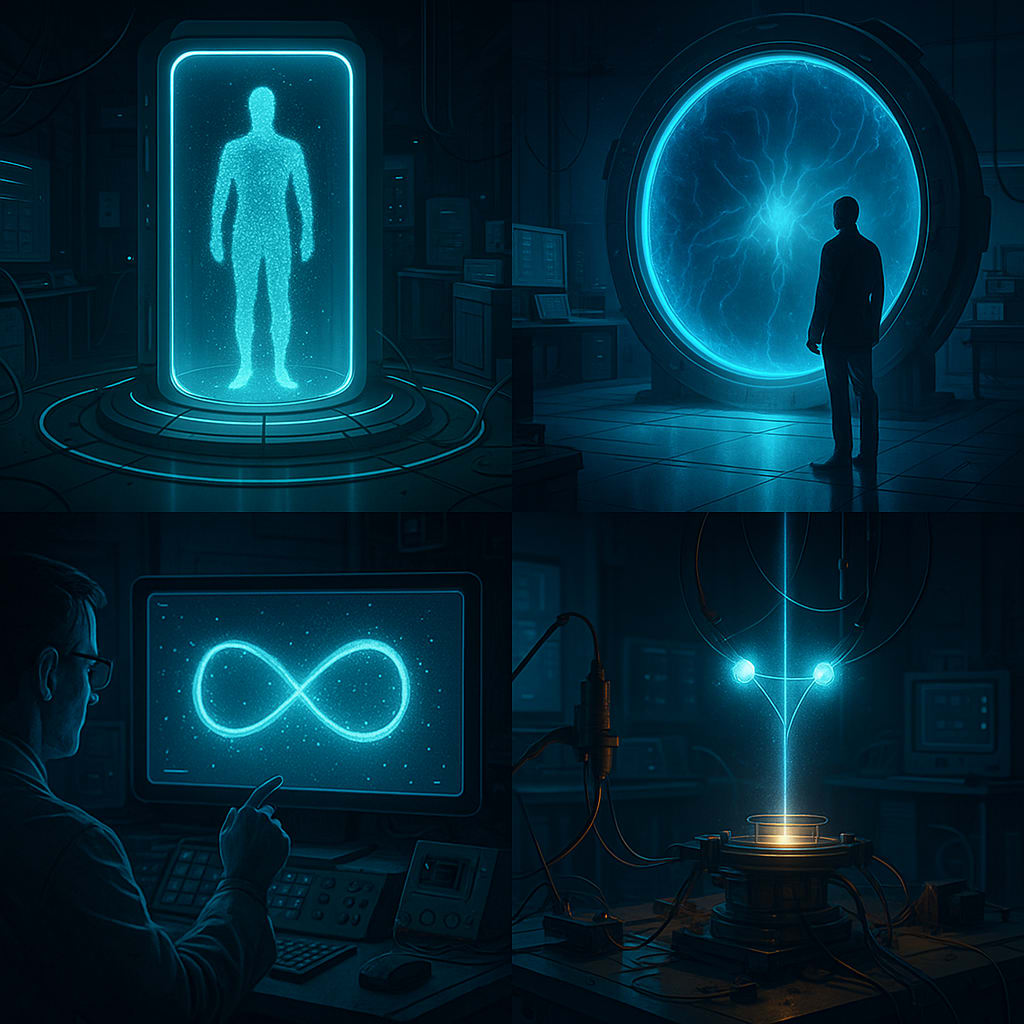
Teleportation — once the stuff of sci-fi dreams — is now inching closer to reality, not in fiction, but in labs around the world. And while we’re not beaming humans across the planet just yet, the science is more real than most people think.
So, What Is Teleportation Really?
Teleportation typically refers to the instant movement of matter from one place to another — skipping space in between. Sci-fi has long sold us on the idea, from Star Trek’s famous “Beam me up, Scotty” to countless futuristic stories where distance is no longer a limit.
In the real world, however, scientists define teleportation a bit differently. It’s not about magically vanishing and reappearing. Instead, it's about transferring the exact quantum state of a particle from one place to another — effectively recreating it elsewhere without physically moving the particle.
This is called quantum teleportation, and it’s not just theory anymore.
Quantum Teleportation: The First Real Breakthrough
Back in 1997, a team of physicists in Innsbruck, Austria, performed the world’s first successful quantum teleportation experiment. They teleported the quantum state of a photon — a single particle of light — across a short distance using the phenomenon known as quantum entanglement.
Entanglement is one of the weirdest aspects of quantum physics. When two particles are entangled, anything done to one instantly affects the other, no matter how far apart they are. Einstein called it “spooky action at a distance.” But it’s real — and it’s the foundation of quantum teleportation.
Fast forward to today: Chinese scientists have teleported quantum information between a ground station and a satellite more than 1,000 km away. This isn’t science fiction. It’s verified, published science.
What’s Happening in 2025? The First Real-World Experiments
2025 is turning out to be a big year for teleportation research. Multiple labs across the globe have reported successful experiments that edge us closer to practical use cases.
At MIT, researchers successfully teleported the quantum state of a superconducting qubit between two cryogenic modules. This is a major step forward in scalable quantum computing and communication.
In Zurich, ETH scientists teleported a photon’s quantum state using a microscopic on-chip fiber network. That’s potentially huge for the future of ultra-secure quantum internet.
And in Singapore, researchers are experimenting with transferring molecular energy states using precise laser and magnetic field interactions — a concept that may one day lead to teleporting simple chemical structures.
Is This Real Teleportation?
Yes — but with a big asterisk. In every current experiment, what’s being teleported is information, not actual matter. It’s a perfect clone of a particle's quantum state, recreated somewhere else, while the original is typically destroyed in the process. So technically, it’s more like reconstruction than movement.
No particles are physically traveling through space. And absolutely no people, apples, or cats are being teleported (yet).
When Will We Teleport an Apple?
Don’t expect to teleport breakfast anytime soon. Teleporting a single atom is mind-bendingly complex. Now imagine doing that with the ~10^26 atoms in an apple — each with its own precise quantum state. Then try transferring that massive amount of information with perfect fidelity.
We're decades — maybe centuries — away from teleporting large-scale objects. But we are moving in that direction. Advances in quantum computing, nanotechnology, and AI-driven modeling could help accelerate breakthroughs over the coming decades.
So... Why Bother?
Even without teleporting objects, the technology has revolutionary implications:
Quantum Communication: Ultra-secure communication networks, immune to hacking.
Medical Data Transfer: Molecular-level scans or data transmitted instantly.
Quantum Internet: Faster-than-light information sync (in a sense), ideal for future interplanetary networks.
In essence, quantum teleportation could rewrite the rules of communication and data security long before it rewrites the rules of travel.
Philosophy Meets Physics
Let’s say, in the year 2100, we teleport a human. Here’s the big question: Is the teleported person you — or just a perfect copy, while the original version is destroyed?
Teleportation forces us to ask profound questions about identity, consciousness, and what it truly means to "be." Are we just information that can be moved and rebuilt? Or are we something more?
The Bottom Line
Teleportation isn’t a fantasy anymore. It’s happening — just not the way sci-fi promised. We’re teleporting states, not stuff. But even that opens the door to technologies that could change the world.
For now, quantum teleportation is one of the most fascinating frontiers of physics. And every successful experiment brings us closer to a world where distance might become obsolete — and the impossible might just be another breakthrough away.
Interested in where teleportation might go next? Keep an eye on quantum labs. Because the future is arriving — particle by particle.
About the Creator
Keep reading
More stories from Holianyk Ihor and writers in Education and other communities.
The Fermi Paradox: Where Is Everybody UFO?
Look up at the night sky. It’s filled with stars — billions of them, scattered like cosmic glitter across the void. Our own galaxy, the Milky Way, is home to over 100 billion stars, and most of them likely have planets orbiting them. Many of those planets may even sit in the “habitable zone,” where conditions could support life. So here’s the big question: if life is so potentially common, where is everybody?
By Holianyk Ihor8 months ago in Education
How Regulatory Rules Are Reshaping the Complexity of Modern Lending Facilities
Lending facilities are a core component of the financial system, enabling banks and financial institutions to provide liquidity, manage credit flow, and support economic stability. In today’s highly regulated financial environment, regulatory compliance, financial regulations, and lending rules have become central to how these facilities function. As oversight increases, lenders must navigate a growing web of requirements that directly affect the structure, speed, and accessibility of lending facilities.
By Eric Kleiner5 days ago in Education
Scaling Smart: Growing Your Small Business on a Tight Budget
Growing a small business doesn’t require massive capital or a large team—it requires intelligent decision-making and a resourceful mindset. Many successful companies started with limited budgets and used creativity and strategic planning to expand. If you're working with constrained resources, here’s how you can still scale effectively and sustainably.
By Alexander Schifter5 days ago in Education




Comments (1)
Quantum teleportation is fascinating. It's amazing how far we've come since that first experiment in 1997. Now, with Chinese scientists teleporting over 1,000 km away, it seems like we're really getting somewhere. I wonder what these 2025 experiments will bring. Will they lead to even more practical applications? It's exciting to think about where this technology could take us in the future.