
Still I Rise
The Real-Life Journey of Maya Angelou, the Woman Who Gave Pain a Voice

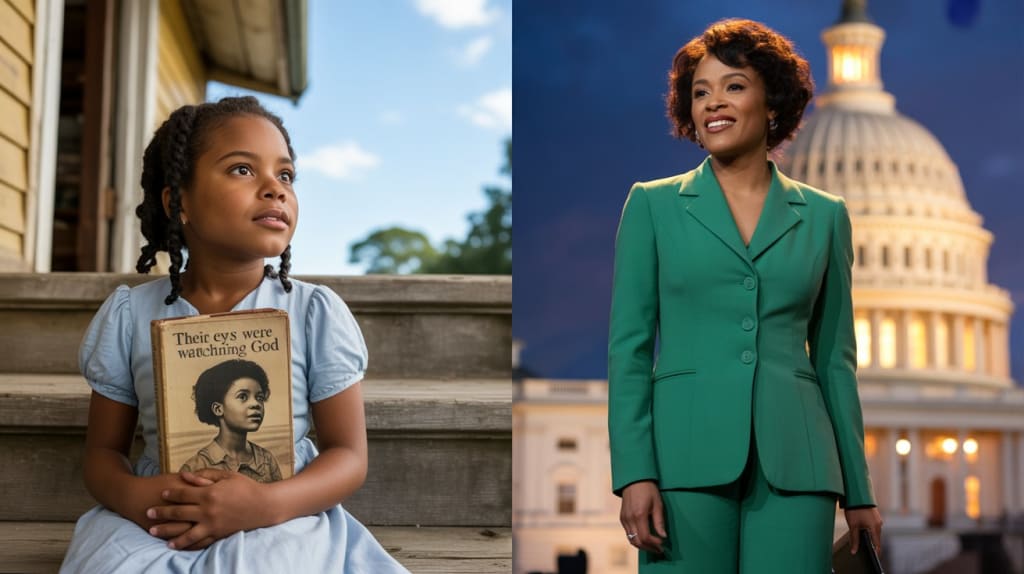
🖋️ The Beginning: A Silent Girl in a Loud World
Before she stood before presidents, before Oprah called her a mentor, before millions knew her words — Maya Angelou was just Marguerite Annie Johnson, a quiet little girl growing up in the deeply segregated South.
She was born in St. Louis, Missouri, in 1928. Her parents split when she was just three, and she and her brother were sent to live with their grandmother in Stamps, Arkansas, a small, racially tense town where Black children knew their place — and were expected to stay in it.
Maya’s early life was filled with confusion, abandonment, and pain. But in the quiet corners of her childhood, she found two anchors:
📖 Books
🖊️ Words
💔 Chapter 1: Silence After Trauma
At the age of just eight, Maya experienced something that would change her forever — she was sexually assaulted by her mother’s boyfriend. When Maya told what had happened, the man was arrested but released shortly after — and was later killed by her uncles.
Overwhelmed with guilt, Maya believed her words had caused his death. So she stopped speaking.
She fell into complete silence for almost five years.
But in her silence, she listened.
She read every book she could find — Shakespeare, Dickens, Black poets, and the Bible.
Words became her secret world. Her safe space. Her weapon and her shield.
🎤 Chapter 2: Finding Her Voice
Eventually, it was a teacher and family friend — Mrs. Bertha Flowers — who helped Maya find her voice again. Mrs. Flowers introduced her to poetry, reading aloud with beauty and grace, and told her:
“You do not love poetry until you speak it.”
Slowly, Maya began to speak. And once she started, the world would never forget what she had to say.
🌍 Chapter 3: A Life Lived Fully
Maya Angelou’s life wasn’t just about writing. She lived more in one lifetime than many ever dream:
She was the first Black female streetcar conductor in San Francisco.
She danced professionally in Africa and Europe.
She acted in theater and film, working with major stars.
She learned to speak six languages.
She worked as a journalist in Ghana and met leaders like Malcolm X and Dr. Martin Luther King Jr.
She didn’t follow a straight path — she lived boldly, took risks, and kept writing and performing wherever she went.
📚 Chapter 4: “I Know Why the Caged Bird Sings”
At age 41 — when many writers feel it’s too late to start — Maya published her first autobiography, I Know Why the Caged Bird Sings (1969). It was raw, honest, and groundbreaking.
In it, she spoke about:
Her childhood trauma
Being Black in America
Gender, racism, identity
The struggle to find her voice
Many were shocked. Some libraries banned the book. But readers — especially women and people of color — felt seen for the first time.
She had turned pain into poetry, truth into art, and silence into thunder.
The book was nominated for a National Book Award and remains one of the most taught and loved memoirs in American literature.
✊ Chapter 5: A Voice for Her People
Maya Angelou became not just a writer, but a cultural icon.
She wrote poetry, plays, essays, and film scripts.
She was a professor, a civil rights activist, and a public speaker.
She appeared on national TV, always dignified, powerful, and unapologetically herself.
In 1993, she delivered the poem “On the Pulse of Morning” at President Bill Clinton’s inauguration, becoming only the second poet in U.S. history invited to perform at such an event.
Her words echoed:
“History, despite its wrenching pain, cannot be unlived, but if faced with courage, need not be lived again.”
Millions watched and wept.
🧠 Chapter 6: Wisdom and Grace
In her later years, Maya became a beacon of wisdom. Celebrities, politicians, students, and everyday people looked to her for guidance. She spoke often about:
Forgiveness
The power of words
Courage
Black pride
Womanhood
Hope
She reminded us again and again that we are more than what happened to us.
She famously said:
“I've learned that people will forget what you said, people will forget what you did, but people will never forget how you made them feel.”
🪦 Chapter 7: A Legacy That Cannot Die
Maya Angelou passed away in 2014, at the age of 86. But her voice never stopped echoing.
She left behind:
Over 30 books
Millions of hearts changed
A life lived in full truth and expression
In 2022, she became the first Black woman to appear on a U.S. quarter, a symbol of how far her voice reached — from Southern silence to national honor.
🌍 What Maya Angelou Taught Us
Your past doesn’t define your future – Trauma and pain didn’t silence her forever; they shaped her art.
Words are power – She showed that a poem, a line, or a voice can shake systems.
It’s never too late – Her most famous book came after 40.
Live many lives – You don’t have to fit one label. Maya was a poet, actress, dancer, mother, activist, and mentor.
Tell your truth, even when it trembles – Because someone out there needs it to survive.
💬 Final Words: Still She Rises
Maya Angelou once said:
“There is no greater agony than bearing an untold story inside you.”
She told hers — boldly, beautifully, unapologetically.
And through her, countless women, survivors, and artists found their voice.
So if you have a story inside you, if you’ve been silenced, hurt, or doubted — remember Maya.
She started in silence.
She ended in symphonies.
And so can you.
About the Creator
Farzad
I write A best history story for read it see and read my story in injoy it .
K-12 Education Technology Spend Market to Reach USD 253.9 Billion by 2033
K-12 Education Technology Spend Market Summary The K-12 Education Technology (EdTech) Spend market covers the budgets allocated by schools and districts for digital learning software, connected classroom tools, student devices, broadband, cybersecurity, and IT support services. This spend is increasingly treated as core education infrastructure, not an optional add-on, because teaching, assessment, and school operations are now tied to digital systems. The global market size is expected to reach USD 253.9 billion by 2033, up from USD 78.2 billion in 2023, reflecting a forecast CAGR of 12.5% from 2024 to 2033.
By Roberto Crum5 days ago in Education
Why Generic Medicines Are Expanding Access to Healthcare Across Latin America?
Healthcare accessibility remains a central priority across Latin America, and generic medicines are playing a critical role in improving treatment availability. Generic drugs provide cost-effective alternatives to branded pharmaceuticals while maintaining the same active ingredients, dosage, and therapeutic effects.
By deepanshu Thakur5 days ago in Education
Review of 'Man on the Run'
My wife and I saw Man on the Run, a nearly 2-hour documentary on Amazon Prime, about Wings, Paul McCartney's group that flew around the world from shortly after The Beatles broke up in early 1970 to shortly after John Lennon was murdered at the end of 1980, making a Beatles reunion forever impossible.
By Paul Levinson7 days ago in Beat



Comments
There are no comments for this story
Be the first to respond and start the conversation.