
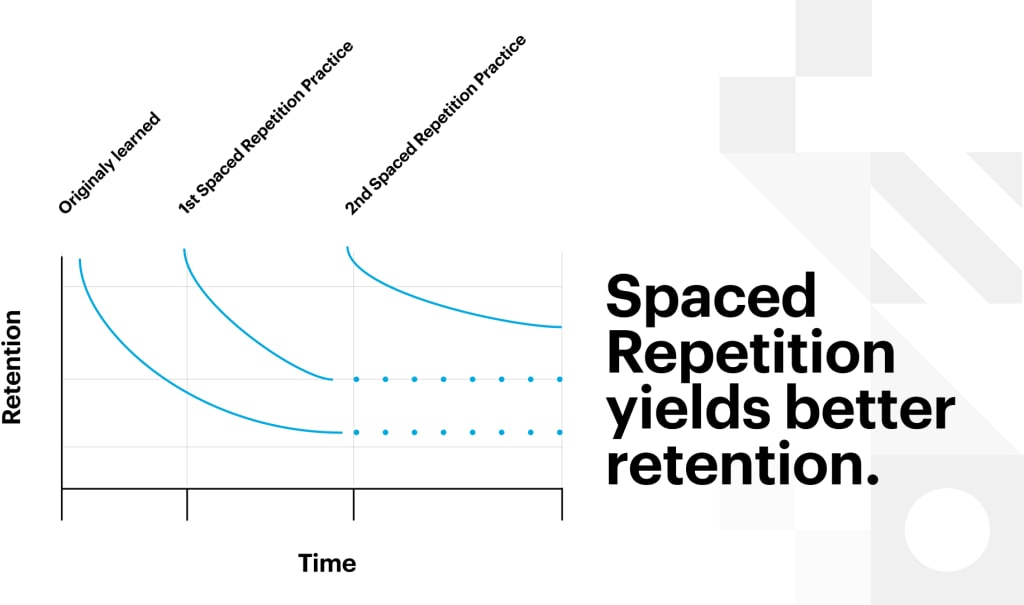
An effective technique for enhancing your memory and learning new material is spaced repetition. The fundamental tenet of spaced repetition is that you should review material at increasing intervals in order to revisit it just before you forget it. Studies demonstrating that spaced repetition can significantly increase memory and learning are the overwhelming majority of the scientific evidence in favour of it.
One of the key advantages of spaced repetition is that it can be used to effectively learn a wide range of information, from vocabulary words in a foreign language, to historical dates, to complex scientific concepts. In order to get started with spaced repetition, you’ll need to find a tool or app that can help you schedule your reviews. There are many different spaced repetition apps available, and some popular options include Anki, Quizlet, and Memrise. I have used Anki since my third year of medical school, therefore I can testify for it personally.
Once you’ve chosen an app, you’ll need to start creating flashcards for the information that you want to learn. These flashcards should be simple and easy to understand, and should include the information that you want to remember on one side, and the answer on the other. For example, if you’re trying to learn the vocabulary of a foreign language, you might create a flashcard that has the English word “house” on one side, and the translation in your target language on the other.
As you create your flashcards, you’ll also need to set up a schedule for reviewing them. The exact schedule will depend on the app you’re using, but most apps will allow you to specify how often you want to review each card. For example, you might review a card that you just created once a day for the first week, then twice a week for the second week, and so on.
Now, you might be thinking, “This sounds like a lot of work!” And you’re right, it can be. But here’s the thing:
“the effort you put into creating and reviewing flashcards will pay off in the long run”
Studies have shown that people who use spaced repetition to learn new information tend to remember that information for longer periods of time than people who don’t use spaced repetition.
Another great feature of spaced repetition is that it can be customized to fit your specific learning style and needs. For example, if you’re someone who learns best by seeing and hearing information, you might want to use a spaced repetition app that allows you to add audio and images to your flashcards. Similarly, if you’re someone who struggles with memorizing lists of facts, you might want to use a spaced repetition app that allows you to create flashcards that include multiple choice or fill-in-the-blank questions.
Another way to customize your spaced repetition practice is by using the Leitner system. This system uses a hierarchical box system in which flashcards are sorted into different boxes based on how well you know them. For example, flashcards you struggle with will be in the first box, and as you correctly answer them, they move to the next box and so on. This system allows you to focus on the cards that you need to review the most, and it can help you to make the most of your study time.
One of the most important things to keep in mind when using spaced repetition is consistency. The key to making spaced repetition work is to stick with it and review your flashcards on a regular basis. It can be easy to get sidetracked by other things, but if you make reviewing your flashcards a priority, you’ll be much more likely to see progress.
Finally, it’s important to note that spaced repetition is not a magic bullet. Learning takes time and effort, and there’s no substitute for putting in the work. However, by using spaced repetition, you can make that effort more effective and efficient. You’ll be able to master new information faster and retain it longer, which will give you a real edge in whatever you’re trying to achieve.
So, don’t be afraid to give spaced repetition a try, and don’t forget to have fun with it! And remember, as Confucius once said,
“The man who moves a mountain begins by carrying away small stones.”
So, take it one flashcard at a time and before you know it, you’ll be a master of the information you want to learn.
In a nutshell, spaced repetition is a scientifically-proven method for improving your memory and mastering new information. It can be used to learn a wide range of information, from vocabulary words in a foreign language, to historical dates, to complex scientific concepts. By using spaced repetition apps, creating flashcards, setting up a schedule and customizing your practice you can make the most of your study time and achieve your learning goals.
About the Creator
M. A. S
Doctor | Aspiring surgeon | Caffeinaholic | Gamer | Tech enthusiast
Guide to become more productive today!
Being productive is an essential aspect of achieving success in both personal and professional life. However, with so many distractions and tasks vying for our attention, it can be difficult to stay on track and accomplish everything we set out to do. Fortunately, there are a number of strategies and techniques that can help you be more productive and get more done.
By M. A. S3 years ago in Motivation
Guide to Canada's Six Essential Learning Skills for Students
Written by Kiki Devano In Canada, there are the six essential skills that are encouraged for students to develop. These learning skills have a formidable impact on student learning and will help them achieve further success. This is a guide to aid students in successfully developing the essential skills.
By Kiki Devanoa day ago in Education
Benefits of Study Abroad Scholarships
Benefits of Study Abroad Scholarships Millions of students around the world long to study abroad. It's very exciting to have the chance to study at a foreign university, learn about a new culture, and build a career that spans the globe.
By Farida Kabira day ago in Education



Comments
There are no comments for this story
Be the first to respond and start the conversation.