
Soviet-Era Spacecraft Crashes Back to Earth After 53 Years in Orbit
Unexpected, explosive, and decades overdue, a forgotten Cold War relic finally makes its way home.
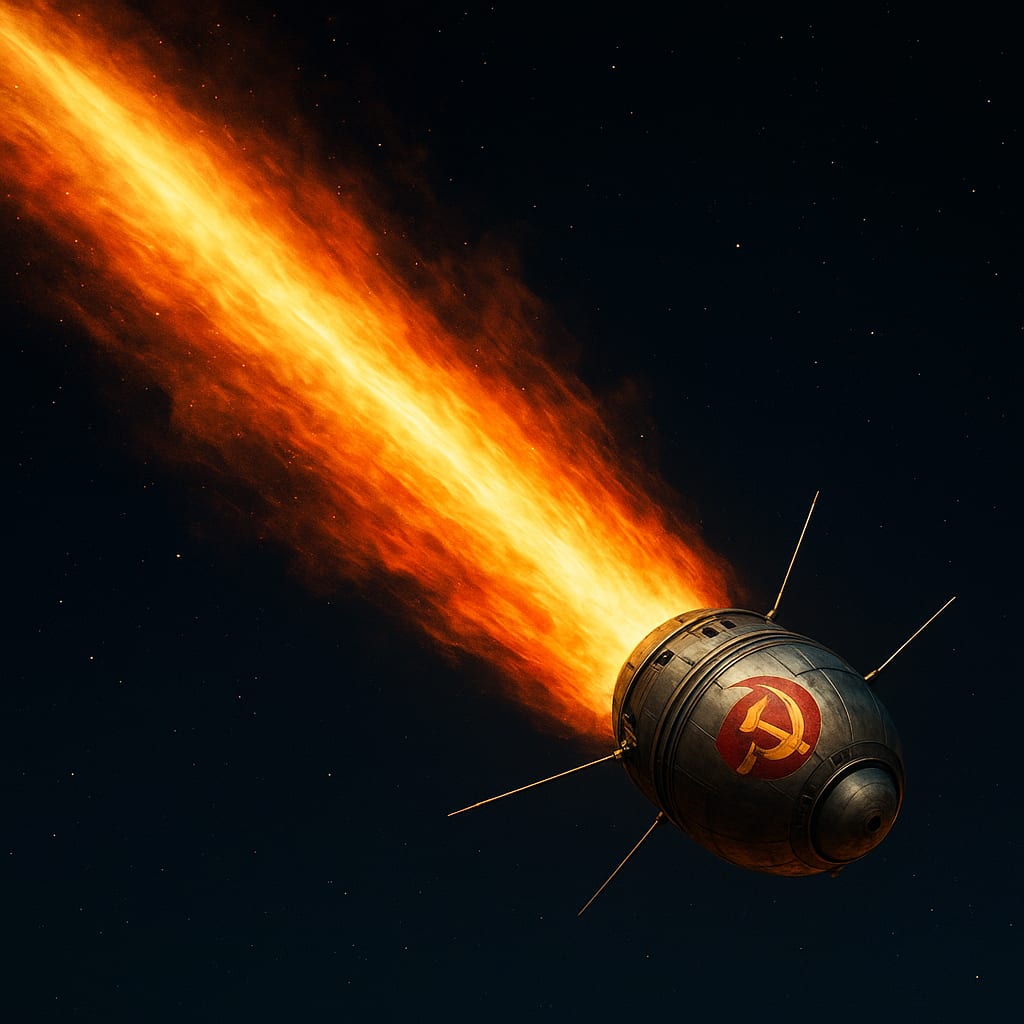
On a quiet morning in April 2024, the skies over the South Pacific briefly lit up as a streak of fire cut across the atmosphere. It wasn’t a meteor or space junk from a recent mission. It was a Soviet-era spacecraft—launched more than half a century ago—that had finally re-entered Earth's atmosphere after spending 53 years orbiting the planet.
The spacecraft, known as Kosmos 305, was launched in January 1971 by the Soviet Union during the height of the space race. Originally designed for military reconnaissance and experimentation, its mission was expected to last just a few weeks. Instead, a malfunction left it stranded in low Earth orbit… where it remained, silently circling the globe, for more than five decades.
A Mission Lost in Time
Kosmos 305 was part of the DS (Dnepropetrovsk Sputnik) satellite program, a secretive project run by the Soviet military and space agency. These satellites were used for a variety of purposes—from testing electronic surveillance tools to studying cosmic rays and monitoring nuclear activity.
The launch went as planned. The spacecraft entered orbit and began its mission. But just days later, a critical failure—believed to be a power system short—rendered it inoperable. Unable to respond to commands or perform its tasks, Kosmos 305 became what space experts now call a “zombie satellite”—a dead spacecraft, still in orbit, but unable to communicate or function.
At the time, the Soviet Union quietly removed it from official records. In a world without the internet or real-time satellite tracking, it faded from memory.
But Kosmos 305 didn’t go anywhere.
Trapped in Orbit
For the next 53 years, the spacecraft circled the Earth approximately 16 times per day, covering millions of miles. It became one of thousands of pieces of space debris orbiting the planet—unseen, unnoticed, and often forgotten.
Space experts knew it was up there. International tracking systems, particularly after the 1990s, kept tabs on aging satellites like Kosmos 305. Predictions showed it would eventually fall back to Earth—but when? That was anyone’s guess.
Low Earth orbit is crowded. Additionally, the Earth's gravity and atmospheric drag gradually pull even dead satellites back toward the atmosphere over time. Still, the process can take decades, especially for objects launched as far back as the 1970s.
Then, in early 2024, tracking stations noticed something unusual.
Kosmos 305’s orbit was decaying faster than expected. Minor shifts in solar activity were increasing atmospheric drag. The prediction: the long-lost satellite would finally come home—and soon.
The Fiery Return
On April 23, 2024, at approximately 3:37 a.m. GMT, Kosmos 305 re-entered the Earth’s atmosphere. The event was captured by multiple satellites and even by a few lucky skywatchers in the South Pacific.
As it plummeted through the atmosphere at over 17,000 mph, friction caused its surface to heat up to thousands of degrees. The satellite glowed white-hot, then began to break apart. The sky was illuminated by a fiery trail, a stunning but destructive sight. Experts believe that most of the spacecraft burned up entirely, disintegrating before reaching the ground. Some fragments may have survived, but if they did, they likely fell into the remote ocean, far from human civilization.
Thankfully, no one was hurt, and no damage was reported.
A Glimpse Into the Past
While Kosmos 305’s return didn’t cause any harm, it did spark renewed interest in the early days of space exploration, especially the Cold War-era rivalry between the U.S. and the USSR.
There were a lot of rapid-fire launches in the 1960s and 1970s, many of which were military in nature and kept secret. Some satellites like Kosmos 305 were never meant to be public knowledge. Others were part of ambitious scientific projects, long since forgotten.
Experts are now combing through declassified Soviet documents, trying to piece together more about the satellite’s exact mission. What technology was on board? What were its true goals? These are questions that might never be fully answered.
But one thing is clear: Kosmos 305 represents a time when nations were willing to send machines into space, even without knowing if they could bring them back.
The Problem of Space Junk
This dramatic return also brings attention to a growing issue: space debris.
Kosmos 305 is just one of more than 25,000 tracked objects in orbit today. These include working satellites, dead spacecraft, spent rocket stages, and fragments from collisions or explosions.
Each piece of debris poses a potential risk. A small metal shard traveling at orbital speeds can cripple a functioning satellite—or worse, cause a chain-reaction collision known as the Kessler Syndrome, which could make spaceflight dangerous for decades.
Governments and private companies are now exploring ways to clean up orbit, such as using robotic arms, space nets, or even lasers to remove debris. However, the technology is still in its infancy. The demise of Kosmos 305 serves as a reminder that what we send into space does not remain there forever.
An Eerie Echo of the Past
In an age of reusable rockets, SpaceX, Mars missions, and private space tourism, it’s easy to forget how different space exploration was in the past. The story of Kosmos 305 is like a ghost from a different era—one where the world was divided, and space was the ultimate battlefield for national pride and military dominance.
And yet, even after its mission failed, even after it was forgotten, Kosmos 305 continued to orbit Earth—silently, faithfully, like a sentinel watching over a changing world.
It didn't come back with a whimper, but rather with a fiery bow.
Final Thoughts
The unexpected return of Kosmos 305 captured imaginations around the world. For space historians, it was a rare chance to reconnect with a lost chapter of Cold War history. For scientists, it was a case study in long-term orbital decay. And for the general public, it was a dramatic reminder that what we put into space often stays there much longer than intended.
As we launch more satellites and explore deeper into space, stories like Kosmos 305 will become more common—and more urgent.
Because space, for all its vastness, is starting to get crowded.
About the Creator
Keep reading
More stories from Shahidul islam and writers in Education and other communities.
Top 15 Most Beautiful Places on Earth: A Journey Beyond the Ordinary
1. Yemen's Socotra Island Often called the 'Galápagos of the Indian Ocean,' Socotra is home to plants and landscapes that look like they belong on another planet. The iconic Dragon's Blood Trees, with their umbrella-like canopies and crimson sap, create an eerie yet captivating view. Its isolation has allowed species to evolve in ways seen nowhere else, making it a living museum of natural history.
By Shahidul islam10 months ago in Education
7 AI Tools That Can Replace Hours of Work in 2026 (And Help You Make Money Online)
Artificial intelligence is no longer just a futuristic idea—it’s quickly becoming one of the most powerful tools for productivity and online income. In 2026, AI tools are transforming how people work, create content, start businesses, and automate daily tasks.
By Majus Jasulaitis3 days ago in Education
Distracted Thoughts
I go for a swim every Sunday morning. I’m not sure why I started there. Probably because that’s where I started thinking about writing this. But that being the case I could quite easily have started when I was looking at the hot honey Jaffa Cakes in Tesco that I hadn’t gone in to buy but had caught my eye en route to the eggs. I slipped towards it then. I suppose I could start from the drive to the massive antique shop or a couple of times when I was in there too, the idea drifted in and out like a desperate jellyfish trying hard not to get stuck on the shore. It has some sense of shape but little direction and every chance of being pecked to bits by angry seagulls. Now I’ll go back to the swimming pool, that is a useful place to start.
By Simon Curtisa day ago in Education


Comments
There are no comments for this story
Be the first to respond and start the conversation.