
Some words should never be said to children
The power of "suggestion" is so terrible!

Destroying a child is quite simple
A reporter once interviewed a juvenile offender.
He was mute and not very willing to talk.
Until his father came to see him. Through the glass, the father said to him for the first time, "I'm sorry."
The boy exploded with emotion, he couldn't stop shaking and crying and yelled at his dad.
"Why are you saying sorry to me? Isn't that what you want to see?"
"Ever since I was little, you've been saying every day that I'm no good and only know how to beat me and scold me, you're the one who turned me into this!"
"I'd rather be in jail so you can never hit me."
"Do you think I want to have a father like you? I was left with no choice, no choice!"
It turned out that the boy's father, who was impatient and did not know how to educate his child, used to scold and belittle him by saying.
"How did I give birth to such a loser like you!"
"Like you, you'll go to jail sooner or later."
These words were spoken by the father in a hurry and turned into a real curse on his son.
A survey shows that more than 40% of juvenile offenders have suffered verbal abuse from their parents.
The parents of these children, with one violent word, cut their children's futures short and caused irreversible damage to other families.
It has been said that the murder weapon these children stabbed others was handed to them by their parents themselves.
Never underestimate the mouth of a parent. The things you often say will become a prophecy for your child's life.
In psychology, there is a "self-fulfilling prophecy" phenomenon.
When parents yell at and belittle their children, they give them negative psychological cues. The child will gradually believe these comments, unconsciously act according to the parents' comments, and eventually let the prophecy come true, becoming the "bad child" in the parents' mouths.
If the child is often called stupid, the child's brain will slowly become stupid after receiving the cues.
If the child is often told of his or her shortcomings, the child will become inferior and weak.
If you say that your child is not good enough, your child will gradually decide that he or she is not good enough.
Destroying a child is very simple.
Children who are often hinted at will have amazing changes in their brains
Children who are often cued are not only affected mentally and emotionally, but their brains also undergo amazing changes.
Dr. Martin Thacher of Harvard Medical School found that

The brain areas most likely to be affected by verbal violence are the corpus callosum (the area primarily responsible for transmitting motivational, sensory, and cognitive information between the two brain hemispheres), the hippocampus (the brain area responsible for managing emotions), and the prefrontal lobe (the brain area responsible for thinking and decision-making).
Children who are chronically exposed to verbal violence have a significant reduction in the volume of their hippocampus and corpus callosum.
This means that the child's memory and reaction time will be reduced and their IQ will be directly affected!
Children who are frequently subjected to verbal violence such as yelling, name-calling, and cursing by their parents grow up with an average verbal IQ score of 112, 12 points lower than those who are not subjected to verbal violence.
Moreover, for a child who is frequently yelled at, his ability and desire to learn, are significantly reduced.
Brain science studies also prove this.
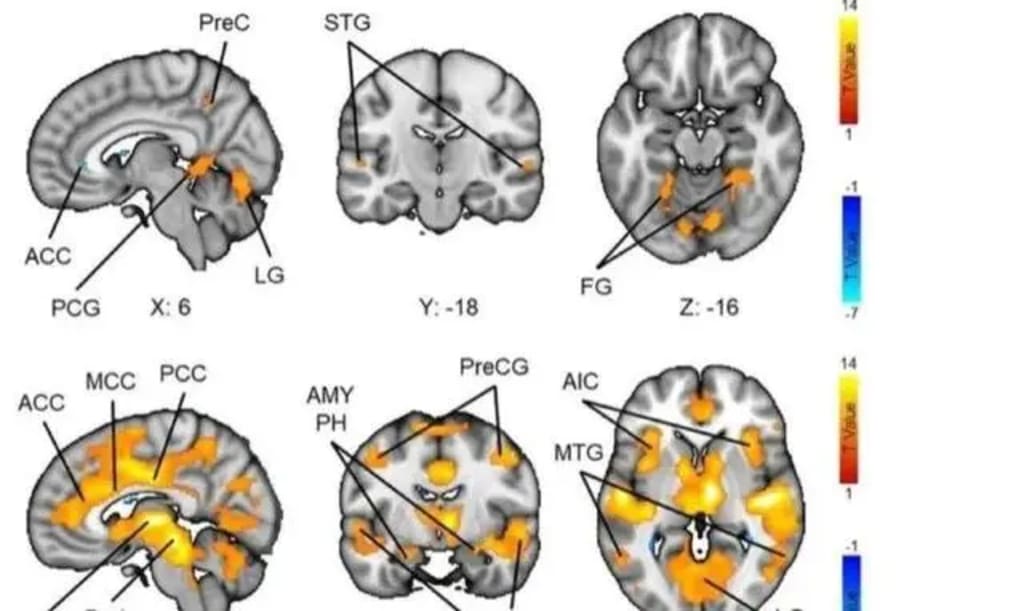
In a chronic yelling environment, the amygdala in a child's brain is constantly stimulated.
The amygdala, is primarily responsible for processing the two emotions of anger and fear.
If the amygdala is repeatedly stimulated, the child lives in fear at all times.
In the case of severe verbal violence, the child may feel trembling all over, shortness of breath, physical pain, and even feelings of nausea and dizziness.
Areas of the brain that are activated by emotional shock
A child who is in fear at all times is destined to be an ineffective learner.
Educator Erikson believes that verbal violence by parents causes far more damage to children than physical violence.
Children will carry these hurts with them for the rest of their lives.
Replace Negative Words with Positive Words
A single word can destroy a child; a single word can also make a child.
There was a famous experiment in psychology - the "authoritative lie" experiment.
Professor Rosenthal, a psychologist, went to an ordinary high school, randomly crossed out 18 names, and said to the teacher, "These students have high IQs and are very smart."
Unexpectedly, 8 months later, a miracle occurred!
Those 18 selected students became the top of the class. Moreover, they were self-confident, eager to learn, and more willing to deal with others.
Why is this so?
Because the students who receive the "excellent" hint feel that they are excellent, so they use the standard of excellence to demand themselves, and they become excellent.
This is the power of positive suggestions!
Rosenthal concludes.
Rosenthal concluded that when a person is labeled in a certain way, it is easy for him to accept the psychological suggestion and thus deflect in the direction the label points to.
This inspires parents: to give their children positive psychological cues to help them work in the desired direction.
How do you do it exactly?
Don't label your child negatively
"My child is too dawdling!"
"He only knows how to play games all day long, when will he ever learn?"
If you say things like this too often, your child will think, "My parents already think that about me anyway, so it's useless for me to behave anymore, so I might as well break the pot.
Replace negative language with positive language
Replace "hurry up" with "we'll leave in 5 minutes".
Replace "No crying" with "Let's talk after crying".
Replace "Can you be good" with "Mommy knows you'll change".
Replace "What are you afraid of?" with "Don't be afraid, mommy is here".
Replace "Stop it" with "Control it a little".
Replace "What's so hard about it" with "No one succeeds at once".
Replace "you're not going to do it right" with "let's try".
When we keep repeating positive words, children will receive positive reminders to change their perceptions and actions.
See more of your child's strengths
It is better to count your child's ten faults than to reward them for their strengths.
Shift your gaze from your child's faults to his or her strengths, praise him or her, and find ways to let him or she know.
There is also no need to be stingy with praise for your child in front of outsiders. Children are more likely to trust the authenticity of their parents' compliments in front of others than direct praise.
Give clear instructions
In Positive Discipline, psychologist Jane Nelson tells a case study.
Many parents struggle with their children making their beds. No matter how much they command, warn or even reprimand, their children refuse to fold the covers.
One 6-year-old, on the other hand, was able to make the quilt neatly and even passed the army test.
The parents were curious and went to ask the child's mother, "Why does your child not only obey but also do so well?"
The mother replied, "In fact, my child was also repeatedly taught at first, and then I found that he was not disobedient, but I said the method, he did not understand.
When I changed all the sheets into a grid and asked him to fold them according to the lines, he easily understood and did it."
So, when your child is not doing well enough, don't rush first and observe if it is your teaching method that is beyond your child's understanding.
If so, give simpler and more understandable instructions.
The writer Hani Rubin famously said.
"Be careful of your words; they will become your actions.
Be careful what you do, it will become your habit.
Be careful of your habits, they will become your character.
Watch your character, and it will become your destiny."
It's the same with teaching children; the things we often say end up becoming prophecies for our children that affect them for the rest of their lives.
If you too have been a victim of verbal violence, remind yourself not to let your child become another version of yourself.
Please believe that every child has the power to change for the better.
About the Creator
Bettye Lutz
Ascent must be inferior, self-esteem is too high can not achieve success, and therefore successful people must cultivate a calm mind, and focus on everything, which is the key to success. I like vocal music
Keep reading
More stories from Bettye Lutz and writers in Education and other communities.
Why are most finance professionals so poorly paid?
The low salary of financial personnel is a "false proposition". Engaged in financial work, some people earn more than a million a year easily, some monthly salary of only three thousand also busy feet, why cause such a big gap? Because in addition to the effort, there are particularly important things, often overlooked.
By Bettye Lutz3 years ago in Education
Empowering Your Financial Journey: The Role of Wellness and Coaching
Financial success is not only about numbers, budgets, and investment strategies. It is also deeply connected to mindset, habits, and overall well-being. Many people work hard to improve their financial situation, yet they often overlook the emotional and behavioral aspects that influence financial decisions. Empowering your financial journey means recognizing that financial wellness and coaching can play a powerful role in building lasting stability and confidence.
By Mario Payne5 days ago in Education




Comments
There are no comments for this story
Be the first to respond and start the conversation.