
Scaling a Multi-Location Dental Clinic Through Structured Local SEO
Local SEO

In highly competitive urban healthcare markets, visibility is often the defining factor between steady growth and stagnation. Even well-reviewed clinics with modern facilities can struggle to generate consistent organic inquiries if their digital presence lacks strategic structure.
This case study explores how a multi-location private dental clinic improved its local search visibility, reduced dependency on paid advertising, and established organic search as a primary patient acquisition channel through a structured SEO framework.
Initial Situation
The clinic operated in a competitive UK metropolitan area with multiple established dental providers competing for high-intent local keywords such as:
Emergency dentist
Invisalign provider
Same-day dental appointment
Cosmetic dentist near me
Despite having:
A professionally designed website
Strong Google reviews (4.8★ average)
Active Google Ads campaigns
Their organic search performance remained underwhelming.
Key Challenges Identified
No Top 3 rankings for core service-based keywords
Limited visibility in Google’s local map results
Heavy reliance on paid traffic (over 70% of inquiries came from ads)
Poorly structured service pages
Weak internal linking and technical inefficiencies
The primary objective was to build sustainable organic visibility while improving conversion quality.
Phase 1: Search Intent & Structural Optimization
Rather than focusing solely on keyword density, the strategy began with search intent mapping.
Keywords were categorized into:
Emergency intent (high urgency)
Commercial investigation intent
Cost-related queries
Informational searches
Branded searches
This process identified 60+ transactional keywords with measurable local demand.
Website Architecture Improvements
The clinic’s website structure was reorganized into service-based silos. Each major treatment category received:
A dedicated landing page
Supporting informational content
Clear internal linking pathways
Technical improvements included:
Fixing crawl depth issues
Improving page load speed
Optimizing Core Web Vitals
Implementing structured data markup (MedicalBusiness, FAQ, Review schema)
These changes enhanced search engine crawl efficiency and improved indexation rates.
Phase 2: Local SEO & Google Business Profile Optimization
Local search visibility was a critical growth factor.
The Google Business Profile was fully optimized, including:
Accurate service categorization
Keyword-aligned descriptions
Weekly content updates
Structured Q&A additions
Consistent review engagement
Additionally, citation inconsistencies were corrected to ensure NAP (Name, Address, Phone) alignment across directories.
Location-based landing pages were enhanced with localized content signals to strengthen geographic relevance.
Within three months, the clinic’s primary emergency service keyword moved from page two visibility into the Top 3 Map Pack positions.
Phase 3: Authority & Trust Signals
Healthcare SEO requires strong trust signals due to the sensitive nature of medical services.
Enhancements included:
Displaying clinician credentials clearly
Adding treatment FAQs to reduce uncertainty
Highlighting patient testimonials strategically
Improving transparency in pricing information
These improvements contributed not only to rankings but also to improved user engagement metrics.
Results After Five Months
The improvements were measured over a five-month period.
Organic Performance Growth
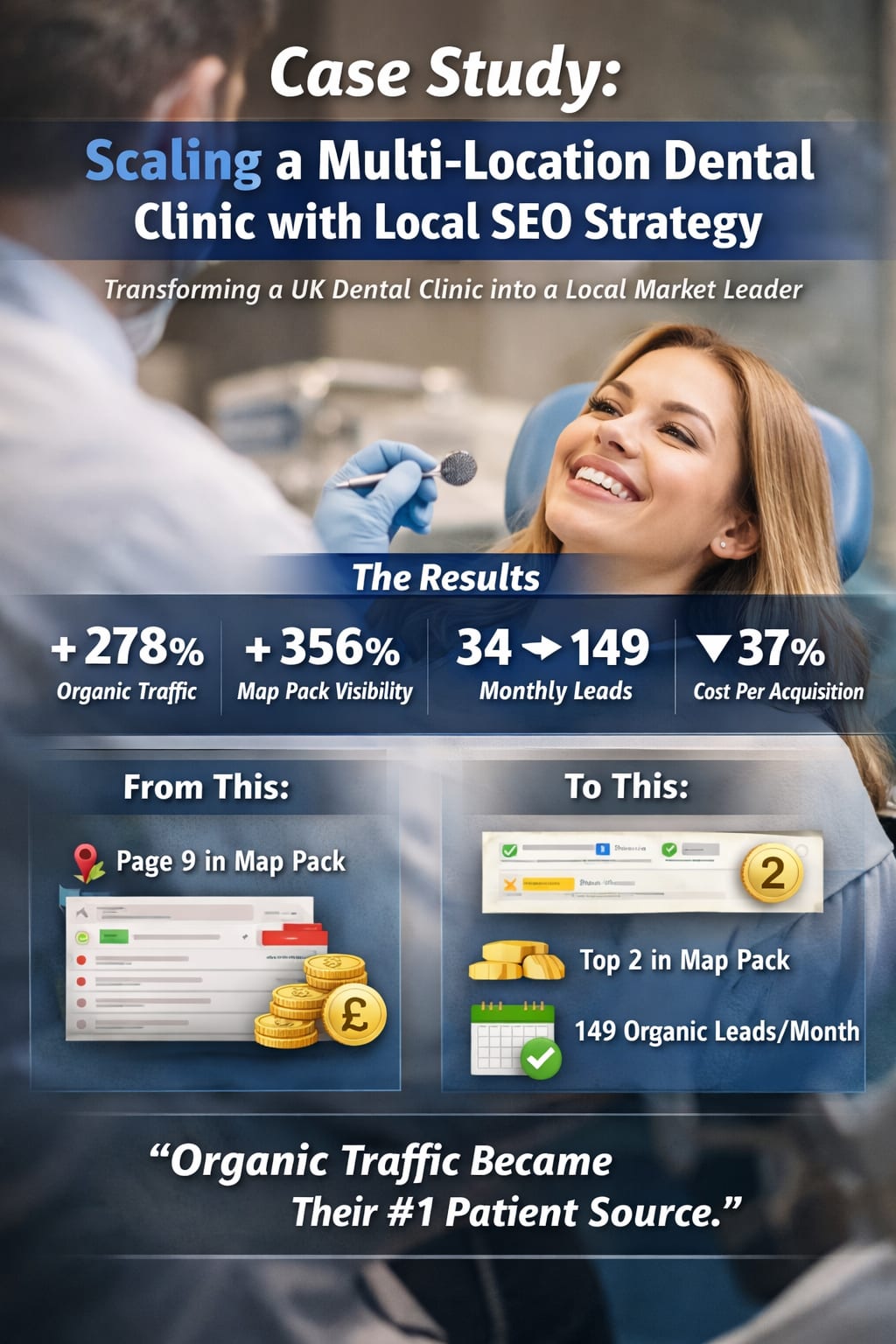
Organic traffic increased by 278%
Map Pack visibility increased by 356%
Indexed pages grew by 41%
Core service keywords achieved consistent Top 3 rankings
Lead Generation Impact
Monthly organic inquiries increased from 34 to 149
Cost per acquisition decreased by 37%
Paid advertising dependency was significantly reduced
Most notably, organic search became the clinic’s primary source of new patient inquiries.
Strategic Insights
Several key lessons emerged from this campaign:
Structure matters more than volume.
Well-organized service silos outperform scattered content.
Local intent must be aligned with geographic signals.
Simply adding city names is not sufficient.
Technical stability supports long-term growth.
Crawl efficiency and page performance directly impact visibility.
Trust signals influence both rankings and conversions.
In healthcare, authority and transparency are essential.
Organic growth reduces long-term marketing risk.
Over-reliance on paid ads can create volatility.
Conclusion
In competitive healthcare markets, visibility is rarely accidental. Sustainable organic growth requires a balanced approach combining technical optimization, structured content, local authority building, and user-focused design.
For this multi-location dental clinic, a structured Local SEO framework transformed organic search from a secondary channel into the foundation of patient acquisition.
The case demonstrates that when search intent, site architecture, and local trust signals align, measurable and predictable growth becomes achievable — even in saturated markets.
M Hamad Local SEO Specialist
https://www.linkedin.com/in/hamad-seo-llm-expert/
About the Creator
M Hamad Local SEO & Google Business Profile Specialist
M Hamad | Local SEO & Google Business Profile Specialist | Helping local businesses rank on Google Maps, get more leads, and boost online visibility with proven SEO strategies.
Keep reading
More stories from M Hamad Local SEO & Google Business Profile Specialist and writers in Education and other communities.
Best CMS for SEO: Why Your Website’s Foundation Matters More Than You Think
When people talk about SEO, the conversation usually starts with keywords, backlinks, or content length. Those elements matter, but they aren’t always the reason a website struggles to rank.
By M Hamad Local SEO & Google Business Profile Specialistabout a month ago in Education
How Collective Giving Shapes Stronger and More Compassionate Communities
Giving back to the community reflects a shared desire to uplift others and create meaningful change. Although many associate giving with financial donations, it can take countless forms, including volunteering, mentoring, or offering skills to local organizations. Each contribution matters because it strengthens the support networks that help communities thrive. As individuals continue to give, they build a culture where charitable involvement becomes a natural and valued part of everyday life.
By Jason Pruet5 days ago in Education
Why the Textile Recycling Market Is Reshaping the Future of Sustainable Fashion?
With the rise of concerns around sustainability in general, and the fashion and textile industry in particular, the environmental impact of textiles, textile waste, and the resources used to make textiles have become subjects of rethinking in the industry and among consumers. The textile recycling market has emerged as one of the leading solutions to address the need for reducing waste and promoting a circular economy.
By Akshay Kumar3 days ago in Education



Comments
There are no comments for this story
Be the first to respond and start the conversation.