

Musical scales are something instrumental students are required to practice, but it is also good for vocal students to learn scales.
The musical scale above from The Sound of Music uses Solfege, a movable scale system commonly taught by music teachers. It originated in the eleventh century. Italian music theorist, Guido of Arezzo, used the first syllable of each line of a Latin hymn to John the Baptist to produce the first six-note scale. The lyrics are as follows:
Ut queant laxīs resonāre fībrīs Mīra gestōrum famulī tuōrum, Solve pollūtī, labiī reātum, Sancte Iōhannēs.
Therefore, his original scale was: Ut, Re, Mi, Fa, Sol, La. The Ut was later changed to Do and Si was added, later changed to Ti, so that each syllable starts with a different letter of the alphabet. Often, Sol is written as So.
Consequently, our scale for traditional Western music, the diatonic scale is as follows:
Do, Re, Mi, Fa, So, La, Ti (repeating as needed in either direction.) They are pronounce: Doh, Ray, Mee, Fah, Soh, Lah, Tee
When I teach scales, I start by teaching the Do Re Mi song by rote, having students echo me on each line until they can sing along. Then, we sing with the recording.
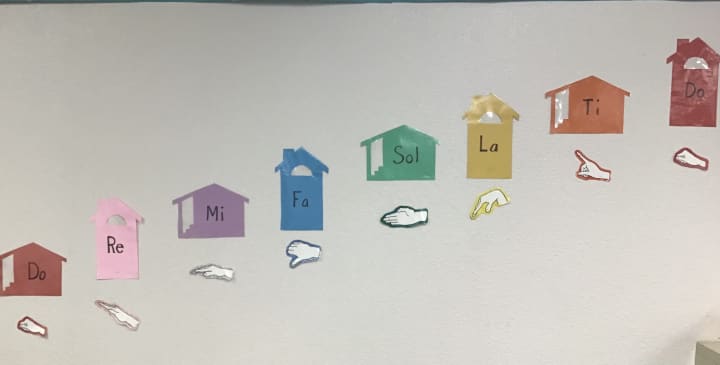
As students learn the solfege syllables and notations little by little, along with hand signs, they will eventually learn enough for a five-note (pentatonic) scale, which consists of these five notes: Do, Re, Mi, So, La. Below is an original song which I teach them. The letters following each line represent the Solfege syllables. The rhythm stays the same all the way through, with the exception of all syllables of the words middle, fiddle, sonic and tonic, which are held twice as long.
Pentatonic Scale
Are you tall or are you small (DRMSLSM)
Or are you in the middle? (RDRMSLS)
Are you like a double bass, (DRMSLSM)
Or like a little fiddle? (RDRMRDD)
*
With a scale, you can compare (DRMSLSM)
The slow or supersonic. (RDRMSLS)
You can also sing a scale. (DRMSLSM)
This one is pentatonic. (RDRMRDD)
I also like this video, with Bobbie McFerrin:
Once my students have learned to notate and sing all of the steps of the diatonic scale, we brainstorm all of the meanings for the word scale that we can come up with. I write them on the whiteboard and give them clues for some they may have missed. Then, I teach the song below, also an original. The melody goes right up and down the scale, for a total of three peaks, repeating only the top note in the middle. The rhythm alternates two eighths and a quarter all the way through except for the last syllable of the words mountain and fountain, which are held out longer.
Scales
There's a scale on a fish (DRMFSL)
And a scale I can weigh with, (TDTLSFM)
And maybe I'll scale up a mountain, (RDRMFSLTD)
But I think that the scale (DTLSFM)
I am singing is best, (RDRMFS)
Shooting up, bubbling down like a fountain. (LTDTLSFMRD)
My school is K-8. If I had high school students, I would go on to teach them the chromatic scale, which includes all of the keys on the piano, rather than just select ones. The sharps (black keys going up) are different than the flats (black keys going down). It is not easy to sing these scales in tune, but here are the syllables for the ascending chromatic scale:
Do, Di, Re, Ri, Mi, Fa, Fi, So, Si, La, Li, Ti, Do
And here are the syllables for the descending chromatic scale:
Do, Ti, Te, La, Le, So, Se, Fa, Mi, Me, Re, Ra, Do
Notice that the half steps, between Mi and Fa and Ti and Do have no other syllables between them, because they're already next to each other. Also notice that the sharps have different names than the flats.
I hope you learned some interesting things about musical scales, and I hope you are able to use some elements of this article with your students. Happy singing!
Online resource: https://en.wikipedia.org/wiki/Solfège
About the Creator
Julie Lacksonen
Julie has been a music teacher at a public school in Arizona since 1987. She enjoys writing, reading, walking, swimming, and spending time with family.
Reader insights
Outstanding
Excellent work. Looking forward to reading more!
Top insights
Easy to read and follow
Well-structured & engaging content
Expert insights and opinions
Arguments were carefully researched and presented
Eye opening
Niche topic & fresh perspectives
On-point and relevant
Writing reflected the title & theme
Keep reading
More stories from Julie Lacksonen and writers in Education and other communities.
Fun with Grammar
There is nothing more grating to an author’s ears or eyes than hearing or seeing poor grammar. I know I’m “preaching to the choir” on this topic, and yet, I’ve seen many grammatical errors right here on Vocal. I’ve been caught a few times myself. Usually it’s just a typo, but more on that later. Some people would be well advised to get the free version of Grammarly. At least twice, I stopped reading stories because the grammar was atrocious.
By Julie Lacksonen4 years ago in Education
How the Sun Shapes Planetary Orbits: The Gravitational Power Behind the Solar System
The Sun’s Gravitational Dominance The Sun contains more than 99.8% of the total mass of the solar system. Because gravity depends on mass, the Sun’s enormous mass gives it overwhelming gravitational influence.
By shahkar jalal4 days ago in Education




Comments (1)
Very instructive. I started weekly music lessons three years ago and have difficulty making sense of scales