
REMOTE TEAMS CHANGING PROJECT MANAGEMENT IN THE US
How Distributed Workforces Are Redefining Collaboration, Accountability, and Success Metrics in Modern Projects


When you have to deal with members of a project team who reside in different parts of the country, managing a project team is already difficult enough on its own. Not only do you have to overcome a unique set of challenges as a result of people not always being in the same workplace, but you also face all of the challenges that you typically face during a project, such as managing client expectations and scope creep. Here is the most effective guidance for managing a hybrid or remote project team in the United States.
How many Americans collaborate on projects via remote teams?
It is essential that we investigate statistics regarding individuals who work from home in order to establish the foundation for our research on remote working teams. They will give us a sneak peek at what employers and employees can anticipate in the future and insights into the current state of work.
1. Twenty percent of workers work from home.
In the United States, 20% of the workforce now works from home, or one fifth of the workforce. This has been attributed to shifts in employee lifestyles and company operations in light of the global pandemic. Traditional work environments are being replaced by more adaptable arrangements.
2. Remote workers are less likely to change companies
Owl Labs conducted a survey in 2023 and found that 23% of employees switched employers. It's interesting to note that 26% of full-time office workers are more likely to experience this. Only 17% of remote and hybrid workers decided to switch jobs.
3. Unbelievable numbers of people want to work from home.
Throughout their careers, 98% of workers want to continue working from home. This figure demonstrates that workers are increasing their desire for more personal time, flexibility, and freedom. Another 98% of people would recommend online work to their friends, which is not surprising.
Why should projects use remote teams?
- Physical distance: companies might have teams all over the place: headquarters in San Francisco, consultants in Boston, and a sales rep in Houston. You no longer need to be in the same office because project management software connects teams as if they were on different floors of the same building.
- Multiple Time Zones: Even if you're not in the same time zone, you can still collaborate. With good project planning software, you can time shift, leaving tasks open for the next person to work on no matter when they are available.
- Diverse talent: you don't have to limit yourself to people in your city; you can hire team members from anywhere. Additionally, it is useful for addressing skill gaps on your team. Without having to relocate someone across the country or remove someone from another team, you can add a remote worker to your team and benefit from their expertise.
- Global pandemics and other unlikely events: a remote team can save your office in the event of, say, a global pandemic that shuts down your office. Before an emergency occurs, form a group of remote workers for projects and practice working remotely. This way, if something happens, you'll be prepared for switching to working remotely.
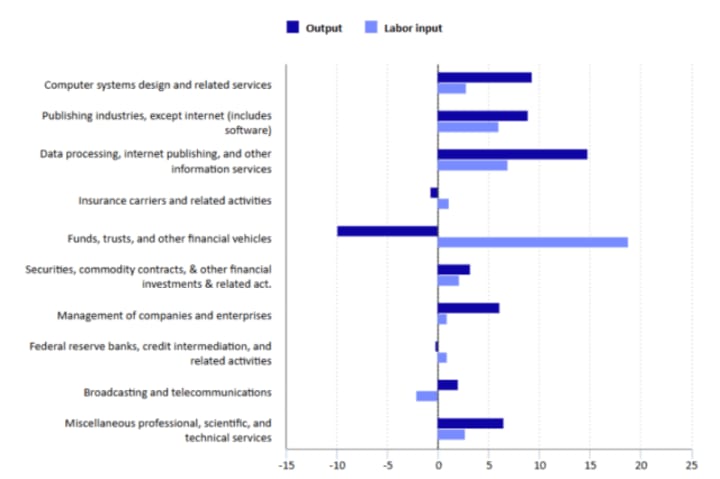
Output and labor input growth in the top 10 industries experiencing the highest percentage-point increase in remote workers
The graph below shows the top ten industries with the highest percentage point increase in remote work between 2019 and 22 as a percentage change in output and labor input (a measure of hours worked adjusted for differences in the workforce's age, education, and sex composition). There are significant increases in both output and labor input in the top three industries (computer systems design and related services; publishing industries, except internet [includes software]; and data processing, internet publishing, and other information services), with output rising much faster than labor input. Management of businesses and enterprises, miscellaneous professional, scientific, and technical services, securities, commodity contracts, and other financial investments and related activities, broadcasting and telecommunications, and miscellaneous professional, scientific, and technical services also experience substantial output growth but either a small, positive growth in labor input or a small decline in labor input. The remaining four major industries are as follows: Workforce input is growing faster than output in the remaining three industries. Thus, most of the industries that experienced substantial increases in the percentage of remote workers were able to enhance output during this time without a corresponding increase in labor.
WHAT EMPLOYEES PREFER
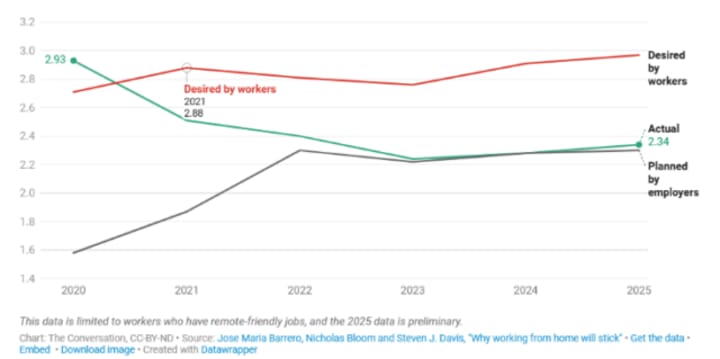
Since the COVID-19 pandemic began, the balance between the days that workers in the United States want to work from home, the days that their employers have planned for them to be at home, and the days that they actually work from home has changed. Since 2023, employers' plans have closely followed actual events. However, employees still prefer a hybrid schedule and would much rather work from home. In 2024, approximately 25% of professional employees preferred office work, 35% preferred remote work, and 40% preferred hybrid work, according to Zoom's research. 15 percent of recent college graduates prefer to work in an office, 20 percent prefer to work from home, and 65 percent prefer a hybrid schedule. However, there is still a lack of agreement regarding the ideal balance between working from home and in an office. Employers prefer three days in the office and two days working remotely, while employees prefer three days at home, according to the Zoom survey. In general, the future of work appears to be hybrid. However, the "fully remote" kind of remote work that was available during lockdowns is still around. This is good news for people who would rather work entirely from home. Most of these workers are parents or take care of adults who need help. They might be located in rural areas or too far from their workplaces to regularly commute. As a means of reducing the number of microaggressions they encounter on the job, many LGBTQ+ employees and people of color have expressed a preference for remote work.
WHAT ARE THE FUTURE TRENDS IN REMOTE TEAM PROJECTS?
It is essential to be aware of emerging trends and adapt your management strategies accordingly in order to stay ahead and ensure success in the ever-changing remote work landscape. The following are some possible future developments in remote team management:
- Hybrid work models: balancing remote and in-office work preferences.
- Analytics with AI: Using AI and data to make decisions about team performance based on data.
- Mental health and work-life balance: these are two important aspects of employee well-being in remote management.
- Adapting to diverse, globally dispersed teams: the global talent pool.
- Enhanced cybersecurity: Investing in robust cybersecurity for data protection.
- Using immersive technologies for remote collaboration, VR and augmented reality are integrated.
- Skill development: Continuous learning and development for team competitiveness.
- Eco-friendly methods: remote work policies that encourage sustainability. Remote work regulations: Adapting to evolving government regulations.
- Utilizing remote-specific performance metrics in project reports to evaluate engagement and productivity.
It is essential to provide your team with the appropriate tools in order to stay ahead of these upcoming trends in remote team management.
About the Creator
Major Real Estate Market Trends Defining the Modern Housing Landscape
The real estate market is undergoing steady, visible change. Buyers think differently. Sellers adjust their strategies. Investors watch new signals closely. These shifts affect prices, demand, and how homes are used. To stay informed, it helps to understand real estate market trends and why they matter today. This article explains the key movements shaping the market in clear, simple terms that are easy to read and follow.
By Michael O'Sullivan Hampton6 days ago in Education



Comments
There are no comments for this story
Be the first to respond and start the conversation.