
Redefining Success: What Modern Education Forgot to Teach Us
Grades don't define genius.Real growth begins where classroom ends.

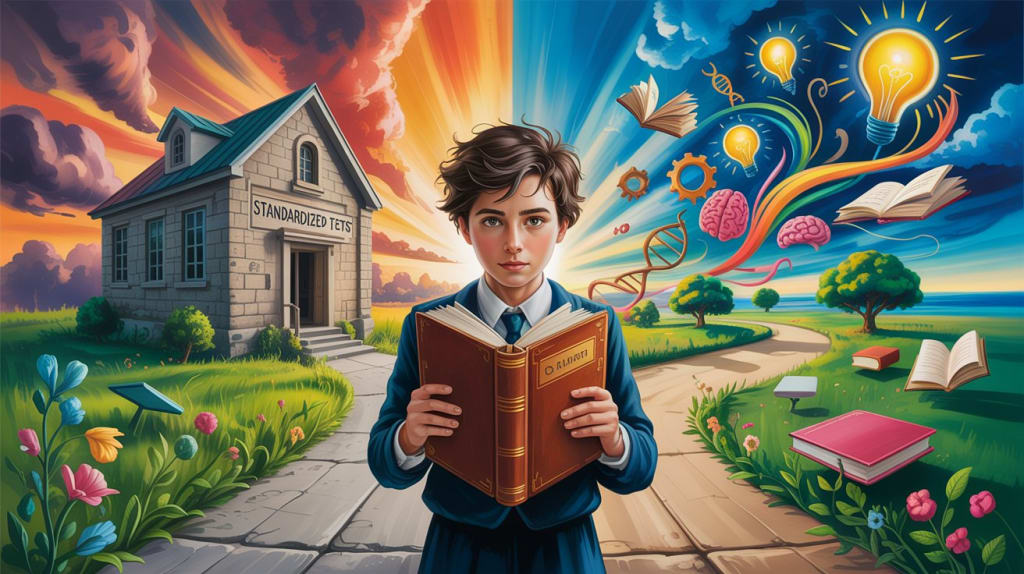
In a world obsessed with scores, rankings, and degrees, it’s easy to forget the purpose of education. We train students to memorize answers, follow routines, and fear failure—yet we rarely teach them how to think, how to question, or how to learn from real life.
If the classroom is where knowledge begins, life is where education is tested. So, what happens when our system fails to prepare us for life?
A System Built for a Different Era
The structure of modern schooling was shaped during the Industrial Revolution—a time when workers were needed for factories, not for innovation. This gave rise to an education model focused on:
- Uniformity
- Obedience
- Efficiency
But today, we live in the age of information, creativity, and rapid change. And yet, our system still runs on 19th-century logic.
“We are educating people out of their creative capacities.”
— Sir Ken Robinson
Creativity, emotional resilience, and critical thinking are among the most valuable 21st-century skills—yet they’re the least rewarded in school systems worldwide.
The Psychology of Real Learning
Psychologists have long studied how learning really works. One of the most powerful concepts is “intrinsic motivation”—the desire to learn out of interest or personal meaning, not reward or punishment.
According to Self-Determination Theory, students thrive when three needs are met:
- Autonomy – having a choice in how they learn
- Competence – feeling capable and effective
- Relatedness – feeling connected to others and the material
Most modern classrooms, unfortunately, suppress all three. Instead, students learn to study for the test, not for themselves. They’re taught to avoid mistakes, even though making them is key to deep learning.
Stories That Break the Mold
Consider the story of Jack Ma, founder of Alibaba. He:
- Failed his college entrance exams three times
- Got rejected from 30 jobs—even KFC didn’t hire him
- Was denied entry to Harvard 10 times
Yet he became one of the most successful entrepreneurs in the world, simply because he believed in himself long after institutions stopped believing in him.
Then there’s Albert Einstein, who didn’t speak until the age of four and was expelled from school for being "mentally slow." The same man went on to revolutionize physics.
Thomas Edison was labeled “unteachable.” Oprah Winfrey was told she was “unfit for TV.” Steve Jobs dropped out of college.
These aren’t just exceptions. They are proof that the system is not the only path to success—and sometimes, it’s not even the best one.
🎓 Beyond GPAs and Gold Stars
Ask any adult what they remember from school, and chances are it’s not algebra formulas or essay rubrics. It’s the moments that shaped their character—a teacher who believed in them, a project they poured their heart into, a failure they learned from.
Yet most education systems still use:
- Grades to measure progress
- Standardized tests to define ability
- Conformity to reward behavior
But none of these capture emotional intelligence, creativity, resilience, or curiosity—which are often the true indicators of future success.
💬 Quotes That Challenge the Status Quo
“Don’t let schooling interfere with your education.” — Mark Twain
“Success is not about how high you have climbed, but how you make a positive difference to the world.” — Roy T. Bennett
“Formal education will make you a living; self-education will make you a fortune.” — Jim Rohn
“The purpose of education is to replace an empty mind with an open one.” — Malcolm Forbes
What Real Education Should Teach
In a better world, education would help us:
- Learn how to think, not just what to think
- Understand our emotions, not suppress them
- Practice resilience through failure
- Embrace diversity in thought, ability, and background
- Develop a growth mindset, where mistakes fuel progress
Instead of fearing a low grade, students would be encouraged to ask:
- “What did I learn?”
- “How can I improve?”
- “What does this mean to me?”
✅ How We Move Forward
- Empower Teachers – Give them freedom to inspire, not just test.
- Encourage Curiosity – Reward questions, not just answers.
- Respect Diverse Talents – Not all intelligence is academic.
- Support Self-Education – Promote learning outside the classroom.
- Redefine Success – Make it about growth, contribution, and character.
🏁 Final Thoughts
We must stop confusing schooling with education.
- You are more than your report card.
- Your ideas matter.
- Your curiosity is powerful.
The most valuable lessons often come from outside the classroom—through books, mentors, mistakes, travel, solitude, and experience.
So if the system didn’t recognize your worth, don’t worry. Build your own path.
“Education is not the learning of facts, but the training of the mind to think.” — Albert Einstein
And thinking is something no exam can measure.
About the Creator
Nowshad Ahmad
Hi, I’m Nowshad Ahmad a passionate storyteller, creative thinker, and full-time digital entrepreneur. Writing has always been more than just a hobby for me; it's a way to reflect, connect, and bring life to ideas that often go unspoken.
Keep reading
More stories from Nowshad Ahmad and writers in Education and other communities.
Freelancing & Work From Home VS Traditional Job: The real life comparison
Over the last decade, the nature of work has changed dramatically. With the rise of the gig economy, remote tools, and online marketplaces like Fiverr and Upwork, the idea of working from home or freelancing full-time has become not only possible—but increasingly popular. But how does it compare to the stability and structure of a traditional 9-to-5 job?
By Nowshad Ahmad8 months ago in Education
Effective Methods for Improving Interpersonal Communication Skills at Work and in Life
Communication plays a major role in how people connect, work together, and solve problems. Every day, people talk with coworkers, friends, family members, and new acquaintances. These interactions depend on clear and respectful communication. Because of this, improving interpersonal communication skills can help people build stronger relationships and avoid many common misunderstandings.
By Micah Love-Allotey6 days ago in Education
How Solar Winds Create Space Weather: Understanding the Sun’s Influence on Space
What Is Solar Wind? Solar wind is a continuous stream of charged particles released from the Sun’s outer atmosphere. These particles mainly consist of electrons and protons, which are atoms that have lost their electrons due to extremely high temperatures.
By shahkar jalal8 days ago in Education



Comments
There are no comments for this story
Be the first to respond and start the conversation.