
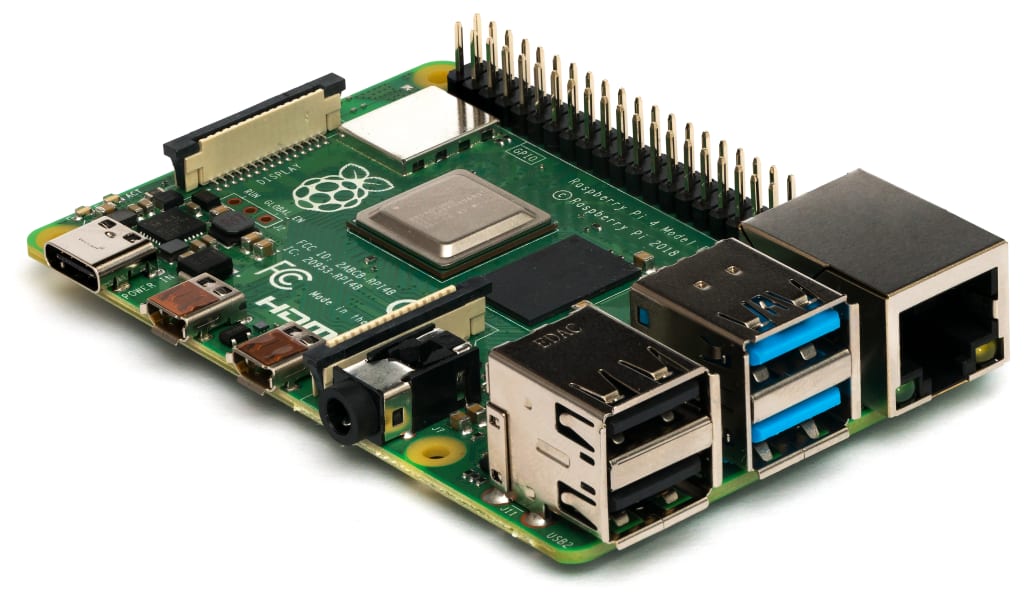
Raspberry Pi is a small, low-cost computer that has gained popularity among hobbyists, educators, and DIY enthusiasts. The Raspberry Pi Foundation, a UK-based charity, created the device to promote the teaching of computer science and coding skills. This review is aimed at beginners who are interested in getting started with Raspberry Pi, regardless of whether they are using a Mac or PC.
What is Raspberry Pi?
Raspberry Pi is a single-board computer that is about the size of a credit card. It has a CPU, RAM, GPU, USB ports, Ethernet port, audio jack, and video output, allowing it to run a wide range of software, including a full desktop operating system.
Hardware Requirements
To get started with Raspberry Pi, you will need the following hardware:
Raspberry Pi computer
Power supply (minimum 5V 2.5A)
MicroSD card (minimum 8GB)
Keyboard
Mouse
Monitor or TV with an HDMI input
HDMI cable
Software Requirements
For Mac or PC, you will need a software application to flash the operating system onto the MicroSD card. Some popular options include Raspberry Pi Imager for Mac and Win32DiskImager for Windows.
Operating System
Raspberry Pi runs on several operating systems, including the official Raspberry Pi OS, which is a distribution of the Linux operating system. You can choose from a variety of other Linux distributions, depending on your needs.
Setting Up Raspberry Pi
Once you have all the necessary hardware and software, you can set up your Raspberry Pi. The steps are as follows:
Flash the operating system onto the MicroSD card
Insert the MicroSD card into the Raspberry Pi
Connect the keyboard, mouse, monitor or TV, and power supply
Boot up the Raspberry Pi
Follow the setup wizard to configure the device
Applications
Raspberry Pi can be used for a wide range of applications, including:
Home automation
Media center
Retro gaming
Robotics
Web server
Educational tools
Advantages
There are several advantages of using Raspberry Pi:
Low cost: Raspberry Pi is much more affordable than a traditional desktop computer, making it accessible to a wider range of users.
Flexibility: Raspberry Pi can run a variety of operating systems and software, allowing users to customize it to their specific needs.
Portability: Raspberry Pi is small and lightweight, making it easy to take with you and use on the go.
Community: Raspberry Pi has a large and active community of users who share resources, tutorials, and support.
Limitations
While Raspberry Pi is a great device for beginners, it does have some limitations:
Limited processing power: Raspberry Pi is not designed for demanding tasks, such as video editing or gaming, and may struggle with resource-intensive applications.
No built-in storage: Raspberry Pi does not have built-in storage, so you will need to use an external storage device or a microSD card.
Limited peripherals: Raspberry Pi does not have built-in Wi-Fi or Bluetooth, so you will need to use a USB adapter for these capabilities.
Projects and Tutorials
There are many projects and tutorials available for Raspberry Pi, both on the official website and from the community. Some popular projects include:
Building a weather station
Making a game console
Setting up a VPN
Creating a security camera
Building a web server
Expansion Options
Raspberry Pi has a 40-pin GPIO header that allows users to connect a variety of sensors and components, such as LEDs, motors, and buttons. This allows users to expand their Raspberry Pi and create custom projects, such as a robot or a home automation system.
Advanced Topics
As you become more familiar with Raspberry Pi, you may want to explore more advanced topics, such as:
Command line interface
Python programming
Linux system administration
Networking and security
Conclusion
In conclusion, Raspberry Pi is a great device for beginners who are interested in learning about computer science, coding, and DIY electronics. It is affordable, flexible, and easy to use, and has a large and active community of users who can provide support and resources. With its expansion options and the ability to explore advanced topics, Raspberry Pi is an excellent tool for learning and experimentation.
Conclusion
In conclusion, Raspberry Pi is a great device for beginners who are interested in learning about computer science, coding, and DIY electronics. It is affordable, flexible, and easy to use, and has a large and active community of users who can provide support and resources. While it has some limitations, such as limited processing power and the need for external storage, these are outweighed by its many advantages.
To Know About The product And Purchase from Below
https://www.digistore24.com/redir/271198/Patilmohit133/
About the Creator
Keep reading
More stories from Mohit Patil and writers in Education and other communities.
The Self-Sufficient Backyard
The Self-Sufficient Backyard is a comprehensive guide for anyone interested in growing their own food, raising chickens, and becoming more self-sufficient. This book is perfect for those who are new to homesteading and want to learn the basics, as well as those who have experience and are looking for new ideas and techniques.
By Mohit Patil3 years ago in Education
From Job to Prison: Revenge, Sacrifice, and Ending
The story begins by showing a bald and strong man named Bradley, who is a car mechanic by profession. As usual, Bradley reaches the garage with a broken car, but after arriving there, he sees that the garage owner is anxiously waiting only for him, which makes him a little surprised. Then the garage owner calls him into his office. Hearing this, Bradley understands that he is about to be fired from his job, and exactly that happens. The owner tells him that these days the garage is going through a financial crisis, and that is why he is being forced to fire some workers. But this is only an excuse, because Bradley is a hard-tempered man, and the owner wants to remove him and hire someone who flatters him. Now since Bradley is a tough man, he does not argue with the owner. He goes to the locker room, takes out his belongings, takes his car, and silently leaves for home. And yes, friends, this is where the downfall of Bradley’s life begins, which continues straight until the end of the story and ends there. Anyway, Bradley stops his car in front of his house, and at the same time he sees that his wife Lauren is sitting in her car, talking to someone on the phone. Bradley becomes suspicious of her. To know the truth, he keeps watching her carefully for some time. When he becomes sure, he immediately goes to Lauren and tells her to open the car door. His wife says, “You came back from work very early today.” At the same moment, Bradley notices marks of someone else’s lips on her neck and says to Lauren, “Give me your phone.” But Lauren refuses to give the phone, because of which Bradley forcefully snatches the phone from her, and his suspicion turns out to be correct. She is talking on the phone with another man. In anger, Bradley tells Lauren to go inside the house. Lauren says, “At least listen to me.” Bradley says, “I said go inside the house.” Then Lauren silently goes inside the house. Now, he had already been fired from his job a little while ago, and now his wife’s affair, because of which he had become even more disturbed, so he starts taking out all his anger on Lauren’s car. How? You can see that yourself. Yes, he is so angry that he does not even realize that his hands have been badly injured. After that, he calms himself down and goes inside the house and questions Lauren about how many days she has been with the other man. Lauren tells him everything, that for the past three months she had been having an affair with someone else. Actually, Bradley’s wife had an abortion a few days earlier, because of which she used to remain sad, and Bradley often stayed busy with his work. Because of this, Lauren felt lonely and very depressed at home, and to fill this emptiness, she had to take support from another man. Hearing these things, Bradley realizes that he should have given time to Lauren. He apologizes to Lauren for this and says that from today, from right now, they will both start a new life. Lauren agrees. After that, Bradley tells Lauren that he has been fired from his job and now he will work for a man named Gil, who is a drug lord. As soon as she hears Gil’s name, Lauren clearly refuses and says, “You yourself said that you would never work with Gil.” Bradley says, “Yes, but in such circumstances, we cannot live like a prosperous family. To run a family, money is needed, and at this time I have no other option.” He also assures Lauren that he will do this work very carefully.
By Filmon Ke Raaz | Movie Mysteries Explained4 days ago in Education
Beyond Speed: How High-Performance Computing Is Shaping Tomorrow’s Discoveries
High-Performance Computing is changing how people explore ideas, test theories, and solve complex problems. It allows machines to work together at great speed. These systems can handle tasks that are far too large for standard computers. As a result, High-Performance Computing and the future of discovery are closely linked.
By Jason Pruet5 days ago in Education
Smart phones, Humans and Aliens.
WARNING. I will be tapping into one of your favorite creative tensions: The absurdity of humans worshipping their glowing rectangles as if they were tiny oracles. There’s something deliciously poetic about that contradiction, and it lends itself beautifully to an instructive proviso.
By Novel Allen7 days ago in Poets



Comments
There are no comments for this story
Be the first to respond and start the conversation.