
Quantum Tunneling: How Particles Break the Rules
Quantum physics is famous for being strange, surprising, and completely different from the world we see around us. But among all its mysteries, quantum tunneling stands out as one of the most mind-bending ideas ever discovered. It describes how a tiny particle can pass through a barrier that it should not be able to cross—almost like a ghost walking through a wall. In the ordinary world, this would be impossible. But in the quantum world, it happens all the time. In fact, without quantum tunneling, stars could not shine, electronics would not work, and life itself might not exist. This article explains quantum tunneling in a simple and clear way so that anyone can understand how particles “break the rules” of classical physics—and why this phenomenon is so important for the universe.

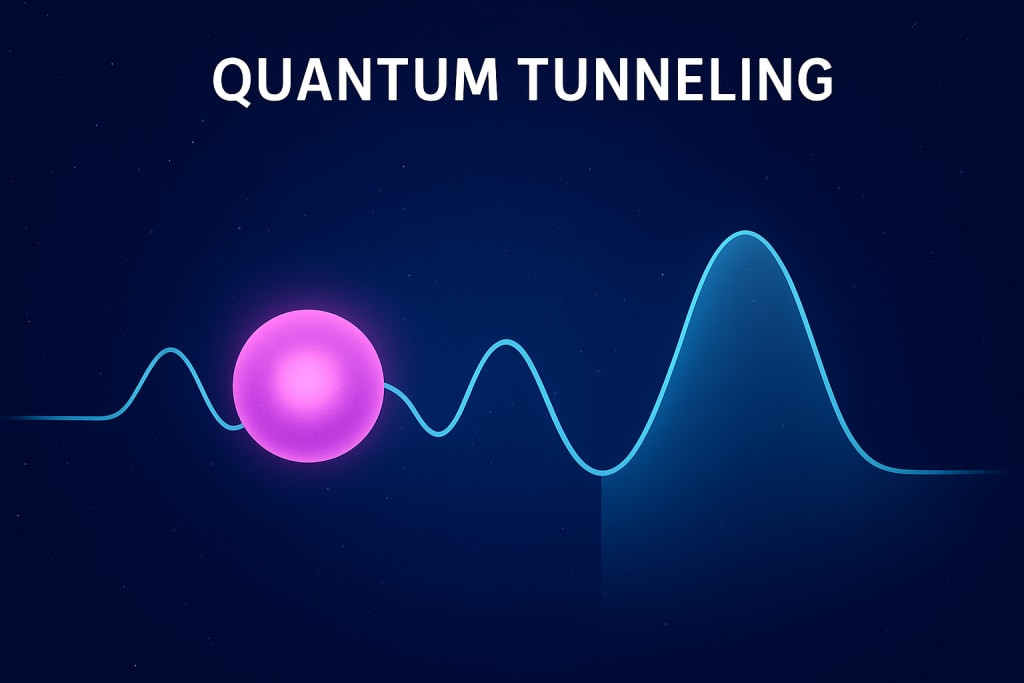
What Is Quantum Tunneling?
To understand tunneling, imagine a ball rolling on the ground. If the ball does not have enough energy to climb over a hill, it stops and rolls back. It cannot magically appear on the other side.
In classical physics, energy decides what is possible and what is not.
But quantum physics plays by different rules.
Quantum tunneling happens because particles such as electrons, protons, and neutrons are not only tiny objects—they are also waves of probability. Instead of existing in one position, they exist in many possible positions at the same time.
This wave-like nature allows a portion of the particle’s wave to “leak” through a barrier. This leakage is what makes the particle appear on the other side—even if it does not have enough energy to cross.
In other words:
Quantum tunneling is the ability of a particle to pass through a barrier that should be impossible to cross.
It doesn’t break physics. It follows the laws of quantum mechanics perfectly.
________________________________________
Why Classical Physics Says This Should Be Impossible
Before quantum mechanics, scientists believed particles moved like tiny balls. According to classical laws:
• A particle with less energy than the barrier should never cross it.
• It can bounce back or stop—but not teleport through.
Quantum tunneling disagrees. It says:
• A particle does not have a single fixed position.
• It exists as a cloud of probabilities.
• Part of this cloud extends into the barrier.
• If the cloud reaches the other side—even slightly—the particle can appear there.
This tiny possibility becomes incredibly important in many natural processes.
________________________________________
Quantum Tunneling Explained Simply
Imagine you're standing outside your locked room. Normally, you must use a key to open the door. But quantum mechanics says:
“There is a very tiny chance you might suddenly appear inside the room without opening the door.”
For humans, this probability is nearly zero. But for subatomic particles, this probability is much higher.
Particles are extremely small, and the barriers they face are also extremely tiny. So the chance of tunneling becomes significant and happens constantly.
________________________________________
The Science Behind Tunneling — The Quantum Wave
Every particle behaves like a wave. This wave:
✔ spreads out
✔ overlaps with barriers
✔ slightly continues on the other side
If the wave extends beyond the barrier, the particle has a probability of being found on the other side. This is called the tunneling probability.
The bigger the barrier, the smaller the probability.
The thinner the barrier, the higher the probability.
This explains why tunneling is common inside atoms but not in everyday objects.
________________________________________
Where Quantum Tunneling Happens in Nature
Quantum tunneling is not rare. It is everywhere around us. Here are the most important places where it operates:
________________________________________
1. Inside the Sun — Tunneling Powers the Stars
The Sun shines because hydrogen atoms fuse to form helium.
But here is the problem:
Hydrogen nuclei repel each other because they are positively charged. They do not have enough energy to collide and fuse.
So how does fusion happen?
Quantum tunneling.
Particles "tunnel" through the energy barrier and fuse even when classical physics says they cannot. Without tunneling:
• The Sun would not burn.
• Stars would not shine.
• Elements like carbon, oxygen, and iron would not form.
• Life would not exist.
Tunneling keeps the universe glowing.
________________________________________
2. Radioactive Decay (Alpha Decay)
Some atoms release alpha particles (2 protons + 2 neutrons) even though these particles are trapped inside by strong forces.
They escape by tunneling through the nuclear barrier.
This is responsible for:
• radioactivity,
• nuclear energy,
• formation of heavy elements in stars.
________________________________________
3. Scanning Tunneling Microscope (STM)
The STM is an ultra-powerful microscope that allows us to see individual atoms.
It works by tunneling:
• A tiny needle is brought extremely close to a surface.
• Electrons tunnel between the needle and the atoms.
• This tunneling current creates an image of atoms.
This invention revolutionized nanotechnology.
________________________________________
4. Quantum Electronics and Modern Chips
Your phone, laptop, and computer all depend on tunneling.
Devices such as:
• tunnel diodes
• flash memory
• quantum transistors
• Josephson junctions
all use tunneling to operate.
Without quantum tunneling, modern electronics would not exist.
________________________________________
5. Chemical Reactions and Life
Inside your body, chemical reactions happen billions of times every second. Many reactions, especially those involving hydrogen atoms, require tunneling.
This means even your heartbeat and brain signals are influenced by quantum tunneling at the molecular level.
________________________________________
Why Tunneling Is So Important in Physics
Quantum tunneling proves that:
• The universe is not deterministic.
• Particles do not follow fixed paths.
• Nature operates on probabilities.
• Reality at small scales behaves differently from what we see.
Tunneling also helps unify quantum physics with cosmology, nuclear physics, and computer science.
________________________________________
Is Tunneling Possible for Humans?
Scientifically, yes—but practically, absolutely not.
Here’s why:
Particles tunnel easily because they are extremely small. Humans are made of 10²⁸ times more particles, making the probability of whole-body tunneling almost zero.
So no, you cannot walk through walls—but electrons can, and they do it constantly.
________________________________________
Quantum Tunneling and the Future of Technology
Although impossible for humans, tunneling provides huge potential for future technology:
✔ Quantum Computers
Qubits can tunnel, allowing them to exist in multiple states and perform impossible calculations.
✔ Fusion Energy
Understanding tunneling can help make artificial fusion reactors more efficient.
✔ Ultra-fast Electronics
Next-generation chips based on tunneling could be faster and smaller than ever.
✔ Medical Imaging
Quantum tunneling could improve scanning resolution at microscopic levels.
The possibilities are enormous.
________________________________________
Quantum Tunneling and the Origins of the Universe
Some cosmologists believe tunneling may explain the birth of the universe.
The idea is that the universe could have “tunneled” from a quantum vacuum state into existence. This concept comes from quantum cosmology and suggests that:
“The universe might have appeared through quantum tunneling—without needing classical energy.”
This remains a powerful and active field of scientific research.
________________________________________
Why Quantum Tunneling Feels Like Magic
Quantum tunneling feels magical because it breaks our everyday intuition. We never see cars tunneling through mountains or people tunneling through doors.
But at the microscopic level, the universe follows strange rules:
• particles behave like waves
• probabilities replace certainties
• barriers lose their meaning
• energy conservation becomes flexible
This is why Einstein once said,
“God does not play dice with the universe,”
but quantum mechanics answered:
“Yes, it does.”
________________________________________
Conclusion: The Universe Works Because Particles Break Rules
Quantum tunneling shows us that nature is far stranger than anything we experience in daily life. Particles can pass through barriers they have no right to cross. They do this not rarely—but constantly.
Thanks to quantum tunneling:
• stars shine
• atoms decay
• electronics work
• chemical reactions occur
• life exists
It is one of the most important—and most mysterious—phenomena in the universe.
Quantum tunneling reminds us that the universe is not limited by our imagination. The quantum world is full of surprises, and we are only beginning to understand how deep this rabbit hole goes.
What Is Quantum Tunneling?
To understand tunneling, imagine a ball rolling on the ground. If the ball does not have enough energy to climb over a hill, it stops and rolls back. It cannot magically appear on the other side.
In classical physics, energy decides what is possible and what is not.
But quantum physics plays by different rules.
Quantum tunneling happens because particles such as electrons, protons, and neutrons are not only tiny objects—they are also waves of probability. Instead of existing in one position, they exist in many possible positions at the same time.
This wave-like nature allows a portion of the particle’s wave to “leak” through a barrier. This leakage is what makes the particle appear on the other side—even if it does not have enough energy to cross.
In other words:
Quantum tunneling is the ability of a particle to pass through a barrier that should be impossible to cross.
It doesn’t break physics. It follows the laws of quantum mechanics perfectly.
________________________________________
Why Classical Physics Says This Should Be Impossible
Before quantum mechanics, scientists believed particles moved like tiny balls. According to classical laws:
• A particle with less energy than the barrier should never cross it.
• It can bounce back or stop—but not teleport through.
Quantum tunneling disagrees. It says:
• A particle does not have a single fixed position.
• It exists as a cloud of probabilities.
• Part of this cloud extends into the barrier.
• If the cloud reaches the other side—even slightly—the particle can appear there.
This tiny possibility becomes incredibly important in many natural processes.
________________________________________
Quantum Tunneling Explained Simply
Imagine you're standing outside your locked room. Normally, you must use a key to open the door. But quantum mechanics says:
“There is a very tiny chance you might suddenly appear inside the room without opening the door.”
For humans, this probability is nearly zero. But for subatomic particles, this probability is much higher.
Particles are extremely small, and the barriers they face are also extremely tiny. So the chance of tunneling becomes significant and happens constantly.
________________________________________
The Science Behind Tunneling — The Quantum Wave
Every particle behaves like a wave. This wave:
✔ spreads out
✔ overlaps with barriers
✔ slightly continues on the other side
If the wave extends beyond the barrier, the particle has a probability of being found on the other side. This is called the tunneling probability.
The bigger the barrier, the smaller the probability.
The thinner the barrier, the higher the probability.
This explains why tunneling is common inside atoms but not in everyday objects.
________________________________________
Where Quantum Tunneling Happens in Nature
Quantum tunneling is not rare. It is everywhere around us. Here are the most important places where it operates:
________________________________________
1. Inside the Sun — Tunneling Powers the Stars
The Sun shines because hydrogen atoms fuse to form helium.
But here is the problem:
Hydrogen nuclei repel each other because they are positively charged. They do not have enough energy to collide and fuse.
So how does fusion happen?
Quantum tunneling.
Particles "tunnel" through the energy barrier and fuse even when classical physics says they cannot. Without tunneling:
• The Sun would not burn.
• Stars would not shine.
• Elements like carbon, oxygen, and iron would not form.
• Life would not exist.
Tunneling keeps the universe glowing.
________________________________________
2. Radioactive Decay (Alpha Decay)
Some atoms release alpha particles (2 protons + 2 neutrons) even though these particles are trapped inside by strong forces.
They escape by tunneling through the nuclear barrier.
This is responsible for:
• radioactivity,
• nuclear energy,
• formation of heavy elements in stars.
________________________________________
3. Scanning Tunneling Microscope (STM)
The STM is an ultra-powerful microscope that allows us to see individual atoms.
It works by tunneling:
• A tiny needle is brought extremely close to a surface.
• Electrons tunnel between the needle and the atoms.
• This tunneling current creates an image of atoms.
This invention revolutionized nanotechnology.
________________________________________
4. Quantum Electronics and Modern Chips
Your phone, laptop, and computer all depend on tunneling.
Devices such as:
• tunnel diodes
• flash memory
• quantum transistors
• Josephson junctions
all use tunneling to operate.
Without quantum tunneling, modern electronics would not exist.
________________________________________
5. Chemical Reactions and Life
Inside your body, chemical reactions happen billions of times every second. Many reactions, especially those involving hydrogen atoms, require tunneling.
This means even your heartbeat and brain signals are influenced by quantum tunneling at the molecular level.
________________________________________
Why Tunneling Is So Important in Physics
Quantum tunneling proves that:
• The universe is not deterministic.
• Particles do not follow fixed paths.
• Nature operates on probabilities.
• Reality at small scales behaves differently from what we see.
Tunneling also helps unify quantum physics with cosmology, nuclear physics, and computer science.
________________________________________
Is Tunneling Possible for Humans?
Scientifically, yes—but practically, absolutely not.
Here’s why:
Particles tunnel easily because they are extremely small. Humans are made of 10²⁸ times more particles, making the probability of whole-body tunneling almost zero.
So no, you cannot walk through walls—but electrons can, and they do it constantly.
________________________________________
Quantum Tunneling and the Future of Technology
Although impossible for humans, tunneling provides huge potential for future technology:
✔ Quantum Computers
Qubits can tunnel, allowing them to exist in multiple states and perform impossible calculations.
✔ Fusion Energy
Understanding tunneling can help make artificial fusion reactors more efficient.
✔ Ultra-fast Electronics
Next-generation chips based on tunneling could be faster and smaller than ever.
✔ Medical Imaging
Quantum tunneling could improve scanning resolution at microscopic levels.
The possibilities are enormous.
________________________________________
Quantum Tunneling and the Origins of the Universe
Some cosmologists believe tunneling may explain the birth of the universe.
The idea is that the universe could have “tunneled” from a quantum vacuum state into existence. This concept comes from quantum cosmology and suggests that:
“The universe might have appeared through quantum tunneling—without needing classical energy.”
This remains a powerful and active field of scientific research.
________________________________________
Why Quantum Tunneling Feels Like Magic
Quantum tunneling feels magical because it breaks our everyday intuition. We never see cars tunneling through mountains or people tunneling through doors.
But at the microscopic level, the universe follows strange rules:
• particles behave like waves
• probabilities replace certainties
• barriers lose their meaning
• energy conservation becomes flexible
This is why Einstein once said,
“God does not play dice with the universe,”
but quantum mechanics answered:
“Yes, it does.”
________________________________________
Conclusion: The Universe Works Because Particles Break Rules
Quantum tunneling shows us that nature is far stranger than anything we experience in daily life. Particles can pass through barriers they have no right to cross. They do this not rarely—but constantly.
Thanks to quantum tunneling:
• stars shine
• atoms decay
• electronics work
• chemical reactions occur
• life exists
It is one of the most important—and most mysterious—phenomena in the universe.
Quantum tunneling reminds us that the universe is not limited by our imagination. The quantum world is full of surprises, and we are only beginning to understand how deep this rabbit hole goes.
About the Creator
Keep reading
More stories from shahkar jalal and writers in Education and other communities.
The Rise of Remote Work: How to Build a Productive and Engaged Virtual Team
The rise of remote work has fundamentally transformed how businesses operate, shifting from traditional office settings to flexible, distributed teams. This trend, accelerated by the global pandemic, continues to shape the modern workforce. While remote work offers significant benefits, such as increased flexibility and a larger talent pool, it also comes with its own set of challenges, especially when it comes to maintaining productivity and engagement. So, how can businesses build a productive and engaged virtual team?
By Baris Kabuloglu3 days ago in Education
What Decision-Theoretic Models Guide Automated Stock Trading Bot?
Automated stock trading bots work in fast financial markets where prices change quickly. Every decision must be made on time and in a logical way. Unlike human traders, bots do not use emotions. They use mathematical models to study data and decide what action to take. These models are called decision-theoretic models. They help the bot choose the best option when the future is uncertain. Decision theory uses probability, statistics, and simple value comparisons to look at possible results and pick the most useful one. In automated stock trading bots, these models control when to buy, when to sell, how much to trade, and how to manage risk. Understanding these models helps explain how professional bots make smart and consistent decisions.
By james hall4 days ago in Education




Comments
There are no comments for this story
Be the first to respond and start the conversation.