
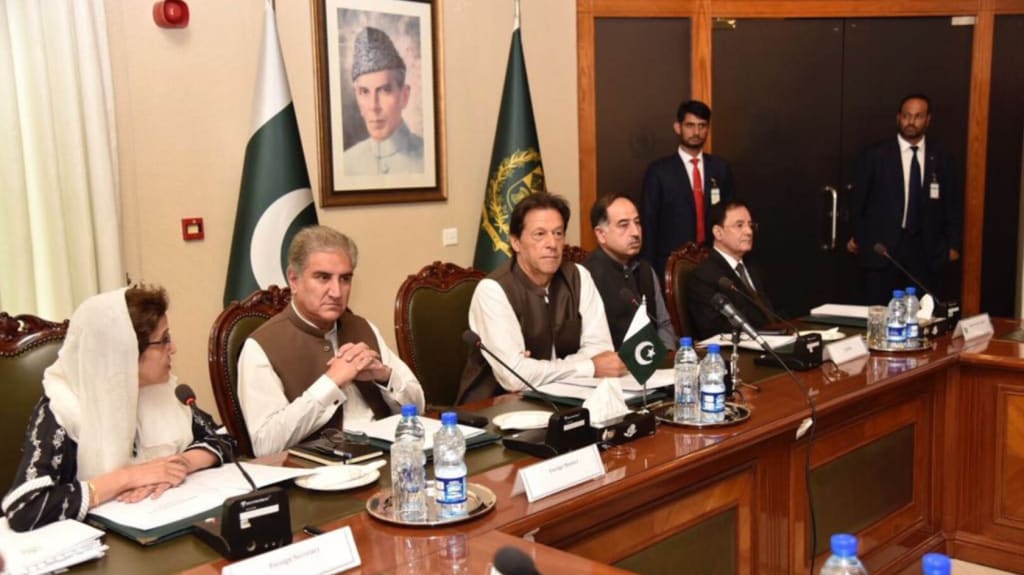
Politics in Pakistan has always been a tumultuous affair, with a long history of military coups, political instability, and corruption. Since its inception in 1947, Pakistan has faced numerous challenges in establishing a stable democratic system, including the influence of military leaders and deep-rooted corruption within the political establishment. In recent years, Pakistan has made some progress towards a more stable political system, but the country still faces many challenges in consolidating its democracy. Pakistan is a federal parliamentary republic, with a President as the Head of State and a Prime Minister as the Head of Government. The Parliament consists of two houses, the National Assembly and the Senate. The National Assembly is composed of 342 members elected for five years, while the Senate is composed of 104 members, with each province electing an equal number of members. The country's political landscape is dominated by two main parties, the Pakistan Muslim League-Nawaz (PML-N) and the Pakistan Tehreek-e-Insaaf (PTI). The PML-N is a center-right party led by Nawaz Sharif, a former Prime Minister who has been in and out of power since the 1990s. The PTI is a center-left party led by Imran Khan, a former cricketer who won the 2018 general elections.
Pakistan's political system has long been influenced by the military, which has intervened in the country's politics several times in its history. The military has traditionally seen itself as the guardian of the country's security.Pakistan has been struggling to establish a stable political system. The country has a rich political history that is marked by periods of military rule, democratic governance, and political unrest. In this article, we will discuss the politics in Pakistan.
Pakistan is a federal parliamentary democratic republic, with a President serving as the ceremonial head of state and a Prime Minister serving as the head of government. The President is elected by the members of the Electoral College, which consists of the members of the National Assembly, the Senate, and the Provincial Assemblies. The Prime Minister is elected by the members of the National Assembly, which consists of 342 members.
The Parliament of Pakistan is a bicameral legislature, consisting of the Senate and the National Assembly. The Senate has 104 members, with four members from each of the four provinces and the federal capital of Islamabad, eight members from the Federally Administered Tribal Areas (FATA), and four members from the Federal Capital Territory. The National Assembly has 342 members, with 272 members elected directly by the people and 70 reserved seats for women and religious minorities.!
Pakistan is a country located in South Asia, with a population of over 220 million people. Since its inception in 1947, Pakistan has been struggling to establish a stable political system. The country has a rich political history that is marked by periods of military rule, democratic governance, and political unrest. In this article, we will discuss the politics in Pakistan.
Pakistan is a federal parliamentary democratic republic, with a President serving as the ceremonial head of state and a Prime Minister serving as the head of government. The President is elected by the members of the Electoral College, which consists of the members of the National Assembly, the Senate, and the Provincial Assemblies. The Prime Minister is elected by the members of the National Assembly, which consists of 342 members.
The Parliament of Pakistan is a bicameral legislature, consisting of the Senate and the National Assembly. The Senate has 104 members, with four members from each of the four provinces and the federal capital of Islamabad, eight members from the Federally Administered Tribal Areas (FATA), and four members from the Federal Capital Territory. The National Assembly has 342 members, with 272 members elected directly by the people and 70 reserved seats for women and religious minorities.
The political system in Pakistan has been marred by political instability and military intervention. Pakistan has been ruled by military dictators for a significant part of its history, and the military has played a significant role in the country's politics. The first military coup in Pakistan was carried out by General Ayyub Khan in 1958, and since then, the military has directly ruled the country for a total of 33 years.
Despite the military's interventions, Pakistan has had several democratic governments. The first democratic government in Pakistan was formed in 1971, under the leadership of Zulfikar Ali Bhutto. Bhutto's government was overthrown in a military coup in 1977, and General Zia-ul-Haq came to power. Zia's regime was marked by the introduction of Islamic laws and the suppression of political opposition.
The return of democracy to Pakistan was initiated by the popular movement for the restoration of democracy (MRD) in the 1980s. The MRD was a coalition of opposition parties that demanded the restoration of democracy and the removal of General Zia from power. The movement was successful in ousting General Zia from power but failed to establish a stable democratic government.
About the Creator
EPF (KWSP) Say What???
So… Employees’ Provident Fund (EPF) or Kumpulan Wang Simpanan Pekerja (KWSP) just casually dropped “You might need up to RM1.3 million to retire” and all of us went: “Haha, cool cool cool… I will simply… not retire?”
By A. J. Karina - The Candid Writerabout 3 hours ago in Education
Why Creative Thinking is the Catalyst for Higher Productivity
In many professional settings, creativity and productivity are often seen as separate, even conflicting, concepts. Productivity is typically associated with structure, deadlines, and measurable output, while creativity is considered unstructured, unpredictable, and harder to quantify. But this outdated thinking overlooks a critical truth: a creative mindset is a powerful driver of productivity.
By Norman Badger5 days ago in Education
The Duelist
The rays of a dying red sun flashed against the onrushing blade. The grey beards say the key to dueling lies in size, speed, reach, righteous fury, whatever the person in front of them pays them to say. Matteo knew better than any it was none of these and had an undefeated record on these sands to prove it.
By Matthew J. Frommabout 6 hours ago in Fiction




Comments
There are no comments for this story
Be the first to respond and start the conversation.