
Photocatalysis for Dye Degradation in Wastewater Treatment
A Green Technology for a Cleaner Future
Background: A Growing Concern Over Dye Pollution
With the rise of industrialization, especially in textile, paper, leather, and plastic industries, the use of synthetic dyes has skyrocketed. It is estimated that over 100,000 commercially available dyes are used globally, with more than 700,000 tons produced annually. A significant proportion of these dyes end up in water bodies through industrial effluents, leading to severe water pollution.
These dyes not only impart color to water but also inhibit sunlight penetration, disrupt aquatic ecosystems, and many are toxic, mutagenic, or carcinogenic. Traditional methods such as coagulation, flocculation, activated carbon adsorption, and membrane filtration have shown limited success due to high operational costs, sludge generation, and poor degradation of complex dye molecules.
Enter photocatalysis — a green and sustainable approach that uses light and semiconductor materials to degrade harmful dyes into harmless end-products, primarily CO₂ and H₂O. This technique has emerged as a promising solution to tackle dye pollution at its core.
What is Photocatalysis?
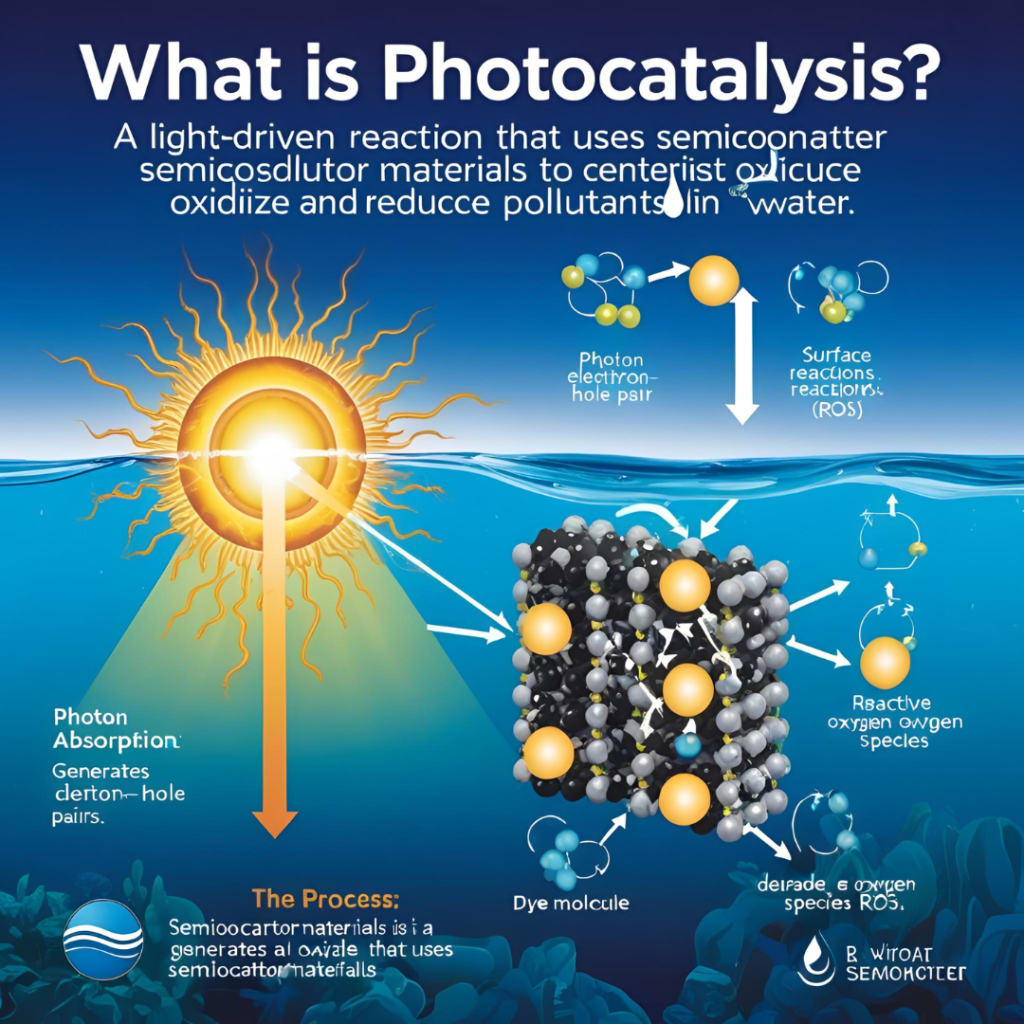
Photocatalysis is a photo-induced redox reaction that occurs in the presence of a semiconductor catalyst and light energy, typically UV or visible light. The process is governed by the generation of electron-hole pairs in the photocatalyst when it absorbs photons of energy equal to or greater than its band gap.
The Basic Mechanism Involves:
Photon absorption → Generation of electron-hole pairs.
Migration of charge carriers to the catalyst surface.
Redox reactions:
Electrons reduce oxygen to superoxide radicals (•O₂⁻).
Holes oxidize water or hydroxyl ions to hydroxyl radicals (•OH).
Attack on dye molecules by reactive oxygen species (ROS), leading to degradation.
This cascade of reactions ultimately breaks down the dye into non-toxic compounds, making the process eco-friendly and efficient.
Common Photocatalysts Used
1. Titanium Dioxide (TiO₂):
Most widely used due to its chemical stability, low cost, and high photocatalytic activity.
Drawback: Active mainly under UV light (band gap ~3.2 eV).
2. Zinc Oxide (ZnO):
Similar band gap to TiO₂ but more sensitive to light.
Issues with long-term stability under illumination.
3. Graphitic Carbon Nitride (g-C₃N₄):
A metal-free photocatalyst active under visible light.
Can be modified easily to improve performance.
4. Doped Semiconductors:
Transition metal or non-metal doping narrows the band gap.
Examples: Fe-doped TiO₂, N-doped ZnO, Ag/TiO₂ nanocomposites.
5. Hybrid Systems:
Combine different materials (e.g., TiO₂ with graphene oxide) for synergistic effects.
Photocatalytic Degradation of Dyes: Reaction Pathways
Photocatalytic degradation typically follows a radical mechanism. Here's how it generally unfolds:
Catalyst + hv → e⁻ (CB) + h⁺ (VB)
h⁺ + H₂O → •OH + H⁺
e⁻ + O₂ → •O₂⁻
Dye + •OH / •O₂⁻ → Intermediate → CO₂ + H₂O
These reactive oxygen species (ROS) play a crucial role in breaking the chromophoric structure of dyes — removing their color and toxicity.
Types of Dyes Treated
Photocatalysis has been effective in degrading a wide variety of dyes, including:
Azo dyes (e.g., Methyl Orange, Congo Red)
Anthraquinone dyes (e.g., Reactive Blue 19)
Triphenylmethane dyes (e.g., Crystal Violet)
Xanthene dyes (e.g., Rhodamine B)
Each dye has a different degradation pathway, but the goal remains the same: mineralization to CO₂, H₂O, and innocuous ions.
Operational Parameters Affecting Photocatalysis
1. Catalyst Dosage:
Optimal dosage improves surface area for reaction.
Excess leads to agglomeration and light scattering.
2. pH of the Solution:
Affects dye ionization and catalyst surface charge.
Optimal pH varies for different dyes (e.g., acidic for Methyl Orange, basic for Methylene Blue).
3. Light Intensity and Source:
Higher intensity increases the number of generated charge carriers.
UV lamps or sunlight are commonly used.
4. Initial Dye Concentration:
Higher concentrations can saturate active sites and shield light.
5. Presence of Electron Acceptors:
Substances like H₂O₂ or O₂ enhance degradation by trapping electrons and reducing recombination.
Advantages of Photocatalysis
Environmentally friendly: No secondary pollutants or toxic residues.
Cost-effective: Uses natural sunlight or low-cost UV lamps.
Complete mineralization: Converts harmful dyes to CO₂ and H₂O.
Broad applicability: Works on various organic pollutants.
Reusability: Catalysts like TiO₂ can be reused after recovery.
Limitations and Challenges
Despite its promise, photocatalysis faces several bottlenecks:
Low quantum efficiency due to rapid electron-hole recombination.
Limited absorption spectrum, especially for UV-active materials.
Difficulty in catalyst recovery from aqueous media.
Scalability issues for real-time industrial applications.
Photocorrosion of some catalysts (e.g., ZnO).
These challenges drive ongoing research into material modification, composite design, and reactor engineering.
Recent Advances and Innovations
1. Visible-Light Responsive Catalysts:
Doping with nitrogen, sulfur, or metals enhances visible light activity.
Example: N-TiO₂ or Ag-TiO₂.
2. Heterojunction Photocatalysts:
Combine two semiconductors with matched band structures.
Improve charge separation and extend light response.
3. Magnetic Photocatalysts:
Embedding magnetic particles allows easy separation using magnets.
4. Immobilized Catalysts:
Fixing the catalyst on a support (glass, fabric) for better handling.
5. Photocatalytic Membrane Reactors (PMRs):
Integration of filtration and photocatalysis for continuous dye removal.
Case Studies and Applications
Case Study 1: TiO₂ Degradation of Methylene Blue
Catalyst: TiO₂ nanoparticles (Degussa P25)
Conditions: UV light, neutral pH
Result: 95% degradation in 60 minutes
Case Study 2: ZnO Nanorods on Glass Substrate
Immobilized ZnO on glass used under solar irradiation.
Dye: Congo Red
Result: 85% degradation after 90 minutes
Case Study 3: g-C₃N₄/Graphene Hybrid
Dye: Rhodamine B
Visible light source used.
Enhanced degradation due to better electron mobility and ROS generation.
Environmental and Industrial Impact
Photocatalytic dye degradation offers enormous environmental benefits, particularly for developing countries facing industrial wastewater problems. It is:
Sustainable with minimal resource consumption.
Scalable for integration into treatment plants.
Adaptable to different wastewater compositions.
Industries adopting this technology can achieve regulatory compliance, reduce ecological footprints, and potentially recycle treated water for reuse.
Future Outlook
The future of photocatalysis lies in:
Material innovation: Bandgap engineering, multi-functional nanostructures.
Solar activation: Efficient harvesting of sunlight via advanced optics.
Real-world reactor design: From batch to continuous flow systems.
AI and modeling: Predicting performance under diverse conditions.
Policy support: Encouraging eco-friendly technologies via subsidies and regulation.
As we move towards a more sustainable and circular economy, photocatalysis stands out as a clean, green, and smart solution for industrial dye pollution.
Conclusion
Photocatalysis represents a revolutionary approach to wastewater treatment — transforming harmful dyes into harmless molecules using nothing but light and nanotechnology. While challenges remain, ongoing research and innovation continue to push the boundaries of what is possible. In the fight against water pollution, photocatalysis is not just a method — it’s a movement toward a cleaner, greener planet.
About the Creator
Atif khurshaid
Welcome to my corner of the web, where I share concise summaries of thought-provoking articles, captivating books, and timeless stories. Find summaries of articles, books, and stories that resonate with you
Keep reading
More stories from Atif khurshaid and writers in Education and other communities.
I Tried Living Like My Grandparents for a Week
My grandparents’ home has always felt different—as if the air moved slower inside it. No buzzing phones, no digital clutter, no rushing from one thing to the next. Just a gentle rhythm. I’d always wondered whether life was actually calmer back then or if nostalgia was tricking me. So I tried living like they did for an entire week.
By Atif khurshaid2 months ago in Education
Why Do We Dream?
In the third millenium BCE, Mesopotamian kings recorded and interpreted their dreams on wax tablets. A thousand years later, Ancient Egyptians wrote a dream book listing over a hundred common dreams and their meanings. And in the years since, we haven't paused in our quest to understand why we dream. So, after a great deal of scientific research, technological advancement, and persistence, we still don't have any definite answers, but we have some interesting theories. We dream to fulfill our wishes.
By Munesh Yadav3 days ago in Education
The $73,000 Text Message That Changed Everything
"Just realized I missed the quarterly payment deadline by one day. How bad is this?" I stared at the message, knowing I was about to deliver devastating news. My client—a successful entrepreneur who built his tech consulting firm from zero to $3.2 million in annual revenue—had just cost himself $73,000.
By Nth Degree Tax5 days ago in Education




Comments
There are no comments for this story
Be the first to respond and start the conversation.