
Philosophy of Regret
A philosopher discovers that the mind can reason through everything — except the heart

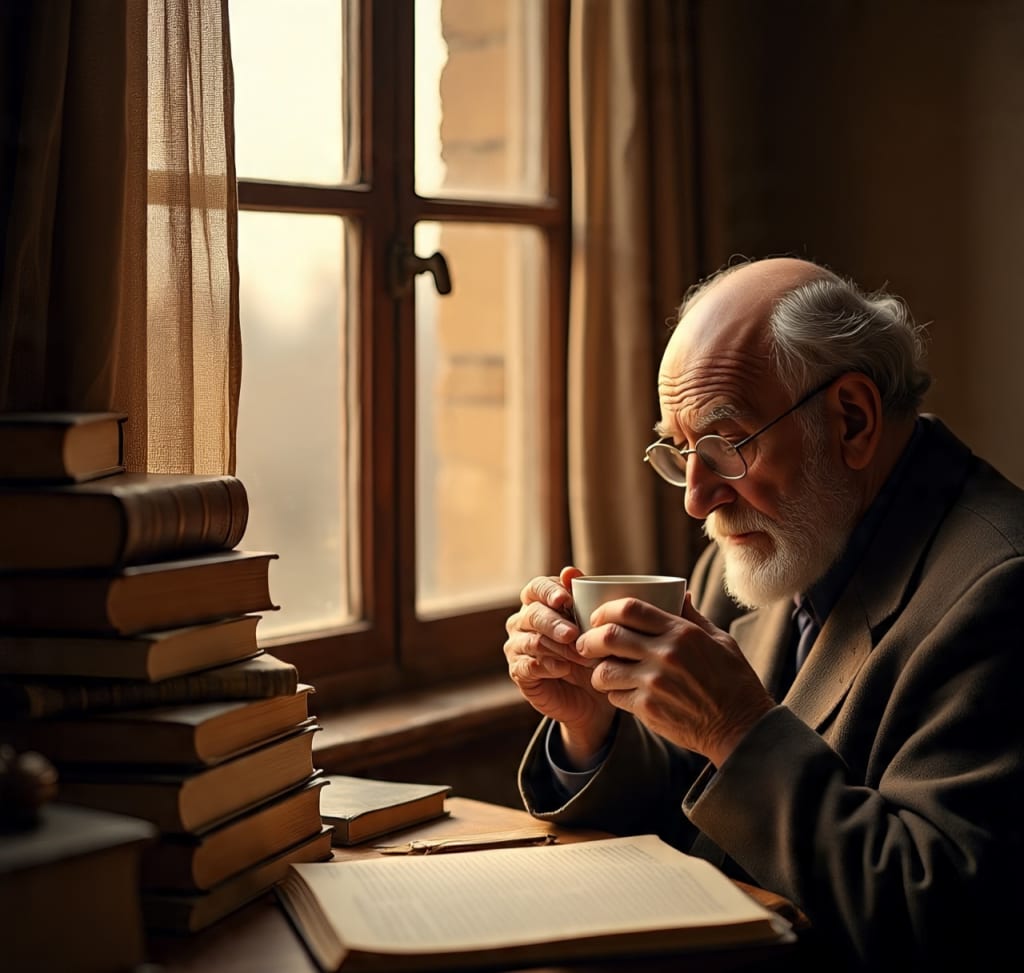
Edward Blythe had spent his life collecting moments he could not return to.
He was a philosophy professor in Oxford, admired for his calm mind and quiet wisdom. His lectures on time, morality, and choice often drew students from across Europe. They said he spoke about life as though he had already lived several. What they didn’t know was that he carried a secret, one that weighed more heavily with each passing year.
In his youth, Edward had been engaged to a woman named Marianne. She was everything he wasn’t — spontaneous, impulsive, full of laughter. He loved how she could find beauty in the most ordinary things. Once, when they walked through a storm, she had smiled and said, “We can’t stop the rain, so we might as well dance in it.”
But Edward was cautious, overly so. He believed that life required reason, not risk. When he received an offer to study abroad, he told her, “It’s only for a year. We’ll have our whole lives after.” She nodded, but her eyes had dimmed slightly.
One year turned into two. Letters became fewer. When he finally returned, she was gone — married to someone else.
He told himself it was fate, that life had its own logic. But deep down, he knew it was fear — not fate — that had cost him everything.
For decades, Edward buried the memory beneath his books and lectures. He taught about Aristotle’s ethics and Kant’s moral imperatives, about the necessity of rational choice. But late at night, when the corridors were quiet, he would sit by the window with a cup of cold tea and whisper the same sentence to himself. “Regret is the only proof that we once cared.”
One winter evening, a student named Amelia stayed behind after class. She was bright, but restless, full of questions that cut deeper than most. “Professor,” she said, “do you believe that reason is stronger than emotion?”
Edward smiled faintly. “I used to.”
“What changed?” she asked.
He looked at her for a long time before answering. “I learned that reason keeps you safe. But emotion keeps you alive.”
Amelia didn’t understand then, but she remembered his words. Weeks later, she told him she was considering ending her engagement because her fiancé wanted to move abroad. She feared distance, uncertainty, and the possibility of loss.
Edward paused. His heart felt strangely familiar with her fear. “Do you love him?” he asked.
“Yes,” she said softly.
“Then go with him,” he replied. “If you stay behind, you’ll only study the idea of love. You won’t live it.”
Amelia looked surprised. “You sound like a poet, not a philosopher.”
“Perhaps I was once both,” he said with a sad smile.
She thanked him and left. That night, Edward walked home through the frost-covered streets, his old cane tapping against the cobblestones. The sky above was heavy with stars. He thought of Marianne again — of her laughter in the rain, of her hand in his.
He stopped by a small café they had once visited and sat by the same window. The place had changed, but the feeling hadn’t. He ordered two cups of coffee out of habit, then chuckled softly to himself.
He took out a small notebook — the same one he had carried since his student days — and wrote a single line. “Regret is a philosopher’s most honest confession.”
Weeks later, he received a letter from Amelia. She had left the country with her fiancé. At the bottom of the page, she had written, “Thank you for teaching me that sometimes the right decision isn’t the rational one.”
He smiled when he read it, feeling something inside him finally settle. It was strange, he thought, how life offers us small redemptions through others.
That spring, Edward retired. On his final day at the university, he gave one last lecture, not from notes but from memory. “Philosophy,” he said to his students, “is not about living without regret. It’s about understanding it. Regret is love’s echo — a reminder that something once mattered enough to lose.”
When he finished, there was silence in the hall. Then, slowly, his students stood and applauded.
That night, as the sun set behind the ancient spires of Oxford, Edward sat once more by his window. He poured himself a cup of tea, raised it to the fading light, and whispered, “For you, Marianne. Thank you for the lesson.”
And for the first time in years, the weight of regret felt almost beautiful.
About the Creator
LUNA EDITH
Writer, storyteller, and lifelong learner. I share thoughts on life, creativity, and everything in between. Here to connect, inspire, and grow — one story at a time.
Keep reading
More stories from LUNA EDITH and writers in Education and other communities.
Learning Outside the System
I learned more from silence than I ever did from a syllabus. Not because classrooms are cruel places—but because they are crowded with answers before we’ve learned how to ask our own questions. From an early age, learning was presented to me like a straight road with guardrails: memorize this, repeat that, don’t wander too far. Curiosity was welcomed, but only if it arrived on time, raised its hand, and fit neatly inside the lesson plan.
By LUNA EDITH2 months ago in Education
Understanding How Argo Turboserve Aerospace Components Support Modern Aviation Engineering
In aviation engineering, I have always believed that reliability is built through precision manufacturing and strict quality control. Aircraft systems depend on thousands of specialized parts working together seamlessly, and one of the manufacturers that appears in aerospace supply catalogs is Argo Turboserve Corporation.
By Beckett Dowhan5 days ago in Education




Comments (1)
I think this is in the wrong category.