

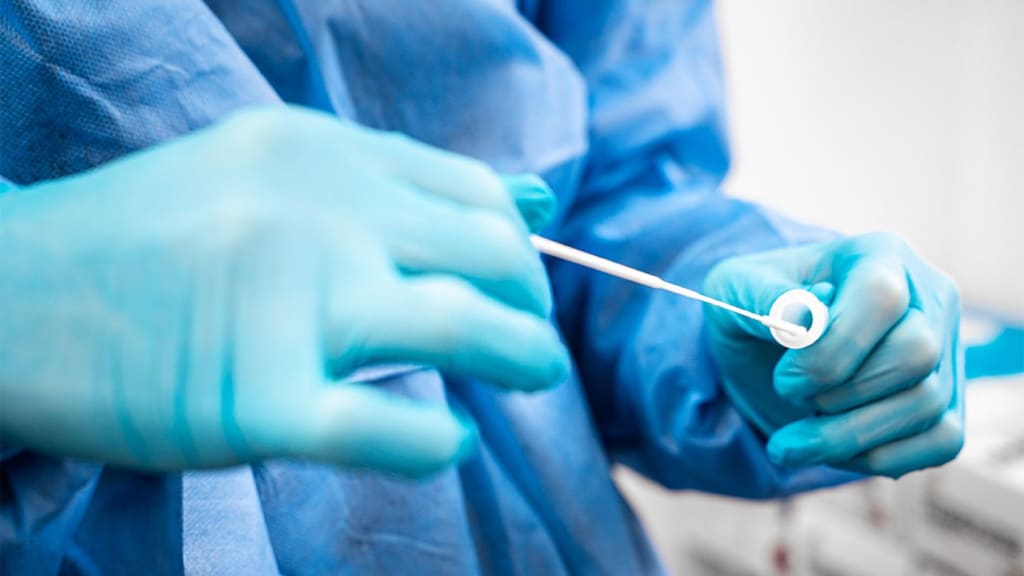
Polymerase chain-reaction
Polymerase chain-reaction is a kind of nucleic acid-test which is very popular and effective method for this purpose as it is fast method with high sensitivity and possess greater specificity as well that’s why, it is considered and believed as the ‘gold standard’ for the prognosis of this contagious viral infection. For SARS-Cov-2, reverse transcriptase-PCR is considered more reliable due to some of its benefits. It is specific as well as it involves simple qualitative-assay. It is also known as biological reaction in which we use DNA molecules or specific set of genes to develop a new kind of material. Early diagnosis of infection is made possible by the real-time RT-PCR as it has adequate sensitivity to help us get through this. So, it is declared and considered as the main method to find the causative agent of this viral infection. But alone this method is not sufficient to detect that the virus as it may give false-positive as well as false-negative results and thus the reliability of this method is not the hundred percent. Both methods real-time RT-PCR along with clinal characteristics can help and facilitates the infected patients in this regard. Other factors are also involved which tells about the inconsistency of the method real-time RT-PCR. Many challenges have to be faced by the scientists and researchers when it comes to the diagnosis and the detection of this SARS-Cov-2 by using the RT-PCR method. This method can be benefit us by showing the limitations that has been observed in the obtained results and hints at the areas where the improvements and changes can be made to better the prognosis of the patients that could save lives.
Limitations of Polymerase Chain Reaction
If the sequence of viral RNA is variated then it can affect the results that has been acquired by using the real-time RT-PCR on employing the primers in various genes. Different studies have shown the genetic diversity as well as the rapid evolution of this disease. False-negative results can be obtained if the mutations occur in the probe target-regions and in the primer of the genome of SARS-CoV-2. Many attempts are made to design such a real-time RT-PCR that it can give the possible precise results but due to target sequences and the variability in the probe, false-negative results are possible to be obtained. The invalid results can be avoided if we use multiple-target gene-amplification method. Several kits of variable quality have been produced as well as approved for the SARS-Cov-2 detection but still, it is not 100% accurate. Sampling procedures may also give false-negative results. According to the recent studies, sputum has been considered as a good sample for the laboratory detection of the coronavirus. Nasal swabs are used along with it. Throat swabs were discarded for this purpose. Bronchoalveolar lavage-fluid are employed when the case is severe to find and locate viral RNAs in the system. However, it is not fast and convenient like the nasal swab and other sampling techniques. Also, it is quite painful for the patient too. Inconsistent results can be avoided if we take samples from different sources which could be blood or stool specimens. One of the reasons why we obtained false results is due to the sample contamination. Viruses are seen to be present in the upper respiratory-tract as well as the lower respiratory-tract. If the multiple results give false results then the sample needs to be checked again as it may have some contaminations in it. Laboratory practices should be improved to avoid the inconsistent and false results which could save many patients and help in the disease management.
About the Creator
Fatima Jamil
In a world where you can be anyone, be yourself.
Keep reading
More stories from Fatima Jamil and writers in Education and other communities.
Treatment of Viral Diseases part-2
Nanotechnology to combat coronavirus Through many years and decades of evolution, many viruses have acquired different molecular mechanisms to enter the cells. They go through different modification mechanisms, inhibition and activation before entering into the cells and alter the defense mechanism of the host. They possess the ability to transfer genes into the host genome. By this natural ability of viruses, they are used for medicinal purposes. Gene-therapy is made possible by the recombinant viral-vectors. Drug-delivery systems are also inspired by looking at the natural capability of these viruses. In nanomedicine, researchers have worked on designing the various nanosystems which can copy the gene-transfer capacity and the high infectivity shown by viral vectors. Molecular mechanisms can be studied and learned in order to develop various delivery systems in the nanomedicine. Cancer therapy and other regenerative medicine use delivery systems that have been developed by biomedical researchers. Nanotechnology develop different delivery tools that are virology inspired tools. It is also useful in fighting against the dangerous viruses.
By Fatima Jamil3 years ago in Education
Breaking Down Private and Commercial Pilot Licenses
Taking flight is more than just a thrill; it can be a lifestyle or a full-fledged career. But before you can soar through the skies, you need to earn the appropriate pilot license. Two of the most common paths for aspiring aviators are the private pilot license (PPL) and the commercial pilot license (CPL). While both enable you to fly aircraft, they serve very different purposes and require varying levels of commitment. If you're deciding between the two, understanding the distinctions can help you make the right choice for your future in aviation.
By Jett Harris of Arkansas5 days ago in Education



Comments
There are no comments for this story
Be the first to respond and start the conversation.