
Overthinking: Why It Happens and How to Gently Shift Out of It Overthinking ,
How to Break Free From the Cycle of Overthinking and Reclaim Inner Peace"

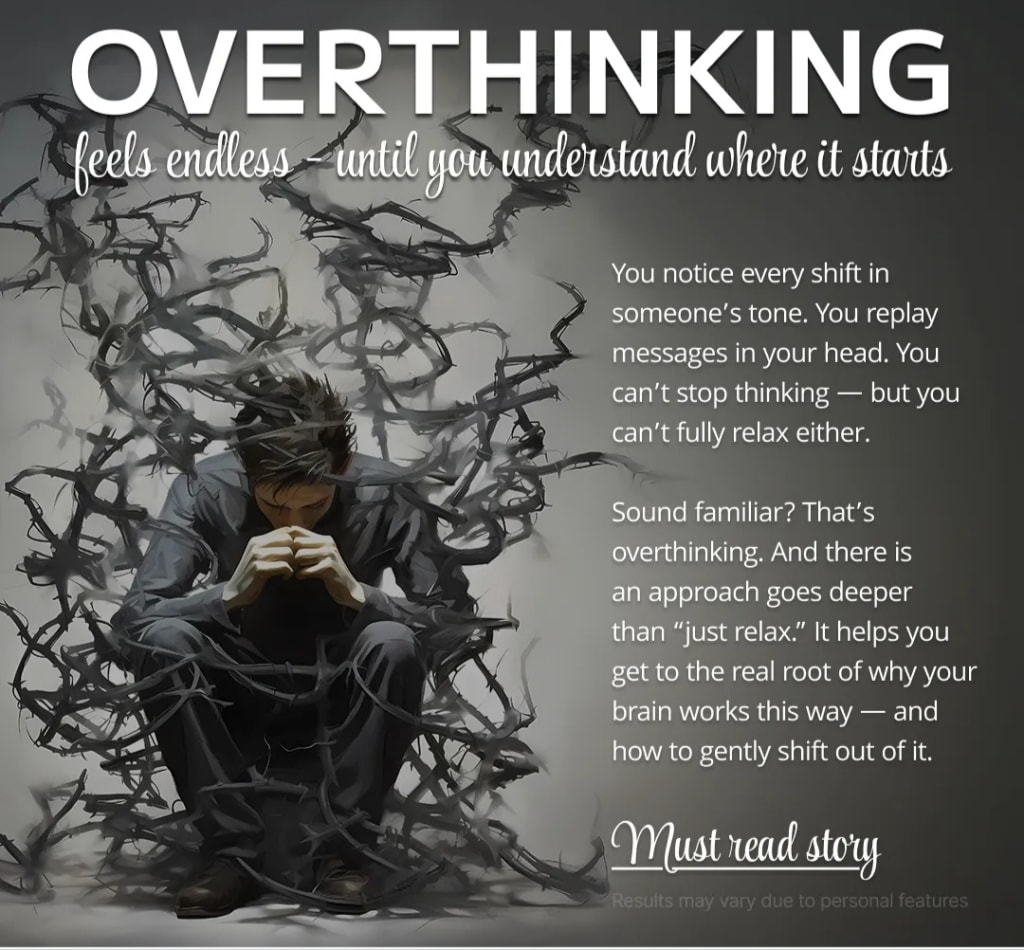
Overthinking: Why It Happens and How to Gently Shift Out of It
Overthinking can feel like being trapped in a mental maze. You analyze every word in a text message, replay conversations, worry about what someone meant by a change in tone, or obsess over whether you made the right decision. It’s exhausting — not just mentally, but physically. Your body stays tense, your mind rarely rests, and even when things are “fine,” you’re waiting for something to go wrong.
If this sounds familiar, you’re not alone — and you’re not broken. Overthinking isn’t simply a bad habit or a sign of weakness. It’s often a learned response rooted in a desire for safety and control. The good news is that it can be unlearned. But instead of forcing yourself to “just stop thinking so much,” a more compassionate and lasting approach begins with understanding why your brain works this way.
Why Overthinking Happens
At its core, overthinking is a protective mechanism. Your brain is trying to keep you safe from emotional pain, uncertainty, or rejection. If you've experienced environments where things were unpredictable — emotionally, physically, or socially — you may have learned that staying alert and anticipating problems helped you avoid getting hurt.
For example, if you grew up in a household where moods shifted quickly, criticism came without warning, or your emotional needs weren’t consistently met, your nervous system adapted. It became hyperaware of subtle shifts in others' behavior. You learned to scan for danger in people’s words, tones, or silences. That skill might have helped you navigate childhood — but now, as an adult, it keeps you stuck in cycles of worry and second-guessing.
Even if your life is relatively calm now, your brain may still operate in “high alert” mode because it hasn’t yet relearned what true safety feels like.
The Cost of Living in Your Head
Overthinking gives the illusion of control — that if you can just figure it all out ahead of time, you won’t be caught off guard. But in reality, it creates more anxiety. When you're caught in this loop, you're not solving problems — you're trying to self-soothe by mentally rehearsing every possible scenario. And ironically, this kind of mental rehearsal actually increases your stress.
It also disconnects you from the present moment. You stop trusting your instincts, delay decisions, or second-guess your words after you speak them. Over time, this can wear down your confidence and make it harder to enjoy relationships, rest, or feel emotionally safe.
Shifting Gently: What Actually Helps
So, how do you move out of overthinking without forcing yourself into fake calm or pretending everything is okay? The key is not to fight the thoughts, but to understand them — and gradually rebuild a sense of safety from the inside out.
1. Name the Pattern Without Judgment
Begin by simply noticing when you’re overthinking. Instead of criticizing yourself for spiraling, try:
“Ah, I’m overthinking again. My brain’s trying to protect me.”
Naming it creates distance from the thought and invites compassion, not shame.
2. Ask Grounding Questions
Rather than obsessing over what someone else meant or what could go wrong, try shifting the focus inward:
“What do I need right now?”
“Am I trying to control something that’s outside of me?”
These questions help bring your attention back to the present and re-center your sense of agency.
3. Practice Sitting With Uncertainty
A huge part of overthinking is trying to eliminate uncertainty. But not everything can be known or controlled — and that’s okay. You can build tolerance for uncertainty by practicing small moments of letting go. For instance:
“I don’t know what they’re thinking, and I can live with not knowing right now.”
This teaches your nervous system that not having an answer doesn’t equal danger.
4. Connect to Your Body
Overthinking is a disconnection from the body — a retreat into the mind. Grounding practices like deep breathing, walking, stretching, or even putting your hand on your chest can help signal safety to your system. The more your body feels safe, the less your mind needs to work overtime.
5. Use Tools That Rebuild Trust
Journaling, therapy, somatic work, and mindfulness are powerful tools. They help you reconnect with your internal world — your emotions, intuition, and needs — so you don’t have to rely on mental analysis to feel in control.
You’re Not Broken — You’re Adapting
If you’re an overthinker, it’s not because you’re weak. It’s because your brain learned to work overtime to protect you. But protection isn’t the same as peace. And the peace you’re seeking doesn’t come from figuring everything out — it comes from learning to feel safe even when you can’t.
With practice, you can begin to shift out of overthinking — not by shutting down your thoughts, but by gently making space for something deeper: self-trust, safety, and presence.
About the Creator
Israr khan
I write to bring attention to the voices and faces of the missing, the unheard, and the forgotten. , — raising awareness, sparking hope, and keeping the search alive. Every person has a story. Every story deserves to be told.
Keep reading
More stories from Israr khan and writers in Education and other communities.
Earth’s Black Box: Humanity’s Last Message to the Future?
Earth’s Black Box: Humanity’s Last Message to the Future? On the windswept, isolated coast of Tasmania, something extraordinary is being built — not a monument of triumph, but a somber testament to our times. Known as Earth’s Black Box, this solar-powered, steel monolith is being constructed with a singular purpose: to document the potential downfall — or the resilience — of humanity.
By Israr khan8 months ago in Education
AI-Driven Drug Discovery: Transforming the Future of Medical Innovation
Developing new medicines has long been one of the most challenging and resource-intensive processes in the healthcare industry. The traditional drug discovery pipeline often involves years of laboratory experiments, extensive data analysis, and multiple stages of clinical trials. Despite these efforts, the majority of potential drug candidates fail before reaching the market. This high rate of failure makes drug development both costly and time-consuming, limiting the speed at which new treatments become available to patients.
By Abba Leffler4 days ago in Education
5 AI Side Hustles You Can Start in 2026 to Make Money Online
Artificial intelligence isn’t just a buzzword—it’s a goldmine for anyone looking to start a side hustle or make extra income online. In 2026, AI tools are more accessible than ever, allowing individuals to automate tasks, create digital products, and provide services that were previously time-consuming or expensive.
By Majus Jasulaitis3 days ago in Education



Comments
There are no comments for this story
Be the first to respond and start the conversation.