
Our sister galaxy and local group galaxies
Understanding beyond your vision
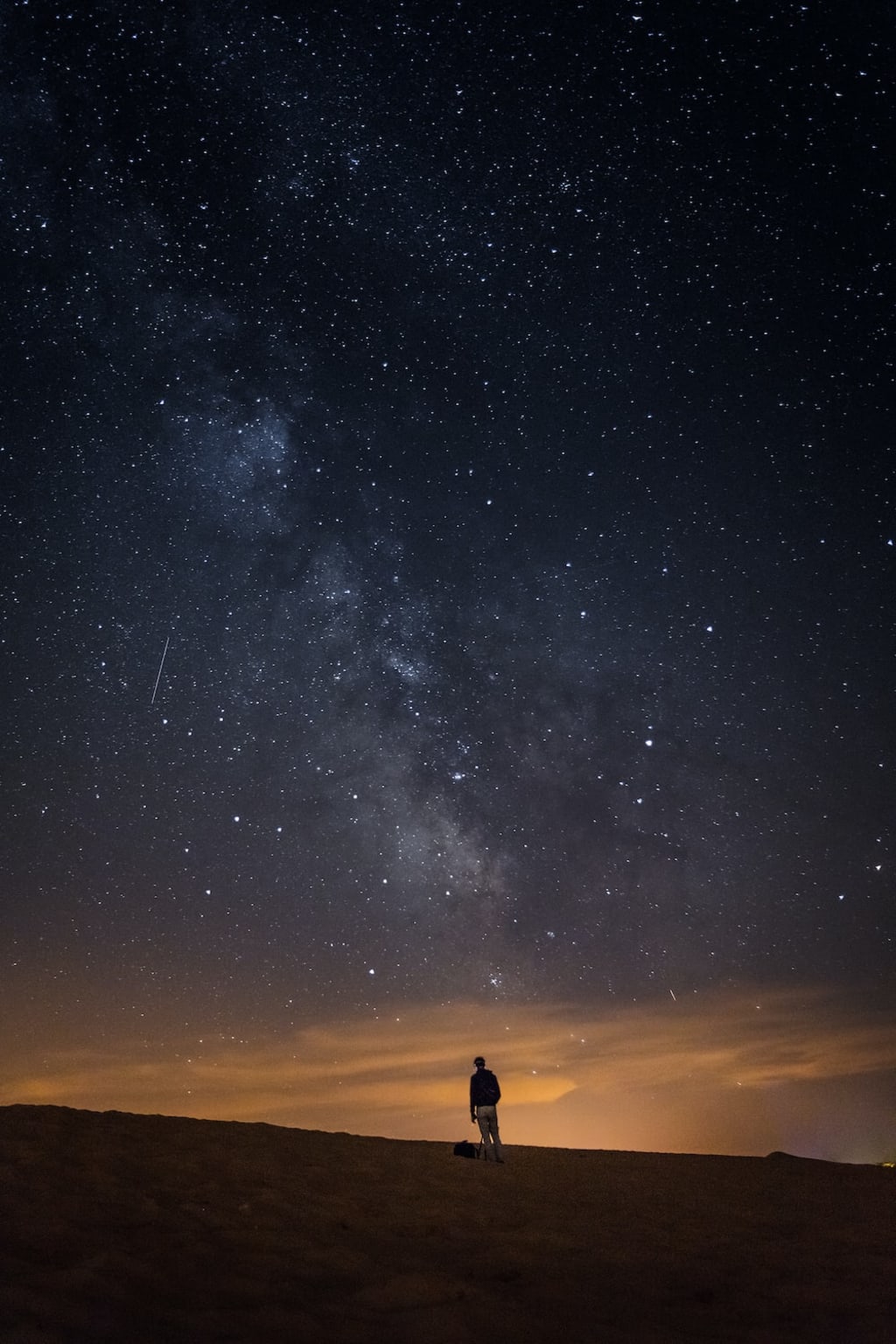
visible to the naked eye and studied by persian astronomers
around 900 a.d the andromeda nebula was thought to be a part of the milky way
in fact it was thought that all the stars in the universe were in our milky way galaxy
that changed in the early 1900s in 1923 edwin hubble found a seafied variable
in the nebula the star altered the course of modern astronomy the star goes by the name v1
and dated october 6 1923 he originally identified three stars and marked each of them with an
n for nova the class of exploding star later hubble realized that the nova at the top right
was actually a c field variable he crossed out the n and wrote var for variable he added
an exclamation point because he knew that this variable would allow him to calculate the distance
you may recall from our segment on distant stars
that we covered how harriet levitt discovered the relationship between cepheid variable frequency
and their intrinsic luminosity and once we know the intrinsic luminosity of a star
we can use the apparent luminosity and the inverse square law to determine how far away the star is
and indeed once the period was measured at 31.4 days he knew he had another galaxy
before v1 distances to stars were measured in thousands of light years after v1
the universe became a much bigger place v1 was over two and a half million light years away
andromeda is a beautiful barred spiral galaxy with two spiral arms that glow
with a massive number of new stars this is very much like our milky way
but andromeda's disc is 220 000 light years wide that's more than twice the width of the milky
but recent studies of star escape velocities indicate that both galaxies have the mass of
about 800 billion suns counting stars gas dust and dark matter
[Music]
light from this magnificent galaxy left its stars just over two and a half million years ago
when the light that entered hubble's telescope left andromeda there were no humans on earth while
the light traveled towards earth we came into being we created and lost great civilizations
and we built the telescope that caught the light when it finally reached our planet [Music]
in 2015 the hubble space telescope captured the sharpest and most detailed image ever taken of
the galaxy it shows over 100 million stars and thousands of star clusters
embedded in a section of the galaxy's disk stretching across over 48 000 light years
it traces the galaxy from its central bulge on the left where stars are densely packed
together across lanes of stars and dust to the sparta outskirts of its outer disk on the right
zooming into the boxed field we see some foreground milky way stars in the line
of sight to andromeda and a couple of distant spiral galaxies shining through andromeda's disk
a large number of star clusters can be seen in this analysis of andromeda
the large group of blue stars in the galaxy indicate star forming regions
in the spiral arms while the dark silhouettes of obscured regions trace out complex dust
structures underlying the entire galaxy is a smooth distribution of
cooler red stars that trace andromeda's evolution over billions of years [Music]
careful analysis of andromeda's proper and radial motion
indicates that it is on a collision course with our milky way [Music]
we'll conclude our coverage of andromeda with a look at its closing velocity
is closing at 14.4 million kilometers per day that's almost 9 million miles per day
but given the 2.5 million light years between us it won't get here for around four to four
and a half billion years we cover this in depth in a subsequent segment on colliding galaxies
[Music]
there are over 30 galaxies in the local group
andromeda is the largest the milky way is second and triangulum is third all the rest are dwarf
galaxies and most of these are orbiting one or the other of the three big ones
as of 2020 we have discovered 59 dwarf galaxies orbiting the milky way
andromeda has at least 34 and the triangulum galaxy has one
the other members of the group are gravitationally not orbiting any of these larger galaxies
we'll take a look at some of these and then move closer to our home with a good look at some of
our milky way orbiting dwarf galaxies [Music] here we are zooming into the triangulum galaxy
it's the third largest member of the local group with a diameter of about 60 000 light years
triangulum is home to around 40 billion stars
that's small compared to our two to 400 billion and andromeda's trillion [Music]
the galaxy doesn't have a bright bulge at its center
but it does contain a huge amount of gas and dust giving rise to rapid star formation
new stars form at a rate of approximately one every two years [Music]
this hubble image contains 10 to 15 million individual stars the mosaic of the triangulum
galaxy showcases the central region of the galaxy and its inner spiral arms [Music]
millions of stars hundreds of star clusters and bright nebula are visible [Music]
ngc 604 is among the largest known star formation regions
in the local group it lies in an outer triangulum spiral arm
this huge star birth region contains more than 200 brilliant blue stars within a cloud of glowing gas
some 1 500 light years across [Music] that's nearly 100 times the size of the orion nebula
by contrast the orion nebula contains just four bright central stars
the bright stars in 604 are extremely young
by astronomical standards having formed a mere 3 million years ago
this small irregular galaxy is one of the milky way's closest neighbors and is considered
prototypical of the earliest fragmentary galaxies that inhabited the young universe
what's striking about ngc 6822 is its unusually high abundance of h2 region
emission nebula these are visible surrounding the small galaxy
this is one of them the glowing gas cloud called hubble 5 has a diameter
of about 200 light years a faint tale of nebulosity trailing off the top of the image
sits opposite a dense cluster of bright stars at the bottom of the irregular shaped
nebula [Music]
ic-10 is another irregular galaxy hubble suspected it might belong
to the local group of galaxies but its status remained uncertain for decades
its membership in the group was finally confirmed in 1996
by direct measurements of its distance based on observations of cepheids
the reason it took so long is that despite its closeness the galaxy lies near the plane of the
milky way and is therefore heavily obscured by our galaxy's interstellar matter [Music]
ngc 3109 looks like a small spiral galaxy if it is a spiral galaxy it would be the smallest
in the local group it is oriented edge on from our point of view and may contain a disk and a halo
it does not appear to possess a galactic nucleus
but it does seem to contain an unusually large number of planetary nebula
young blue stars and older yellow and red stars shine against a dark sky in this image of sexton's
a from japan's subaru telescope the galaxy is a small peculiar square shaped dwarf galaxy
5 000 light years across 4.3 million light years from earth
the bright foreground yellowish stars are in the milky way
here we take a look at a few of the dwarf galaxies orbiting our milky way
gaia's all-sky density map picked up a few of the closer ones and calculated their orbits the lines
represent the orbital track traveled over the past few million years the further away the galaxy the
longer its orbital period it can take billions of years for the satellites further out to complete
a single orbit compare that to the 230 million years it takes us to make one revolution [Music]
sagittarius dwarf is our closest orbiting galaxy
it is so close that it is being ripped apart by the milky way
it will be fully integrated as part of the milky way within the next billion years [Music]
here we are zooming into globular cluster m54 at its center
sculptor dwarf is a dwarf spheroidal galaxy
these are very common they contain an old stellar population with large separations between stars
they are also devoid of gas and dust so there is no new star formation
a team of astronomers use data from both the hubble space telescope
and the gaia satellite to directly measure the 3d motions of individual stars in sculptor
their results show that the galaxy's orbit is quite elongated
currently at 290 000 light years sculptor dwarf is near to its closest point to the milky way
but its orbit will take it as far out as 725 000 light years [Music]
fornax dwarf is one of our furthest orbiting galaxies
it's of interest to astronomers because its globular clusters don't fit
current globular cluster formation theory because
there aren't enough old stars in the clusters as theorized that there should be
research continues
but the two dwarfs of the most interest can be seen in the southern night sky
they are the large magellanic cloud 160 to 170 000 light years away
and the small magellanic cloud a bit further at 200 000 light years from us
these companion galaxies were named for the portuguese navigator ferdinand magellan whose
crew discovered them during the first voyage around the world from 1519-1522 [Music]
a large magellanic cloud or lmc for short is the brightest galaxy in the sky it contains several
billions of stars and many stars are still forming in it the small magellanic cloud or smc for short
contains at least several hundred million stars like the lmc
there is still a lot of star formation taking place within it
here we'll take a look at some of the amazing nebula
in the lmc this stellar region is called 30 doradus it contains millions of young
stars including the most massive stars ever seen weighing more than 100 times the mass of our sun
no known star-forming region in our galaxy is as large or as prolific as 30 doradus
with this closer look we see the tarantula nebula
early astronomers nicknamed the nebula because its glowing filaments resembled spider legs [Music]
the image reveals the stages of star birth from embryonic stars a few thousand years old
wrapped in their eggs to behemoths the die young and supernova explosions
[Music]
astronomers using the unique ultraviolet capabilities of the hubble space telescope
have identified nine monster stars with masses over 100 times the mass of the sun
in the star cluster r136 this makes it the largest sample of very massive stars identified
to date the detected stars are not only extremely massive but also extremely bright
together these nine stars outshine the sun by a factor of 30 million
hodge 301 seen in the lower right hand corner of this image lies inside the tarantula nebula
many of the stars in hodge 301 are so old that they have exploded as supernova
these exploded stars are blasting material into the surrounding region
at speeds of almost 320 kilometers per second that's 200 miles per second
the high speed matter is plowing into the surrounding tarantula nebula shocking and
compressing the gas into a multitude of sheets and filaments seen in the upper left portion of the
picture
this image of supernova remnant 0509-67.5 was made by combining data from two of nasa's great
observatories hubble and the chandra x-ray observatory the results show soft green blue
hues of heated material from the x-ray data surrounded by the glowing pink optical shell
which shows the ambient gas being shocked by the expanding blast wave from the supernova
three decades ago astronomers spotted one of the brightest exploding stars in more than 400 years
the titanic supernova called 1987a in the large magellanic cloud plays
with the power of 100 million suns for several months following its discovery
a dense ring of gas around the supernova is glowing in optical light
and has a diameter of about one light year a flash of ultraviolet light from the explosion
energized the gas in the ring making it glow for decades
this time lapse video sequence of hubble images show the effects of the shock wave from the
supernova blast smashing into the ring the ring begins to brighten as the shock wave hits it
in the past few years the ring's x-ray light has stopped getting brighter and the bottom left part
of the ring has started to fade these changes provide evidence that the explosion's blast wave
has moved into the region beyond the ring this represents the end of an era for the supernova
we expect to learn more about the new region as the blast wave impacts its contents [Music]
a unique peanut-shaped reflection nebula surrounds a cluster of young hot stars
in this view from hubble the double bubble n30b is inside a larger nebula the very bright star at the
top of the picture illuminates the dusty cocoon like a flashlight shining on smoke particles
the searing supergiant star is only 25 light years from the n30b nebula [Music]
swirls of gas and dust reside in this region of star formation it reveals a
region where low mass infant stars and their much more massive stellar neighbors reside
this is just one of the hundreds of star forming systems located in the lmc
this region is a firestorm of raw stellar creation
perhaps triggered by a nearby supernova explosion [Music] the three-dimensional
looking image reveals dramatic ridges and valleys of dust serpent head pillars of creation
and gaseous filaments glowing fiercely under torrential ultraviolet radiation
region is on the edge of a dark molecular cloud that is an incubator for the birth of new stars
in 2019 i released the how old our stars video where we covered hr diagram turn off points
to find the age of star clusters here's ngc 1466 a very old globular cluster in the large magellanic
cloud it has a mass equivalent to roughly 140 000 suns and a turn-off point that indicates its age
is around 13.1 billion years making it almost as old as the universe
itself
[Music]
now let's take a look at a couple of objects in the small magellanic cloud
at the heart of the smc lies cluster ngc 602 the high-energy radiation blasting out from
the young stars is sculpting the inner edge of the outer portions of the nebula
slowly eroding it away and eating into the material beyond elephant trunk-like dust
pillars point towards the hot blue stars and are all telltale signs of their eroding effect [Music]
the ngc 346 cluster at the center of this hubble image is resolved into at least three subclusters
and collectively contains dozens of hot
blue high mass stars more than half the known high mass stars in the entire smc
a myriad of smaller compact clusters is also visible throughout the region [Music]
hubble captured two nebula inside the small magellanic cloud situated as to appear as one
intense radiation from the brilliant central stars is heating the hydrogen in each of the
nebula causing them to glow red this is part of a study to understand how interstellar dust
is different in galaxies that have a far lower supply of heavy elements the small magellanic
cloud has between a fifth and a tenth of the amount of heavy elements that the milky way does
because it is so close astronomers can study its dust in great detail
and learn about what dust was like earlier in the universe's history
here are the local group galaxies we saw in this segment the local group is part of a
larger structure known as the local volume we'll explore this local volume in our next segment you
About the Creator
Keep reading
More stories from writers in Education and other communities.
Visa-Free Travel Map Changes for Indian Passport Holders in 2026: Two Destinations Added, Four Lost
The power of a passport is more than a matter of convenience; it reflects a country’s diplomatic reach, global standing, and reciprocal trust with other nations. In 2026, Indian passport holders are seeing a notable shift in their visa-free travel landscape. While two new destinations have opened their doors without visas, four countries have tightened entry rules, reshaping how Indians plan international travel. The changes offer both opportunities and challenges, and they reveal important trends in global mobility.
By Fiaz Ahmed Brohi5 days ago in Education




Comments