
Origins of the Cosmic Titans: The Birth of Supermassive Black Holes
Unraveling the Mysteries Behind the Universe's Most Powerful Entities

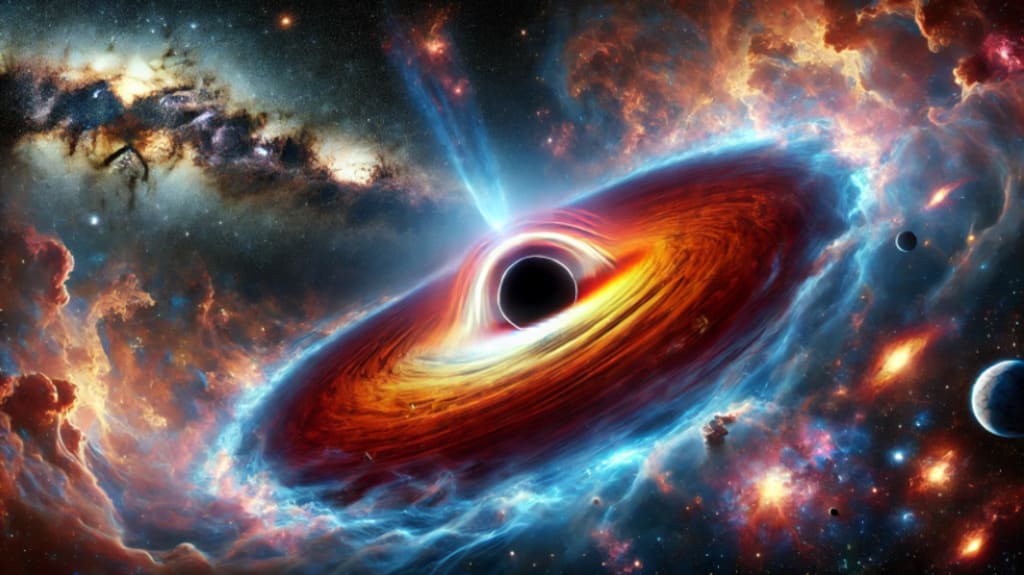
The universe's most captivating mysteries: supermassive black holes.
Hey there, Alisha here! Today, we delve into one of the universe's most captivating mysteries: supermassive black holes. These cosmic giants, which sit at the center of nearly every galaxy we’ve observed, continue to baffle the brightest minds in astrophysics. Despite decades of research and debate, the question of how these titanic structures were formed remains unanswered.
THE Genesis of Supermassive Black Holes:
A Glimpse into the Universe’s Infancy
Over 10 billion years ago, the universe was a vastly different place—a hot and dense environment teeming with enormous clouds of primordial gas, predominantly composed of hydrogen and helium. This early stage of the universe, often referred to as its "infancy,'' set the stage for many cosmic phenomena, including the formation of stars, galaxies, and the enigmatic supermassive black holes that continue to captivate astronomers and cosmologists today.
As gravitational forces acted upon these clouds, one of two scenarios typically unfolded: the gas would either collapse to form stars or, in rare circumstances, it would collapse rapidly enough to form supermassive black holes. The latter scenario, however, presents a conundrum. While the gravitational collapse of gas clouds can lead to stellar formation, it also generates a cooling effect, causing the gas to fragment rather than coalesce into a singular mass capable of forming a black hole. This cooling process raises questions about whether it was even feasible for gas clouds to collapse quickly enough to sidestep this cooling and create supermassive black holes in the early universe.
An alternative explanation suggests the existence of primordial black holes. These theoretical entities would have emerged from the high-density fluctuations present in the infant universe, mere fractions of a second after the Big Bang. In this scenario, the primordial black holes would serve as the building blocks for the supermassive black holes observed today, growing in size as they incorporated surrounding gas and matter over billions of years.
However, the quest for evidence supporting the existence of primordial black holes has proven to be an uphill battle for scientists. Currently, their existence remains speculative and, without concrete evidence, remains an intriguing but elusive aspect of cosmic evolution.
But what if the solution to the mystery of supermassive black hole formation doesn't lie solely with black holes or gas clouds? What if we explore the idea that other forces or entities played a crucial role during this turbulent time in cosmic history?
Emerging theories propose the involvement of dark matter—an unknown substance that does not emit light or energy yet exerts significant gravitational influence within the universe. Dark matter could have played a crucial part in how structures formed during the universe's infancy, potentially aiding in the rapid collapse of gas clouds or influencing their dynamics to favor black hole creation.
The investigation into these phenomena is ongoing. As astronomers and astrophysicists delve deeper into the mysteries of the cosmic past, using advanced observational techniques and simulations, they may yet unearth answers regarding the origins of supermassive black holes and the forces at play when the universe was still a baby.
In conclusion, while the prevailing theories surrounding the formation of supermassive black holes are grounded in the behavior of primordial gas clouds and density fluctuations, the possibilities provided by exploring entities such as primordial black holes and dark matter broaden the scope of our understanding. The early universe, with its swirling clouds of gas and energetic forces, holds secrets waiting to be uncovered. Each new finding brings us one step closer to deciphering the complex narrative of cosmic evolution and the majestic objects that populate the universe today.
Understanding Dark Matter and Its Mysteries: The Cosmic Background of Our Universe
In the vast expanse of our universe, for every photon of visible matter we see, an estimated six times more dark matter lurks in the shadows. While visible matter, also known as baryonic matter, comprises a mere 5% of the universe, dark matter is estimated to make up 27%. And if you’re curious, the remaining 68% is accounted for by dark energy.
The enigma we face is that, despite extensive research and evidence affirming the existence of dark matter, we still don't know what it actually is. What we do know is that through various experiments, we have garnered enough evidence to suggest its presence and even infer where it exists within the fabric of the universe
The Enigmatic Dark Stars: A Glimpse into the Early Universe
As we peer deeper into the cosmos, our understanding of the universe's origins and its fundamental components continues to evolve. Among the most captivating theories regarding the early universe is the concept of dark stars—colossal, elusive celestial bodies that may have been formed during the universe’s infancy, powered not by nuclear fusion but by the annihilation of dark matter particles. These mysterious stars could hold the key to unraveling some of the most profound mysteries of the cosmos.
Exploring the Enigmatic Dark Stars:
Stars of the Early Universe?
Imagine a universe so young that the very fabric of space-time is still shaking off the remnants of a dramatic birth. It’s a cosmos filled with colossal invisible stars, fueled not by nuclear fusion as we know it, but by the annihilation of dark matter particles. These theoretical cosmic titans, dubbed “dark stars,” have captured the imagination of astrophysicists, prompting a reconsideration of how supermassive black holes might have come into existence.
What Are Dark Stars?
These dark stars could have grown massive enough to collapse under their own gravity, forming black holes of immense mass. While this idea is still speculative, it offers a potential solution to the enduring mystery of how supermassive black holes were formed so early in the universe's history.
The Evidence: JWST's Powerful Observations
Despite skepticism surrounding dark stars, recent discoveries from the James Webb Space Telescope (JWST) may lend credence to their existence. Launched in 2021, JWST represents a leap in our observational capabilities, equipped with advanced instruments capable of capturing infrared light from the earliest galaxies. This capability allows astronomers to peer back in time, observing phenomena from the universe’s infancy, just a few hundred million years after the Big Bang.
When JWST scrutinized the early universe, it detected unexpectedly bright galaxies—objects that, according to established theories, should not have existed until long after the Big Bang. Notably, one of these galaxies was identified to be active merely 302 million years post-Big Bang, which challenges existing cosmological models. Such bright emissions may signify the presence of dark stars, absorbing and transforming dark matter into detectable energy.
A New Perspective on Supermassive Black Holes
Katherine Freese, a theoretical astrophysicist, was among the first to propose the notion of dark stars in light of these findings. She suggested that these observed entities might not be conventional galaxies but rather dark stars, each possessing about a million times the mass of our sun. Their round shape, devoid of the wispy details typically associated with galaxies, adds weight to the argument.
So, how can we detect these supposed dark stars? Although dark matter itself is invisible, the interactions between dark matter particles during annihilations can produce immense amounts of energy and light. In theory, early dark stars could have been extraordinarily bright, potentially outshining entire galaxies.
The Search Continues:
Dark Stars in the Milky Way
While scientists are still unraveling the mysteries surrounding dark stars, they believe that conditions for their formation might still exist today. For instance, the S star cluster within our Milky Way—located near the supermassive black hole at our galaxy’s center—exhibits an unusual abundance of young stars and a notable lack of older stars. The hypothesis is that the increased density of dark matter around this region could potentially give rise to new dark stars, continuously generating light through dark matter annihilation..
Unraveling the Cosmos’ Mysteries
the concept of dark stars not only challenges our understanding of black hole formation but also intimates a richer complexity to the cosmos. It hints that the universe may be teeming with shadowy objects and interactions far beyond what our current knowledge allows us to grasp.
As astrophysics continues to evolve, the search for dark stars—whether theoretical or actual—promises to reshape our understanding of the universe’s origins and structures. These extraordinary celestial bodies could very well hold the key to unlocking some of the greatest mysteries of our cosmos.
In conclusion, while dark stars remain a fascinating theoretical concept, the science community is abuzz with new data from cutting-edge technologies like the JWST that may soon help us determine if these cosmic giants are more than mere speculation. As we probe deeper into the annals of time, we might uncover a universe much more interconnected and dynamic than we ever dared to imagine.
About the Creator
ALISHA JAMILA
Hi, I'm ALISHA JAMILA. I'm passionate about writing and exploring a variety of topics like mystery, psychology,facts and many more My goal is to share stories and insights that resonate with readers and spark meaningful conversation
Keep reading
More stories from ALISHA JAMILA and writers in Education and other communities.
THIS WILL FIND YOU WHEN YOU NEED IT THE MOST
If I suddenly had two minutes to talk to the entire world, I would share a crucial insight: a lot can change in a year, and your life will definitely not look the same a year from now. No matter what path you choose, there’s simply nothing you can do to escape the passage of time. But the difference in how your life unfolds one year from now is entirely up to you.
By ALISHA JAMILAabout a year ago in Fiction
Best Laptop for Digital Art
In the vibrant world of digital art, the right laptop can be your greatest creative ally. Whether you're sketching breathtaking illustrations, designing compelling graphics, or animating entire worlds, you need more than just a machine you need a digital canvas that brings your ideas to life.
By Home Care Ranksa day ago in Education
5 signs you're a good driver
As one of the agency’s best employees, you’ve been selected as a finalist to potentially take on a new top-secret mission. You've already shown your aptitude for surveillance and disguise, but the agency is looking to test one last critical skill: how well you can drive. To prove yourself, you’ll need to complete a series of complicated challenges behind the wheel. As the test begins, you notice that the distances between yourself and the cars around you are being meticulously monitored. One of the most widely recommended strategies when it comes to safe driving
By Munesh Yadavabout 17 hours ago in Education




Comments
There are no comments for this story
Be the first to respond and start the conversation.