
One Giant Leap: How the Moon Landing Shaped Our World
Exploring the Cold War rivalry and the ambition that led to the Apollo 11 mission

**One Giant Leap: How the Moon Landing Shaped Our World**
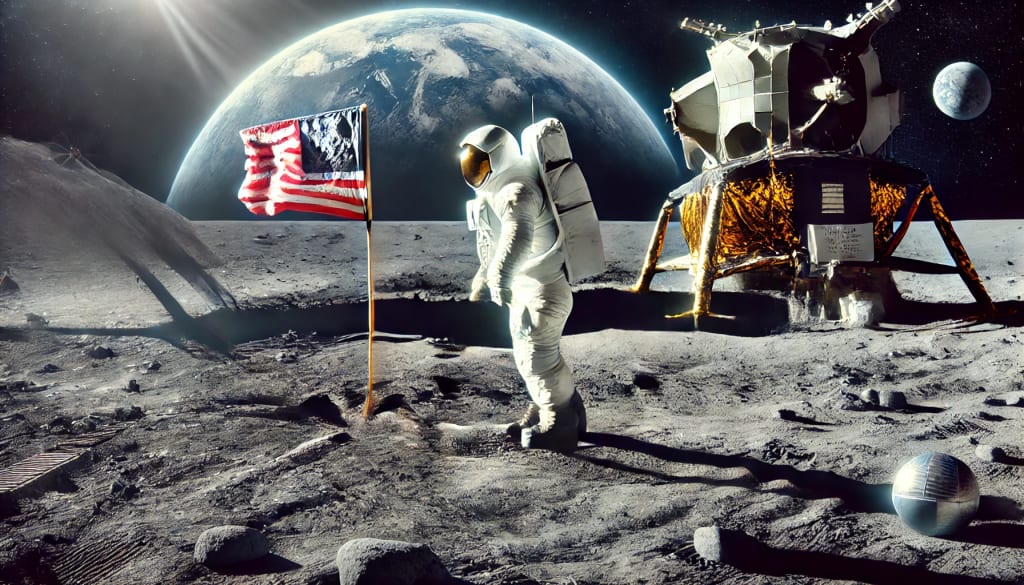
The Moon Landing on July 20, 1969, was an extraordinary achievement that captured the imagination of people around the globe. As Neil Armstrong stepped onto the lunar surface and uttered the famous words, "That's one small step for man, one giant leap for mankind," the world united in awe of what humanity had achieved. The Apollo 11 mission wasn't just a triumph of science and technology—it was a defining moment in human history, reflecting ambition, ingenuity, and the spirit of exploration. Its ripple effects have shaped our world in ways that continue to resonate today.
### The Race to the Moon: A Cold War Catalyst
The Moon Landing was born out of the intense rivalry between the United States and the Soviet Union during the Cold War. Following the Soviet Union's success with **Sputnik 1**, the first artificial satellite launched in 1957, the U.S. felt an urgent need to reassert its technological and ideological dominance. President John F. Kennedy set the ambitious goal of landing a man on the moon by the end of the 1960s, framing the mission not only as a scientific endeavor but also as a statement of American values of freedom and progress.
The space race galvanized unprecedented investments in science, technology, and education. Entire industries evolved to support space exploration, from advanced computing to materials engineering. Beyond competition, the race to the moon also laid the foundation for international collaboration, as the pursuit of space exploration grew beyond national boundaries.
### A Triumph of Human Ingenuity
The Apollo 11 mission demonstrated the incredible heights that human ingenuity can achieve when driven by a common goal. Over 400,000 scientists, engineers, and technicians worked together to make the mission possible, overcoming countless challenges along the way. The Saturn V rocket, the most powerful ever built, symbolized the culmination of years of research and development.
The mission’s success also highlighted the importance of teamwork, perseverance, and innovation. From the precise calculations required to ensure the spacecraft's trajectory to the problem-solving skills displayed during unforeseen issues, Apollo 11 set a benchmark for complex, high-stakes projects. Today, its legacy continues to inspire engineers, scientists, and visionaries to pursue ambitious goals.
### Uniting Humanity: The Moon as a Symbol
The Moon Landing transcended national boundaries and political divides. For the first time in history, billions of people around the world watched a live broadcast of the same event. Seeing Earth from the lunar surface—a fragile blue sphere suspended in the darkness of space—profoundly shifted humanity’s perspective. It underscored our shared existence and the need to care for our planet.
This unifying effect remains one of the Moon Landing’s most significant legacies. The famous **Earthrise** photo taken during the Apollo 8 mission, preceding Apollo 11, is often credited with sparking the modern environmental movement. It reminded humanity of the planet’s fragility and our collective responsibility to protect it.
### Technological Advancements: Beyond Space
The Moon Landing didn’t just fulfill a dream; it created technologies and innovations that transformed everyday life. The Apollo program catalyzed advancements in materials science, telecommunications, and computing. Many of the technologies developed for space exploration found applications in other fields, leading to the creation of products like:
- **Microchips**: The demand for small, reliable computing systems in spacecraft accelerated the development of integrated circuits, which became the foundation of modern electronics.
- **Memory Foam**: Originally developed for spacecraft seats, this material is now widely used in mattresses and cushions.
- **Cordless Tools**: The need for portable drills on the lunar surface led to the development of battery-powered tools.
Moreover, the Apollo missions set the stage for modern satellite technology, enabling advancements in GPS, weather forecasting, and global communications. The technological legacy of the Moon Landing continues to shape industries and improve quality of life worldwide.
### Inspiring Future Exploration
The Moon Landing reignited humanity’s curiosity about the cosmos and sparked a renewed interest in exploration. It paved the way for subsequent missions, such as the Mars rovers, the International Space Station, and the James Webb Space Telescope, which continue to push the boundaries of our understanding of the universe.
Today, countries and private companies alike are planning ambitious space missions, from returning to the moon to colonizing Mars. NASA’s Artemis program, for example, aims to establish a sustainable human presence on the moon by the 2030s. The Moon Landing’s legacy serves as a constant reminder that exploration is not just about reaching new frontiers but also about inspiring future generations to dream big.
### Cultural Impact: One Giant Leap for Humanity
The Moon Landing left an indelible mark on global culture. It inspired countless works of art, literature, music, and film, from David Bowie’s "Space Oddity" to Stanley Kubrick’s **2001: A Space Odyssey**. It also shaped public perceptions of what humanity is capable of achieving, creating a shared sense of wonder and possibility.
The event became a symbol of hope and progress, especially during a tumultuous era marked by civil rights struggles, the Vietnam War, and widespread social change. It demonstrated that even amid conflict and division, humanity could come together to achieve something extraordinary.
### Conclusion: The Moon Landing’s Enduring Legacy
More than five decades later, the Moon Landing remains one of humanity’s greatest achievements. It was a moment that showed what is possible when we dare to dream, work together, and push the limits of what we know. Its impacts—scientific, technological, cultural, and philosophical—continue to shape our world in profound ways.
As we look to the future of space exploration and the challenges facing our planet, the legacy of Apollo 11 reminds us that the sky is not the limit. It is a call to action to reach for the stars while staying grounded in our shared responsibility to build a better world for future generations.
About the Creator
Nora Ariana
Empowering through stories and sound igniting purpose, sparking growth, and awakening the power within.
Keep reading
More stories from Nora Ariana and writers in Education and other communities.
A goal is a dream with a deadline
A goal is a dream with a deadline. This powerful quote reminds us that without action, dreams remain just that wishes floating in our imagination. But when we set a timeline and commit to achieving them, they evolve into goals, bringing clarity, direction, and purpose. Many people go through life holding on to dreams, hoping they will come true someday. But someday is not a day on the calendar. Dreams without structure often fade with time or get buried under the weight of daily responsibilities. Turning a dream into a goal is what separates those who achieve from those who continue to wish.
By Nora ArianaExclusive • 11 months ago
Beginner Investing Blueprint: A Simple Path Toward Wealth and Financial Freedom
Investing is one of the most powerful ways to build wealth and reach financial freedom. Yet many people delay investing because it feels complex or risky. The truth is that investing does not need to be complicated. A clear beginner investing blueprint can help anyone start building a strong financial future.
By Millicent Prince5 days ago in Education
Ferrara Enterprises Inc: A Trusted Manufacturer of NSN Components for Aviation and Industrial Systems
In the aerospace and defense supply chain, reliable component manufacturers play a crucial role in maintaining aircraft systems and industrial equipment. One such manufacturer is Ferrara Enterprises Inc, a company associated with producing components that appear in various National Stock Number (NSN) catalogs used across aviation, defense, and industrial sectors.
By Beckett Dowhanabout 12 hours ago in Education


Comments
There are no comments for this story
Be the first to respond and start the conversation.